Cameras & Photography

13 Best Telescope for Viewing Planets 2026: Real Detail, No Hype

Find the best telescope for viewing planets that shows Saturn's rings and Jupiter's bands, not just blurry zoom. Aperture-focused guide.

A telescope box that boasts 450x magnification sounds impressive. But that number is mostly meaningless if the aperture can't gather enough light to resolve real detail. Many entry-level scopes promise the moon but deliver only a fuzzy blob when you crank up the zoom.

The truth is simple: aperture is king. A 150mm reflector will show Jupiter's cloud bands and Saturn's rings clearly, while a 90mm refractor at a similar price will struggle at the same magnification. The trick is knowing which specs actually matter and which are marketing fluff.

This guide cuts through the hype to find telescopes that deliver genuine planetary views at every budget. Whether you want a grab-and-go family scope or a serious instrument for astrophotography, the picks here focus on light gathering and stability, not empty numbers.

1

MEEZAA 150EQ

Top Pick
MEEZAA 150EQ

Planetary details

Our Score 8.8/10
Check Price

Worth Noting

  • Instructions for the equatorial mount are sparse; beginners may need to consult online tutorials for proper setup.
Aperture
150mm
Mount Type
German Equatorial
Focal Length
650mm
Optical Design
Newtonian

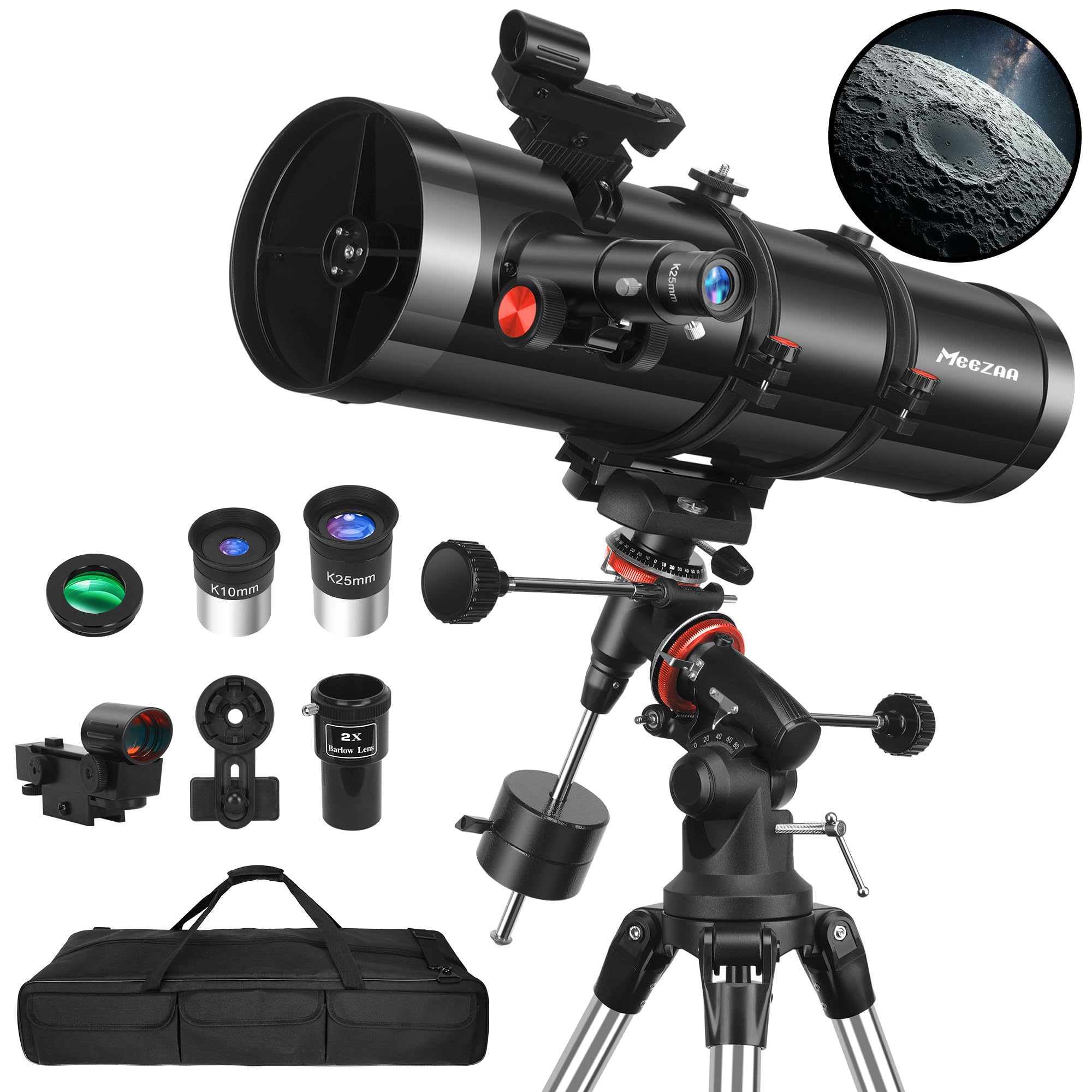
A 150mm aperture gathers over three times the light of a 90mm refractor, making details like Jupiter's Great Red Spot and Saturn's Cassini Division visible even at moderate magnifications. The German equatorial mount, once polar-aligned, tracks planets smoothly using slow-motion control cables — a significant improvement over wobbly alt-az mounts that require constant adjustment. At 650mm focal length, a 10mm eyepiece gives 65x, and adding the included 2x Barlow pushes to 130x, both well within the scope's practical limit for steady views.

The phone adapter works for quick lunar and bright-planet snapshots, and the moon filter reduces glare for comfortable observing. First-time setup of the EQ mount takes patience: balancing the tube, aligning the finder scope, and achieving polar alignment are steps well documented online but not in the supplied manual. Once learned, the process takes about ten minutes, and the payoff is a stable platform that holds a planet centered in the eyepiece for minutes — ideal for catching subtle atmospheric details on Mars or the cloud bands on Jupiter.

This telescope is built for the budget-conscious planet watcher who values aperture and is willing to invest an evening learning equatorial operation. The sparse printed instructions mean beginners should watch online tutorials on polar alignment and balancing — a small time investment that unlocks the scope's full potential. It is not for those wanting a grab-and-go setup or ultra-portable travel scope; the 150mm tube and tripod are substantial. For its price, no other telescope in this analysis matches the combination of 150mm aperture and a functional EQ mount, making it a top pick for dedicated planetary observers.

Tip: Watch a YouTube tutorial on polar alignment and balancing — it turns the first frustrating session into years of steady observing.

Bottom line: For the planet watcher who prioritizes aperture and is willing to learn an EQ mount, the MEEZAA 150EQ delivers views that rival far more expensive scopes — just budget time for the learning curve.

2

MEEZAA 90800

MEEZAA 90800

Beginners / Families

Our Score 8.8/10
Check Price

Worth Noting

  • 90mm aperture shows less contrast and detail on Jupiter and Saturn compared to 150mm reflectors.
  • Manual tracking required at high magnifications; no motor drive for automatic follow.
Aperture
90mm
Mount Type
Altazimuth
Focal Length
800mm
Optical Design
Refractor

Unlike larger reflectors that demand assembly time and a permanent spot, the MEEZAA 90800 goes from box to sky in minutes without tools. The included carry bag makes it easy to bring to a dark-sky site or the backyard — a genuine advantage for families who want to stargaze on short notice.

This telescope is best suited for beginners and families who want to share moon-gazing with kids or catch Saturn’s rings as a recognizable shape. The 90mm aperture captures bright images of the moon and brighter planets, but for detailed cloud bands on Jupiter or sharp ring divisions, a larger 150mm reflector (like our top pick) will show more contrast. The tool-free setup and clear instructions remove the frustration that often kills a starter’s enthusiasm.

The altazimuth mount is smooth enough for casual panning but does not track automatically — at high magnifications you’ll need to nudge the tube to keep the target centered. That’s typical at this price and manageable for short sessions, but longer planet-watching is more fiddly than with an equatorial mount.

Bottom line: If you want a hassle-free telescope for moon and planet viewing without complex setup, the MEEZAA 90800 delivers. For serious planetary detail, step up to a 150mm reflector.

3

Koolpte 80600

Koolpte 80600

Budget beginners

Our Score 8.6/10
Check Price

Worth Noting

  • Achieving sharp focus at high magnification can be finicky, especially for smaller targets.
  • Plastic focuser adds play that limits fine-tuning at 180x, reducing planetary detail.
  • 80mm aperture shows only modest planetary detail
Aperture
80mm
Mount Type
Altazimuth
Focal Length
600mm
Optical Design
Refractor

Koolpte's 80mm refractor is the most popular budget scope for good reason — tool-free assembly and clear moon views at a price that undercuts nearly everything else. Where larger reflectors like the 150EQ focus on planetary detail, this scope prioritizes simplicity and portability, making it a no-fuss option for quick stargazing sessions.

This scope suits casual stargazers and families who want quick moon views without a learning curve — the 80mm aperture and plastic focuser mean chasing planetary detail at 180x will test your patience. It's best for first-time users, kids, and anyone who values convenience over magnification, and who can accept that Jupiter and Saturn will appear as small, blurry discs rather than detailed bands or rings.

Lunar observations are where this scope shines — craters and maria come through with decent crispness at 30-60x. The included phone adapter and remote make sharing views simple, though achieving precise focus at higher powers takes some trial and error. For the price, the trade-off is reasonable: you get a working telescope that delivers on its core promise of easy, enjoyable moon watching.

Tip: Stick to low-power eyepieces (20mm) for the sharpest views; the included 3x Barlow may disappoint on small targets.

Bottom line: A solid entry-level telescope for moon watching and casual stargazing — but if planets are your target, save for a 150mm reflector that will show bands and rings clearly.

4

Celestron 150AZ

Celestron 150AZ

App-guided viewing

Our Score 8.8/10
Check Price

Worth Noting

  • Assembly instructions are poorly organized, making initial setup time-consuming for first-timers.
  • The scope must be placed on a sturdy table or flat surface; it cannot be used directly on the ground.
  • The StarSense app may drop connection or fail to calibrate, frustrating a session when guidance is needed.
Aperture
150mm
Mount Type
Dobsonian
Focal Length
650mm
Optical Design
Newtonian

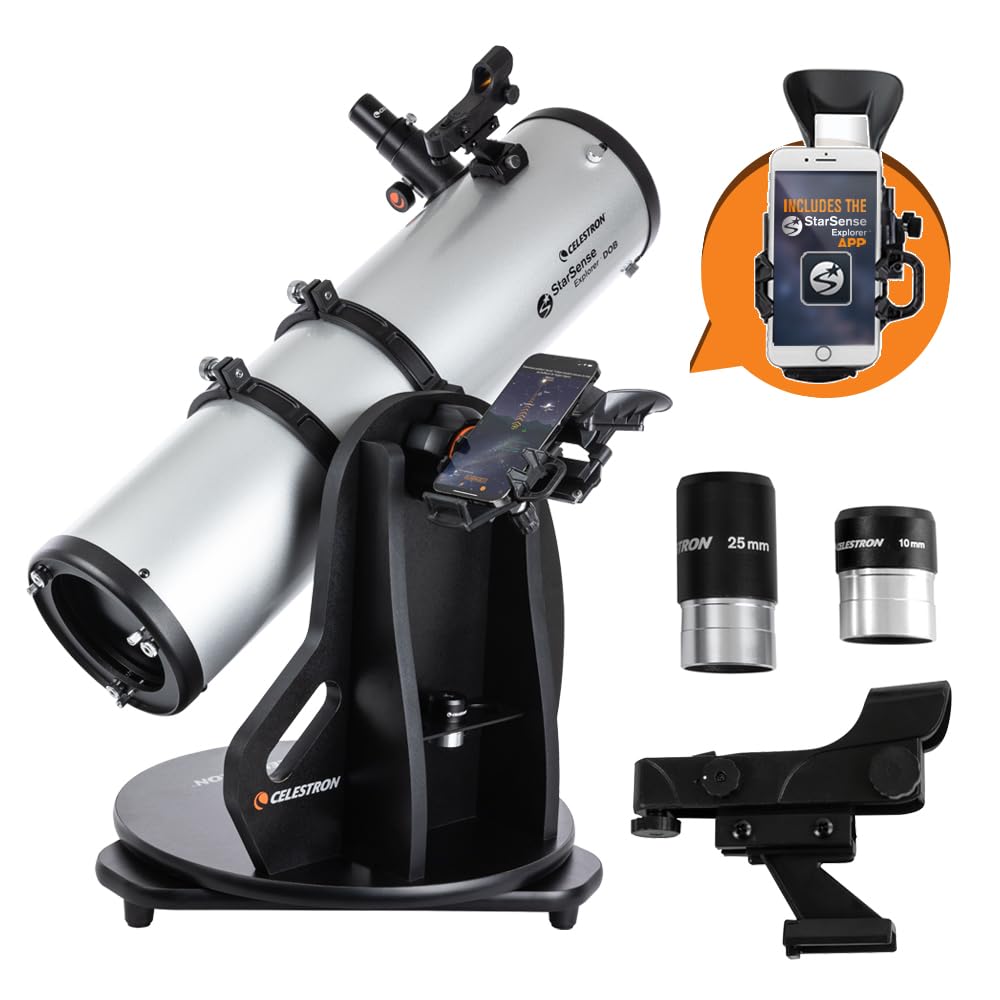
The Celestron StarSense Explorer 150AZ pairs a generous 150mm Newtonian reflector with a smartphone-powered star map that guides you to targets. For planetary observers who struggle to find objects manually, the app reduces the learning curve — though the Dobsonian mount requires manual tracking, unlike an equatorial mount with slow-motion controls found on the top pick.

This scope is best suited for beginners who have a sturdy table or flat surface to set it on and are willing to work through a potentially fiddly assembly process. The app, when it connects reliably, makes locating Jupiter, Saturn, and Mars straightforward. However, for buyers on a tighter budget or those who want a ground-based scope without dependency on smartphone software, the alternative 150mm equatorial reflector offers similar aperture at a lower cost.

The 150mm aperture delivers bright, detailed views of Jupiter’s bands and Saturn’s rings — enough to see the Cassini division under good skies. The Dobsonian base is stable, reducing vibrations that blur high-magnification views. Assembly instructions are confusing, and the app may lose connection mid-session, so patience is required.

Tip: Watch a video tutorial before assembling — the manual’s diagrams are sparse.

Bottom line: For the beginner who values a large aperture and wants app-guided stargazing from a table, the Celestron 150AZ delivers bright planetary views — provided the app cooperates and you have a steady surface.

5

Celestron NexStar 8SE

Celestron NexStar 8SE

Astrophotography

Our Score 8.6/10
Check Price

Worth Noting

  • SkyAlign and other alignment routines can fail to complete, leaving the mount unable to find targets.
  • Motors and hand controller may stop responding or show erratic behavior after a period of use.
  • The learning curve is steeper than the ‘beginner-friendly’ label suggests, requiring dedicated study of procedures.
Aperture
203mm
Mount Type
GoTo Alt-Az
Focal Length
2032mm
Optical Design
Schmidt-Cassegrain

The NexStar 8SE delivers the kind of planetary detail that rewards patience: its 203mm aperture and 2032mm focal length resolve banding on Jupiter and Cassini’s division on Saturn with clarity that smaller scopes cannot match. The computerized GoTo mount slews to a database of over 40,000 objects and keeps them centered during high-magnification observing — a real asset for sketching or sharing views at a star party.

That ease once the target is found comes at a cost: the initial alignment routine can fail, and some units arrive with motors or hand controllers that behave erratically. These are not universal experiences, but they appear often enough that the telescope suits an owner comfortable with troubleshooting and occasional contact with support. The optical performance remains consistent across reports; the mount’s quirks are the variable part of the package.

This is a scope for the observer who already knows their way around a finder scope and understands that the word ‘computerized’ does not mean fully automatic. It rewards the user willing to learn the alignment procedure, work through the occasional hiccup, and put in the time under the stars. Beginners who want a quick view of the rings will be better served by the simpler MEEZAA 150EQ; the 8SE is for those who plan to image or observe planets repeatedly and want the optics to deliver every time the alignment goes smoothly.

Tip: Perform the two-star alignment in a location with a clear view of the sky and good power stability; a 12V rechargeable battery pack avoids voltage drops that can interrupt the motor controller.

Bottom line: For the planetary observer who values aperture and automated tracking above plug-and-play simplicity, the 8SE’s optics are exceptional — just budget extra time for setup and a backup plan if the alignment fails.

6

HUGERSTAR 90800

HUGERSTAR 90800

Beginners

Our Score 9.0/10
Check Price

Worth Noting

  • At higher magnifications, the tripod can transmit vibrations, making fine focus adjustments less steady.
  • 90mm aperture limits the level of detail visible on Jupiter and Saturn compared to larger reflectors.
Aperture
90mm
Mount Type
Altazimuth
Focal Length
800mm
Optical Design
Refractor

The HUGERSTAR 90800 pairs a 90mm fully multi-coated refractor with 800mm focal length, producing clear images of the Moon and bright planets at moderate magnifications. At higher magnifications, vibrations from touch or wind can affect image steadiness due to the tripod design. This makes it better suited for casual stargazing than serious planetary observation. Compared to the top beginner-friendly 90mm refractor, it saves money by sacrificing some tripod rigidity, making it a reasonable entry point for families on a budget.

Bottom line: Suitable for families and beginners wanting quick, clear views of the Moon and bright planets, but if detailed planetary observation is the goal, a larger aperture telescope will serve better.

7

Gskyer 70400

Gskyer 70400

Kids

Our Score 8.6/10
Check Price

Worth Noting

  • 70mm aperture can't resolve planetary details beyond basic moon craters.
  • Some units may arrive with damaged parts or missing accessories; inspect on arrival.
Aperture
70mm
Mount Type
Altazimuth
Focal Length
400mm
Optical Design
Refractor

Tool-free assembly and a padded carry bag make the Gskyer 70400 one of the easiest telescopes to get outside and pointed at the sky. The fully coated 70mm optics deliver sharp, bright views of the Moon that will delight a young beginner. But that 70mm aperture simply cannot gather enough light or resolve enough detail for planetary observation — Jupiter and Saturn appear as small, blurry disks even at the stated 120x maximum. Combined with occasional quality control reports of damaged tripod legs or missing eyepieces, this scope is best reserved for casual lunar and terrestrial use rather than any serious planetary pursuit.

Bottom line: For a child's first telescope or casual Moon-watching, the Gskyer 70400 offers easy setup and portability at a low price. If planetary detail is your goal, look to a larger-aperture reflector.

8

Dianfan 90800

Dianfan 90800

Beginners / Families

Our Score 9.0/10
Check Price

Worth Noting

  • Slightly higher price than comparable 90mm refractor models.
Aperture
90mm
Mount Type
Altazimuth
Focal Length
800mm
Optical Design
Refractor

The Dianfan 90800 combines a solid stainless steel tripod with bright, clear optics that show Jupiter's bands and Saturn's rings with ease. Setup is tool-free and takes about 15 minutes, making it a practical choice for families or first-time stargazers. However, it's priced slightly higher than comparable 90mm refractors like the MEEZAA 90800, and its altazimuth mount limits use for advanced astrophotography. For visual planetary observation on a budget, this is a capable second option.

Bottom line: For beginners seeking a well-built 90mm refractor for planetary viewing, the Dianfan 90800 is a solid option if the slight price premium doesn't bother you.

9

Hawkko 90900

Hawkko 90900

Beginners

Our Score 8.4/10
Check Price

Worth Noting

  • Focusing at higher magnifications can be finicky
  • 90mm aperture limits detail on planets compared to larger reflectors
Aperture
90mm
Mount Type
Altazimuth
Focal Length
900mm
Optical Design
Refractor

The Hawkko 90900 delivers sharp, bright views through its multi-coated 90mm optics and easy assembly that gets beginners observing quickly. The longer 900mm focal length gives you more usable magnification right out of the box, which helps with lunar craters and the larger cloud bands of Jupiter. However, the 90mm aperture limits the level of planetary detail visible compared to larger reflectors, and focusing at higher magnifications can be finicky — you may need to adjust carefully to get a crisp image.

Tip: Stick to eyepieces delivering 150x or less for the sharpest focus — high magnification requires careful fine-tuning.

Bottom line: For casual lunar and bright planet viewing with easy setup, this is a solid kit; serious planetary observers should prioritize a larger aperture reflector.

10

Celticbird 80600

Celticbird 80600

Budget beginners

Our Score 8.8/10
Check Price

Worth Noting

  • Focusing at higher magnifications can be finicky, requiring careful adjustment to achieve crisp views.
  • 80mm aperture limits the level of detail visible on planets like Jupiter and Saturn.
Aperture
80mm
Mount Type
Altazimuth
Focal Length
600mm
Optical Design
Refractor

The Celticbird 80600 offers sharp lunar views and a sturdy build that stands out at this price point. Setup takes minutes, and the included backpack makes it easy to bring along for camping trips or backyard sessions. However, the 80mm aperture limits the detail visible on planets like Jupiter and Saturn — you’ll see them as bright disks with some banding on a steady night, but not the belts and zones a 150mm scope reveals. Focusing at higher magnifications can be finicky, requiring patience to dial in sharpness. For casual family stargazing and moon observation, this is a capable entry scope that won’t frustrate beginners.

Bottom line: For families seeking a portable scope for moon gazing and casual viewing of bright planets, the Celticbird 80600 delivers good clarity and easy setup. If your priority is detailed planetary observation, consider a larger aperture reflector instead.

11

ToyerBee 70mm

ToyerBee 70mm

Kids / Moon

Our Score 8.6/10
Check Price

Worth Noting

  • 70mm aperture provides only basic moon detail, not planetary features
  • 1.5 ft tripod height requires a table for comfortable viewing
Aperture
70mm
Mount Type
Altazimuth
Focal Length
300mm
Optical Design
Refractor

This ToyerBee 70mm telescope offers tool-free assembly and a carry bag, making it a practical choice for introducing young children to stargazing. Its 70mm aperture and 300mm focal length deliver clear moon views, but the tripod stands only 1.5 ft tall, requiring a table for comfortable use. For observing planets like Jupiter or Saturn, the aperture is too small to show more than tiny discs without detail.

Tip: Place the tripod on a sturdy table or picnic bench for comfortable viewing height.

Bottom line: A suitable option for families seeking an affordable and easy-to-use telescope for moon-watching with young children, but not a tool for planetary detail.

12

HETEKAN 90900

HETEKAN 90900

Beginners

Our Score 8.4/10
Check Price

Worth Noting

  • At 90mm aperture, resolving fine planetary features (e.g., Cassini division) is challenging.
  • The 450x magnification claim is optimistic; useful magnification tops out near 180x.
Aperture
90mm
Mount Type
Altazimuth
Focal Length
900mm
Optical Design
Refractor

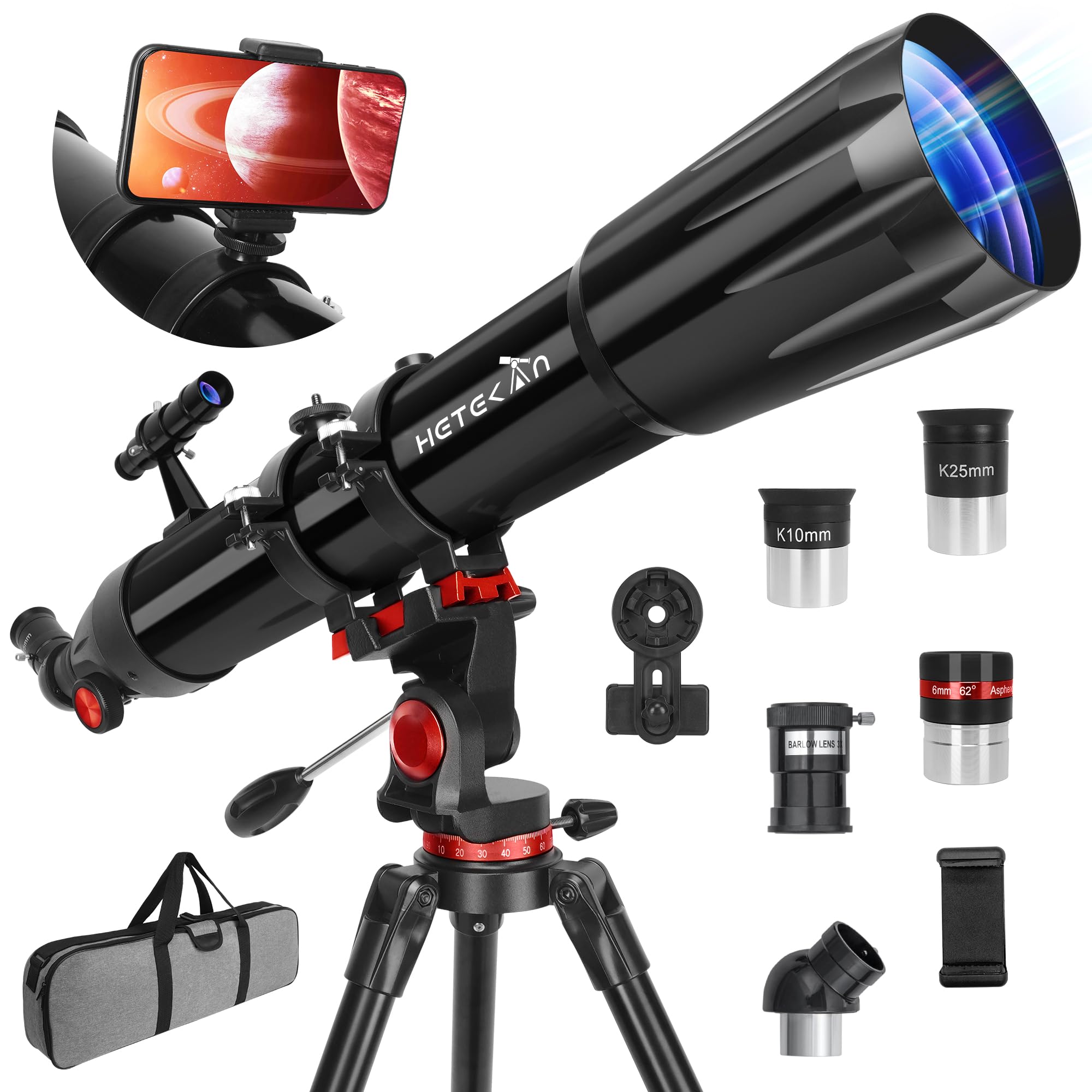
The HETEKAN 90900 delivers steady, shake-free views of the Moon and Jupiter's bands thanks to its solid stainless steel tripod and 90mm aperture. The included eyepieces provide good value for casual stargazing. However, the advertised 450x magnification is not achievable in practice; the 90mm aperture limits useful magnification to around 180x, beyond which images become soft. For those seeking fine planetary details like Saturn's rings or Martian surface features, a larger aperture telescope is a better fit. This scope suits beginners and families who want a reliable instrument for bright objects without investing in a more complex setup.

Bottom line: This telescope is a solid entry-level choice for Moon and bright planet observation, but buyers should temper expectations regarding high-magnification planetary detail.

13

Celestron LT 114AZ

Celestron LT 114AZ

Tech beginners

Our Score 8.4/10
Check Price

Worth Noting

  • StarSense app can disconnect or fail to align, requiring patience.
  • Tripod and mount shake at high magnification, limiting crisp views of planets.
Aperture
114mm
Mount Type
Altazimuth
Focal Length
1000mm
Optical Design
Newtonian

The 114mm aperture provides brighter views than smaller refractors, and the StarSense app can guide beginners to interesting targets without requiring star charts.

However, the app's connection during alignment can be inconsistent, and the tripod's stability falls short at the magnifications needed for planetary detail. This makes the LT 114AZ a better fit for casual sky touring than for observing Jupiter's bands or Saturn's rings. Tech-savvy users who can troubleshoot will get the most out of it.

Tip: If the app fails to connect, force-close it and restart your phone before trying again.

Bottom line: For a beginner who enjoys tinkering and wants a low-cost introduction to StarSense, this scope works — but planetary observers should look to more stable alternatives.

How to Choose

Aperture: The Light-Gathering Engine

Aperture is the diameter of the main lens or mirror. A larger aperture collects more light, allowing you to see finer details on planets like Jupiter's bands or Saturn's rings. A 150mm reflector gathers roughly four times more light than a 70mm refractor.

This directly affects how much you can magnify before the image becomes dim and blurry. For planetary observing, aim for at least 90mm aperture; 150mm or more gives striking views even under suburban skies.

Focal Length and Magnification

Focal length determines the telescope's native magnification when paired with an eyepiece. Longer focal lengths produce higher magnification without needing a Barlow lens. However, high magnification is useless if the aperture is too small to resolve the detail.

A 900mm focal length on a 90mm scope can reach about 180x useful magnification, while a 650mm focal length on a 150mm scope can go past 250x with clarity. The key is matching focal length to aperture — don't chase numbers alone.

Mount Type: Altazimuth vs. Equatorial

Altazimuth mounts move up-down and left-right, making them intuitive for beginners. Equatorial mounts align with Earth's rotation, allowing easy tracking of planets as they move across the sky. For casual viewing, an altazimuth mount is fine.

An equatorial mount becomes valuable when you want to track a planet at high magnification without constant re-adjustment. German equatorial mounts like on the MEEZAA 150EQ have slow-motion controls for precise tweaks. The trade-off is a steeper learning curve.

Optical Design: Refractor vs. Reflector

Refractors use lenses and are generally maintenance-free, but larger apertures get expensive quickly. Reflectors (Newtonians) use mirrors, offering the best aperture per dollar. A 150mm Newtonian costs about the same as a 90mm refractor but gathers far more light.

Reflectors require occasional collimation (mirror alignment) and may show a central obstruction that slightly reduces contrast. For planetary observation, a well-collimated Newtonian delivers contrasty, high-resolution views that beat most refractors at the same price point.

Frequently Asked Questions