Tools & DIY

9 Best Oscilloscope for Hobbyists of 2026: 4-Channel Reliability Without the Premium Price

Find the right oscilloscope for your electronics projects: reliable bench scopes and portable handhelds that actually deliver accurate measurements without quality control headaches.

Shopping for a hobbyist oscilloscope often means weighing tempting specs against real-world reliability. Many sub-$150 handhelds advertise 100 MHz bandwidth and built-in signal generators, but user experiences reveal inconsistent accuracy, dead-on-arrival units, and frustrating interfaces. The difference between a tool that works every time and one that becomes a project itself often comes down to the brand and price tier.

This guide cuts through the noise by focusing on the specs that actually matter for everyday electronics work: number of channels, memory depth, and proven firmware stability. The best choices offer four analog channels for digital logic debugging, deep memory for serial decoding, and a large user community to lean on. That combination ensures you spend time troubleshooting circuits, not the oscilloscope.

Investing in a proven bench scope from a reputable brand eliminates the gamble of budget models. You get reliable measurements, responsive controls, and access to a large community for troubleshooting. That is the difference between a tool you outgrow and one that grows with you.

1

Rigol DS1054Z

Top Pick
Rigol DS1054Z

Electronics hobbyists

Our Score 9.4/10
Check Price

Worth Noting

  • Menu navigation can feel slow when jumping between settings compared to higher-end scopes
Channels
4
Bandwidth
50 MHz
Form Factor
Bench
Sampling & Memory
1 GSa/s, 24 Mpts

Few scopes under $500 offer four channels alongside 24 million points of memory and hardware-based serial decoding. The DS1054Z gives you the ability to decode I2C, SPI, UART, and other protocols without buying extra options, making it a practical choice for debugging digital logic on a bench.

The front-panel knobs and buttons have a solid, tactile feel, and the layout is logical for both beginners and intermediate users. The 7-inch 800x480 display provides clear waveform visibility, and the deep memory helps capture long serial data streams without losing time resolution.

This scope suits hobbyists who need to watch multiple digital signals simultaneously, students learning electronics, or anyone upgrading from a basic two-channel model. The 50 MHz bandwidth covers common microcontroller projects (clock speeds up to 16 MHz and typical digital protocols), while the 1 GSa/s sampling rate captures fast edges reliably. The menu navigation can feel slow when hopping between settings compared to higher-end instruments, but the core measurement capabilities and feature set make that a manageable compromise for the price.

The built-in signal decoding and analysis features reduce the need for a separate logic analyzer for many common tasks. For higher-speed work above 50 MHz or applications requiring 12-bit vertical resolution, other scopes in this price range (like the DHO804) offer modern interfaces but come with their own firmware reliability questions, making the DS1054Z the safer bet for consistent daily use.

Tip: Use the front-panel shortcuts for common settings to reduce menu navigation time.

Bottom line: If you need four channels and deep memory on a hobbyist budget, this is the scope to buy - just don't expect the snappy UI of a $1000 instrument.

2

Rigol DHO804

Rigol DHO804

Advanced hobbyists

Our Score 8.8/10
Check Price

Worth Noting

  • Occasional lock-ups during boot or menu navigation may require a power cycle
  • No printed manual included
Channels
4
Bandwidth
70 MHz
Form Factor
Bench
Sampling & Memory
1.25 GSa/s, 25 Mpts

The DHO804's 12-bit resolution captures subtle waveform details that 8-bit scopes miss, and the 7-inch touch interface responds quickly to taps and drags for scaling and measurements. Deep 25 Mpts memory lets you zoom into long captures without losing sample rate — a clear upgrade path for anyone moving from a basic 8-bit model.

Four channels and a 1.25 GSa/s sampling rate cover the spectrum for digital electronics debugging, PWM analysis, and serial bus decoding. The 70 MHz bandwidth suits the majority of hobbyist projects — only those chasing signals above 100 MHz need to look elsewhere. Connectivity options (LAN, USB, HDMI) make it easy to screen-capture or log data to a PC.

The main tradeoff is firmware stability: some units have experienced lock-ups during boot or while navigating menus, and a restart is sometimes needed. This isn't a pattern of widespread failure, but it does mean the DHO804 hasn't built the same long-term reputation as the DS1054Z. For buyers who prefer a more conservative, drop-in-reliable scope, the older model remains the safer call.

Tip: Keep the scope on a firmware updater's list — Rigol has improved stability with patches, and staying current reduces the chance of encountering a lock-up.

Bottom line: If you want the best signal detail a hobbyist scope can offer and don't mind a small chance of needing a restart now and then, the DHO804 is a compelling step up from older 8-bit designs. For those who prioritize absolute day-one reliability, the DS1054Z is still the benchmark.

3

HANMATEK DOS1102

HANMATEK DOS1102

Beginners

Our Score 8.8/10
Check Price

Worth Noting

  • In a quiet measurement environment, the included power supply can introduce RF noise that appears on the trace
  • Above roughly 60-70 MHz, the displayed waveform edges can look slightly fuzzy, reducing measurement confidence for fast digital signals.
Channels
2
Bandwidth
110 MHz
Form Factor
Bench
Sampling & Memory
500 MS/s, 10 Kpts

The HANMATEK DOS1102 delivers 110 MHz bandwidth and a generous 7-inch 800x480 TFT-LCD display, a combination rarely seen under $200. The interface is laid out with clear labels and dedicated knobs, so you can adjust timebase and voltage without digging through menus — a real advantage when you are just learning to interpret waveforms.

This scope suits newcomers and hobbyists who work mainly with audio circuits, power supplies, and low-frequency digital signals. The 500 MS/s sampling rate covers common projects, though trace clarity softens above roughly 60-70 MHz — still usable for detecting signal presence but not for precise edge measurements. The bigger tradeoff is the included wall-wart power supply: it can inject RF noise into sensitive measurements. Using a cleaner external DC source or a battery resolves the issue for most bench setups.

Tip: Replace the stock wall wart with a linear power supply or a quality USB-C PD adapter to suppress RF noise pickup on the trace.

Bottom line: If you are starting out in electronics and want a large screen and real bandwidth without stretching your budget, the DOS1102 delivers — just budget for a cleaner power adapter if you work with low-noise analog circuits.

4

FNIRSI 2C53T

FNIRSI 2C53T

Tight budget

Our Score 8.8/10
Check Price

Worth Noting

  • Battery life may vary; some units last only 30 minutes on a charge.
  • Unit-to-unit quality control can affect controls or channels on arrival.
  • Interface and documentation are not intuitive
Channels
2
Bandwidth
50 MHz
Form Factor
Handheld
Sampling & Memory
250 MS/s, —

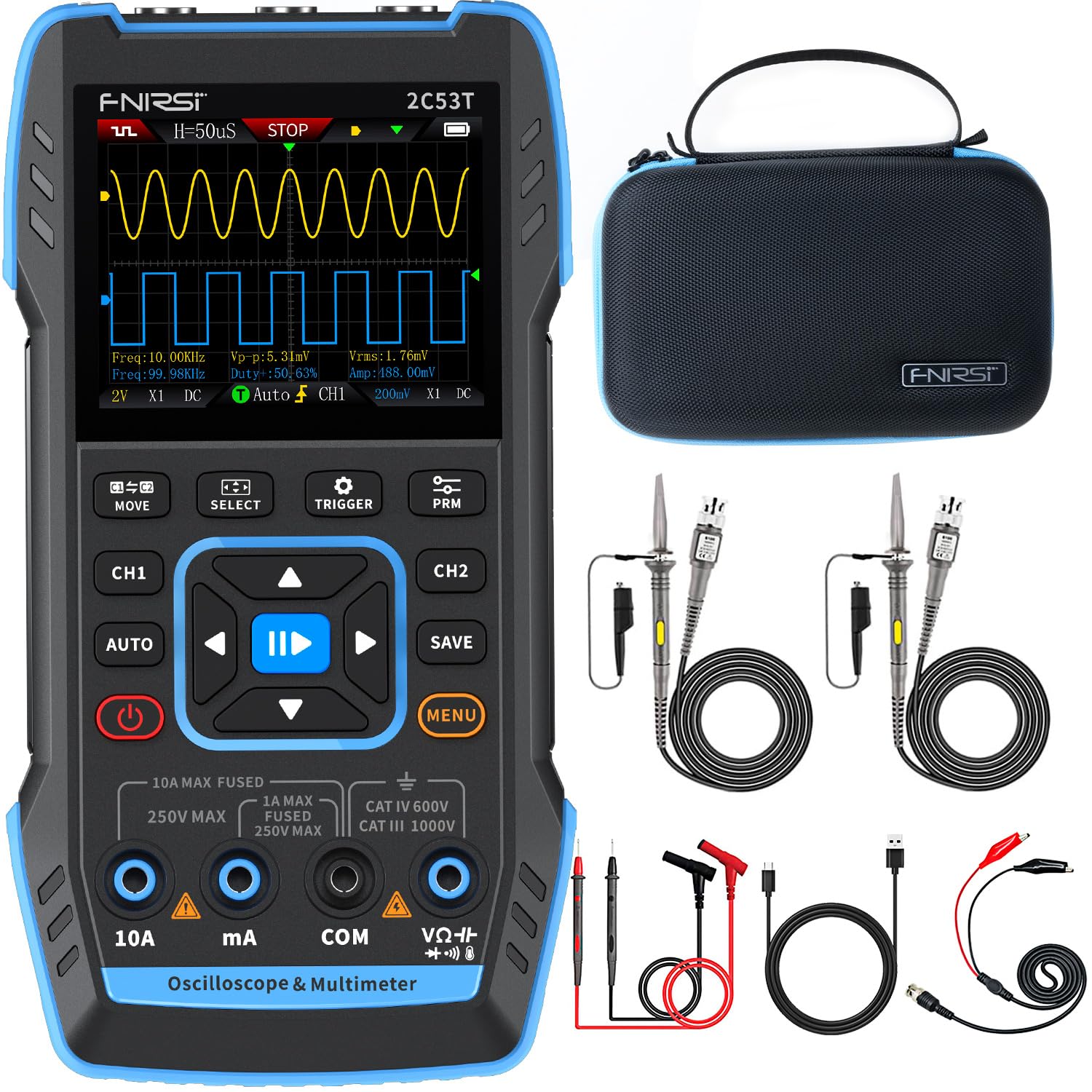
The FNIRSI 2C53T packs an oscilloscope, multimeter, and DDS signal generator into a rugged handheld form factor that slips into a tool bag. The 50 MHz bandwidth and 250 MS/s sampling rate cover the basics for general-purpose electronics work, while the 19999-count multimeter adds continuity and voltage checks without a second device. The included probes and accessories feel solid for the price point.

Where it fits best is the hobbyist or field technician who needs one compact tool for quick signal verification, automotive sensor probing, or audio circuit diagnosis. The battery life can vary between units — some last a full work session, others may need a top-up after 30 minutes. The interface takes some getting used to, and the manual offers only minimal guidance. Those who require consistent, daily precision would be better served by a bench scope like the Rigol DS1054Z, which delivers reliable performance with a proven track record.

Tip: Treat the battery as a bonus — keep the USB cable handy for long sessions, especially if you plan to leave it running for more than an hour.

Bottom line: A capable all-in-one for the occasional user who values portability over polish, but budget for a possible swap if the battery or controls don't match expectations.

5

Siglent SDS1202X-E

Siglent SDS1202X-E

High bandwidth

Our Score 9.4/10
Check Price

Worth Noting

  • Two channels limit simultaneous comparison of multiple signals
  • Cooling fan produces audible noise in quiet home lab settings
Channels
2
Bandwidth
200 MHz
Form Factor
Bench
Sampling & Memory
1 GSa/s, 14 Mpts

The Siglent SDS1202X-E delivers 200 MHz bandwidth at a price that typically buys only 100 MHz from competitors — making it the go-to option for hobbyists working with fast digital signals like SPI, CAN, or high-frequency analog circuits. Its 1 GSa/s sampling rate and 14 Mpts memory depth handle long captures without aliasing, and the included serial decoding for I2C, SPI, UART, CAN, and LIN reduces reliance on external tools.

This two-channel scope suits those who need raw bandwidth for signal integrity analysis rather than multi-channel logic tracing. It serves as a capable tool for decoding serial protocols and capturing glitches on fast clocks. However, the Amazon listing provides minimal technical details and customer reviews, so purchasing here feels like a blind buy — independent reviews and Siglent’s reputation are your real guide.

In bench use, the interface is straightforward, though the cooling fan produces audible noise in quiet home lab settings — less of an issue in a workshop with ambient sound. The robust build quality and intuitive menu layout are consistent with Siglent’s established instrument lineup, giving confidence in long-term performance even without extensive Amazon feedback.

Tip: The fan noise can be mitigated by placing the scope on a soft surface or in a ventilated rack — not a dealbreaker for most bench work.

Bottom line: For hobbyists who prioritize bandwidth over channel count and are willing to research independent reviews, the SDS1202X-E offers the best high-frequency capture under $500 — just don’t rely on the Amazon listing alone to inform your purchase.

6

FNIRSI 1013D Plus

FNIRSI 1013D Plus

Field service

Our Score 8.6/10
Check Price

Worth Noting

  • Some units may arrive non-functional or experience problems early on.
  • Voltage accuracy may deviate by a few percent in some measurements.
Channels
2
Bandwidth
100 MHz
Form Factor
Handheld
Sampling & Memory
1 GSa/s, —

The FNIRSI 1013D Plus packs a 100 MHz bandwidth and a roomy 7-inch touchscreen into a portable package, making it easy to read waveforms on the go. Its bundled high-voltage probe adds value for automotive diagnostics. However, quality control is uneven — some units may arrive non-functional or develop issues early, and voltage accuracy can deviate by a few percent in certain measurements. This limits its suitability for critical bench work but it works well for occasional field checks where absolute precision is not required. Similar to the FNIRSI 2C53T but with a larger display, its reliability track record is not better, so the 2C53T remains a slightly safer choice for most hobbyists.

Bottom line: Suitable for field use where a large screen is important and budget is limited, but verify measurements against a known reference if accuracy matters.

7

Pico 2204A BASIC PicoScope 2 channel + AWG, 10MHz, w/o Probes

Pico 2204A BASIC PicoScope 2 channel + AWG, 10MHz, w/o Probes

Also Great

Our Score 9.4/10
Check Price

Worth Noting

  • Probes are not included, adding to the total cost.
  • 10 MHz bandwidth is not suitable for digital circuits or RF work.

The Pico 2204A delivers polished software and a compact USB form factor ideal for automotive sensor-level diagnostics. However, its 10 MHz bandwidth and absence of included probes restrict it to low-frequency work, making it unsuitable for general hobbyist electronics projects where 50-200 MHz and probes are standard.

Bottom line: This scope suits users who already own good probes and need a USB scope for low-frequency automotive sensor work — not for general electronics projects.

8

FNIRSI DSO152

FNIRSI DSO152

Also Great

Our Score 8.8/10
Check Price

Worth Noting

  • The 200 kHz bandwidth restricts measurements to audio-frequency signals; anything beyond that is invisible to this scope.
  • The 2.8-inch 320x240 display may be cramped for detailed waveform inspection.

At under $40, the DSO152 is the cheapest way to visually confirm a waveform in the audio range. Car audio enthusiasts use it to set amplifier gains without guesswork. The auto-trigger and simple controls make it easy to get a stable trace for low-frequency signals. Its compact size and battery power make it convenient for field checks. It also serves as a basic educational tool to demonstrate sine, square, and triangle waves. For anyone needing a general-purpose scope for electronics projects, this is not the tool.

Bottom line: If your only need is to set car audio amp gains or demonstrate basic sine waves on a shoestring budget, the DSO152 does the job otherwise invest in a proper bench scope.

9

Rigol DHO924S

Rigol DHO924S

Advanced professionals

Our Score 9.0/10
Check Price

Worth Noting

  • Fan noise can be audible in quiet workspaces
  • Premium pricing places it outside the range of most hobbyists on a limited budget
Channels
4 analog, 16 digital
Bandwidth
250 MHz
Form Factor
Bench
Sampling & Memory
1.25 GSa/s, 50 Mpts

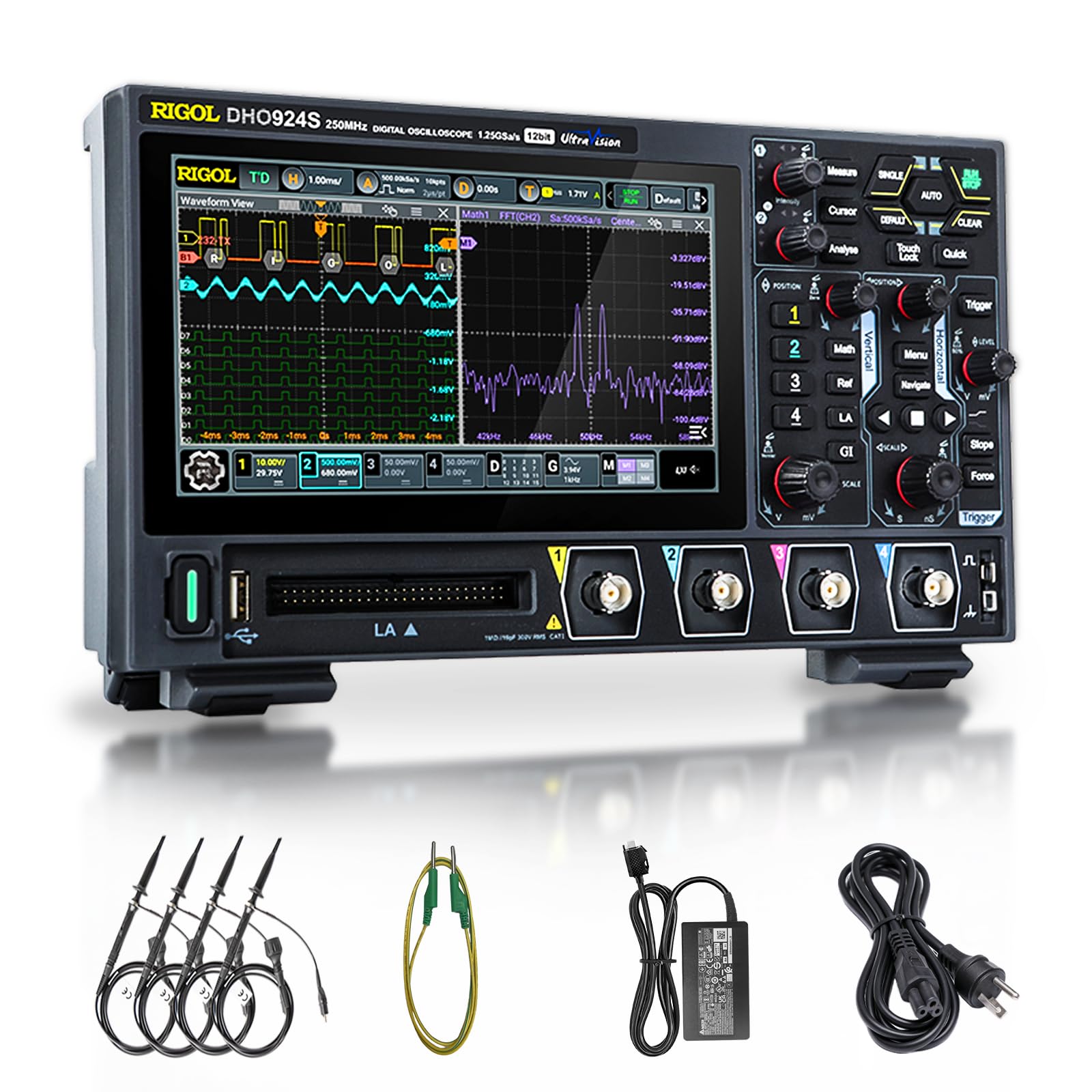
The Rigol DHO924S delivers 250 MHz bandwidth, 12-bit resolution, 4 analog plus 16 digital channels, and a responsive touchscreen in a compact bench form factor. Its low noise floor and deep 50 Mpts memory make it suitable for detailed power analysis and mixed-signal debugging. However, the price sits well above the typical hobbyist budget for a general-purpose scope, and the fan noise may be noticeable in quiet home lab environments.

Bottom line: A fit for experienced engineers or advanced hobbyists who need MSO and 12-bit performance and have the budget to match. Not a practical choice for general-purpose hobbyist work under $500.

How to Choose

Bandwidth: How Much Is Enough?

Bandwidth determines the highest frequency signal you can measure accurately. A 50 MHz scope covers most hobbyist circuits like audio, basic microcontrollers, and power supplies. Going to 100-200 MHz only helps if you work with fast digital buses or RF stages. The trade-off: higher bandwidth scopes often cost significantly more and may amplify noise on low-frequency signals.

Channels: Two vs Four

Four channels let you observe multiple signals simultaneously, such as clock, data, chip select, and ground for SPI or I2C debugging. Two channels force you to probe sequentially, making it harder to see timing relationships. The hidden trade-off: four-channel scopes usually have deeper memory and more triggering options, but they cost more and take up more bench space.

Sampling Rate and Memory Depth

Sampling rate (e.g., 1 GSa/s) determines how many points per second the scope captures, while memory depth (e.g., 24 Mpts) decides how long you can record at that rate. For serial decoding of protocols like UART or I2C, deep memory is essential to capture a full packet without zooming out. Shallow memory forces you to reduce timebase, potentially missing glitches. Aim for at least 1 Mpts per channel.

Vertical Resolution: 8-bit vs 12-bit

8-bit resolution divides the voltage range into 256 steps, sufficient for most digital signals. 12-bit resolution (4096 steps) reveals small amplitude details like power supply ripple or signal noise that 8-bit scopes miss. The trade-off: 12-bit scopes generally cost more and have higher noise floors at high bandwidth. They are most useful for power rail analysis and low-level sensor work.

Form Factor: Bench vs Handheld

Bench scopes offer larger screens, more knobs, deeper memory, and better reliability. Handheld scopes sacrifice features and accuracy for portability, making them suitable for field diagnostics but not for precise bench work. The hidden trade-off: budget handhelds often have limited memory, poor build quality, and inconsistent measurements, so they only make sense if you must work away from an outlet.

Frequently Asked Questions