Tools & DIY

8 Best Network Cable Tester 2026: Skip Unnecessary Features

Find the right cable tester for your actual workload – from basic continuity checks to professional certification – without paying for features you'll never use.

Most network cable testers on the market today promise length measurement, PoE detection, and cable certification – features that sound essential but rarely get used by the average DIYer or even many IT professionals. The reality is that a simple continuity check confirms 90% of cable faults faster than any multi-function device.

The real choice isn't between cheap and expensive: it's between a tool that matches your daily job and one that adds complexity for capabilities you'll never need. Whether you're terminating a single patch cable or troubleshooting a hundred-run install, this guide helps you find the tester that fits your actual workload.

The best tool is the one that reliably tells you what you need to know – and nothing more.

1

Klein LAN Scout Jr. 2

Top Pick
Klein LAN Scout Jr. 2

Ethernet verification

Our Score 9.6/10
Check Price

Worth Noting

  • Tests only RJ45 Ethernet cables
  • No cable length measurement
Fault Detection
Open, Short, Miswire, Split-Pair
Cable Type Support
RJ45 only
Cable Length Measurement

The LAN Scout Jr. 2 catches every common wiring fault in Cat5e, Cat6, and Cat6A cables – opens, shorts, miswires, split pairs, crossovers, and shield continuity. The backlit LCD shows results in clear icons and text, eliminating guesswork.

Continuity testing is consistently accurate across repeated terminations. The built-in tone generator works with Klein's probe (sold separately) for tracing cables through walls or patch panels. The compact body fits easily in a tool pouch.

This tester suits anyone who needs to verify Ethernet cable terminations – home network DIYers terminating keystone jacks, IT staff checking patch panel runs, or technicians who want a tool that simply works without fiddling with menus.

The combination of consistent fault detection and straightforward operation reduces training time – hand it to a new technician and they can use it immediately. At a mid-range price, it delivers the essential function without the cost of features many users rarely need.

Tip: The auto-off feature conserves battery during intermittent use – no need to remember to power down.

Bottom line: For Ethernet cable continuity checks, this tester delivers consistent results without the complexity or cost of multi-cable alternatives.

2

Klein Scout Pro 3 Kit

Klein Scout Pro 3 Kit

Multi-cable testing

Our Score 9.4/10
Check Price

Worth Noting

  • Some units may produce false readings or stop working after moderate use.
  • Length measurement can be off on certain wire pairs, limiting its use for precise cable length needs.
Fault Detection
Open, Short, Miswire, Split-Pair
Cable Type Support
RJ11, RJ45, Coax
Cable Length Measurement
Up to 2,000 ft

The Klein Scout Pro 3 tests Ethernet, coax, and phone cables in one unit, including five mapping remotes for each cable type. This feature set is uncommon at its price point, where most competitors offer only Ethernet support or charge significantly more for multi-cable capability. The included length measurement adds practical value for installers tracking cable runs, though the top pick offers simpler Ethernet-only testing with fewer tradeoffs.

This kit fits network installers and IT professionals who manage mixed cable plants — telephone lines, coax video connections, and data drops — and need a single tool for continuity checks, wiring fault detection, and approximate cable length. The tradeoff is that some units may produce incorrect readings or fail after moderate use, and length measurements can be inconsistent on certain wire pairs. For those who prioritize testing all common media types over absolute reliability, the Scout Pro 3 covers that ground without requiring a separate coax or phone tester.

The backlit display and simple button layout make basic cable testing quick, even for users new to cable verification. The mapping remotes clearly identify each cable run, which speeds up troubleshooting in patch panels or wall jacks.

Tip: For length readings, use as a relative indicator rather than absolute measurement; compare known-good cables to establish baseline accuracy.

Bottom line: Best for network installers and IT pros who need to test a mix of cable types and want length measurement, provided they can accept occasional variability in accuracy and unit longevity.

3

TESMEN TLP-123A

TESMEN TLP-123A

Occasional use

Our Score 9.6/10
Check Price

Worth Noting

  • For installers needing cable length, PoE detection, or tone tracing, this tester offers only basic pass/fail results
  • The plastic enclosure may feel flimsy and is unlikely to survive repeated drops in a professional setting
  • Cannot test coax cables, limiting its use to twisted-pair and phone lines
Fault Detection
Continuity, Open, Short, Miswire
Cable Type Support
RJ11, RJ45
Cable Length Measurement

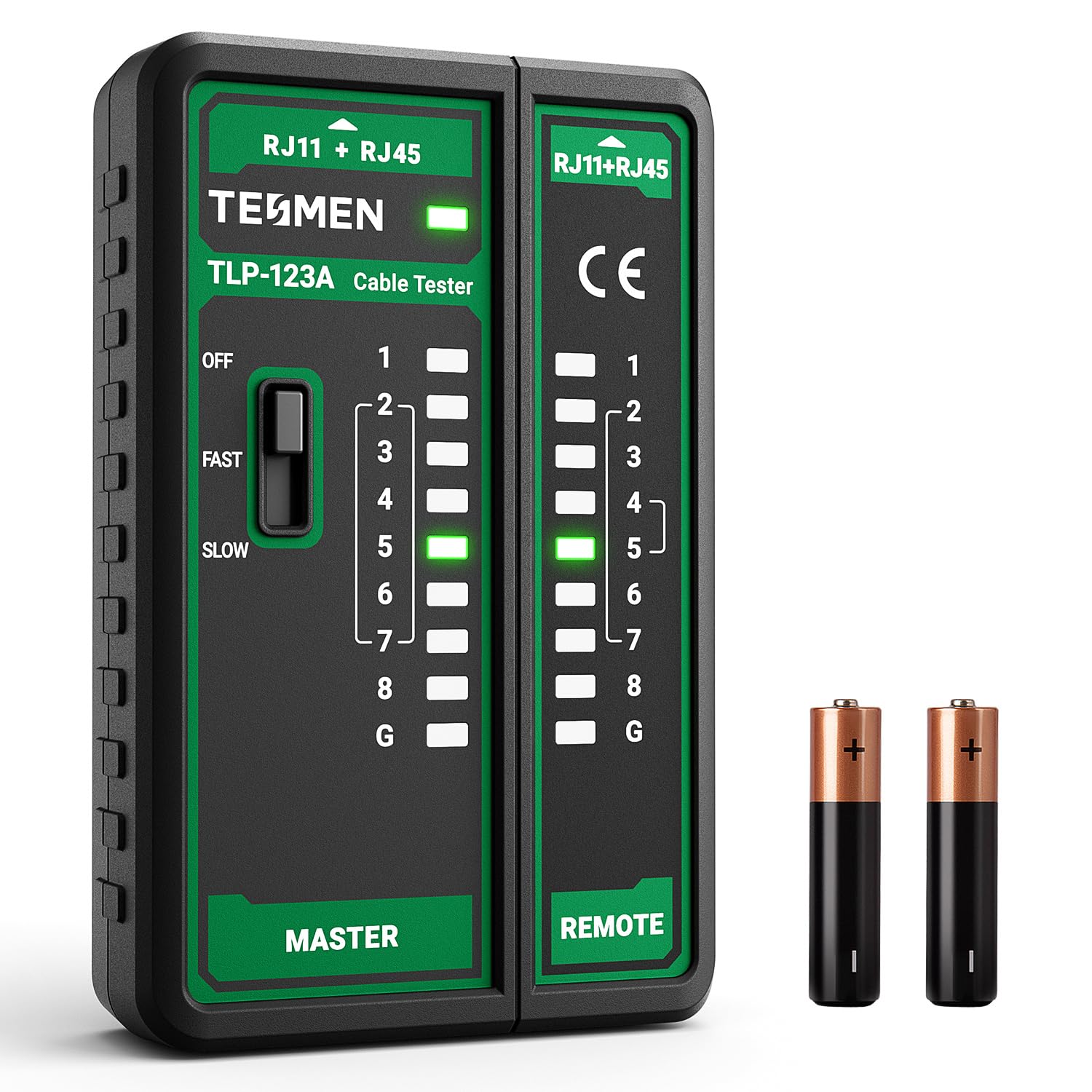
The TESMEN TLP-123A delivers basic continuity testing for under $10, making it the cheapest functional option for verifying Ethernet and phone cables. It checks for opens, shorts, miswires, and shield continuity across Cat5 through Cat7 with a detachable remote that lets you test runs from both ends.

For students learning cable termination or homeowners who occasionally make a patch cable, this tester provides clear pass/fail feedback without confusing menus. The plastic enclosure keeps weight low but feels insubstantial in hand — a concern if you plan to toss it in a daily carry toolkit. Lack of length measurement, PoE detection, or toner means it cannot replace a field-grade tool for professional installers.

Setup is straightforward: insert two AAA batteries, plug the cable into the main unit and remote, then slide the switch. The LED sequence lights up pin-by-pin for quick visual confirmation. At this price, there is no expectation of durability under heavy use, but for the target audience of budget-constrained or infrequent users, it gets the job done.

Bottom line: Best left in a home drawer or student kit for verifying patch cables — not a field tool for network installers who need more than continuity.

4

Fluke MicroScanner2

Fluke MicroScanner2

Professional verification

Our Score 9.0/10
Check Price

Worth Noting

  • Length measurement accuracy can vary in certain conditions.
  • Plastic loopback connector may break if handled roughly.
  • No PoE testing capability at this premium price.
Fault Detection
Wiremap, distance to fault
Cable Type Support
RJ11, RJ45, Coax
Cable Length Measurement
Yes

The Fluke MicroScanner2 brings IntelliTone toning and distance-to-fault measurement to cable verification, a step beyond basic continuity testers. Its interface is intuitive, and the built-in toner saves significant time when locating specific runs in a bundle. The housing is rugged, though the plastic loopback connector is a weak point that may break with repeated use.

This verifier suits network technicians who work daily on complex cable installations and need a tool that verifies 10/100/1000Base-T wiring, coaxial and phone lines. The absence of PoE testing is a notable gap at this price, and length measurement accuracy has been flagged as inconsistent in some field conditions. For those who can forgo PoE and are comfortable with occasional length variance, the MicroScanner2 delivers dependable toning and fault location.

The IntelliTone generator works reliably on live networks, and the distance-to-fault feature helps pinpoint breaks along a run. The yellow casing is easy to spot on a cluttered workbench. Compared to more feature-packed alternatives like the Scout Pro 3, the Fluke commands a higher price but offers a more refined toning experience.

Tip: The plastic loopback connector is removable; store it in a padded compartment to extend its life.

Bottom line: For technicians who prioritize precise toning and fault location over PoE and cost, the MicroScanner2 is a capable field tool.

5

NOYAFA NF-8508

NOYAFA NF-8508

Copper & fiber

Our Score 8.6/10
Check Price

Worth Noting

  • Interface complexity can make basic tasks harder than expected
  • Length and voltage measurements can be inconsistent, especially on longer shielded cables
Fault Detection
Continuity, wiremap, VFL
Cable Type Support
RJ45, RJ11, BNC, Fiber
Cable Length Measurement
Up to 200 m

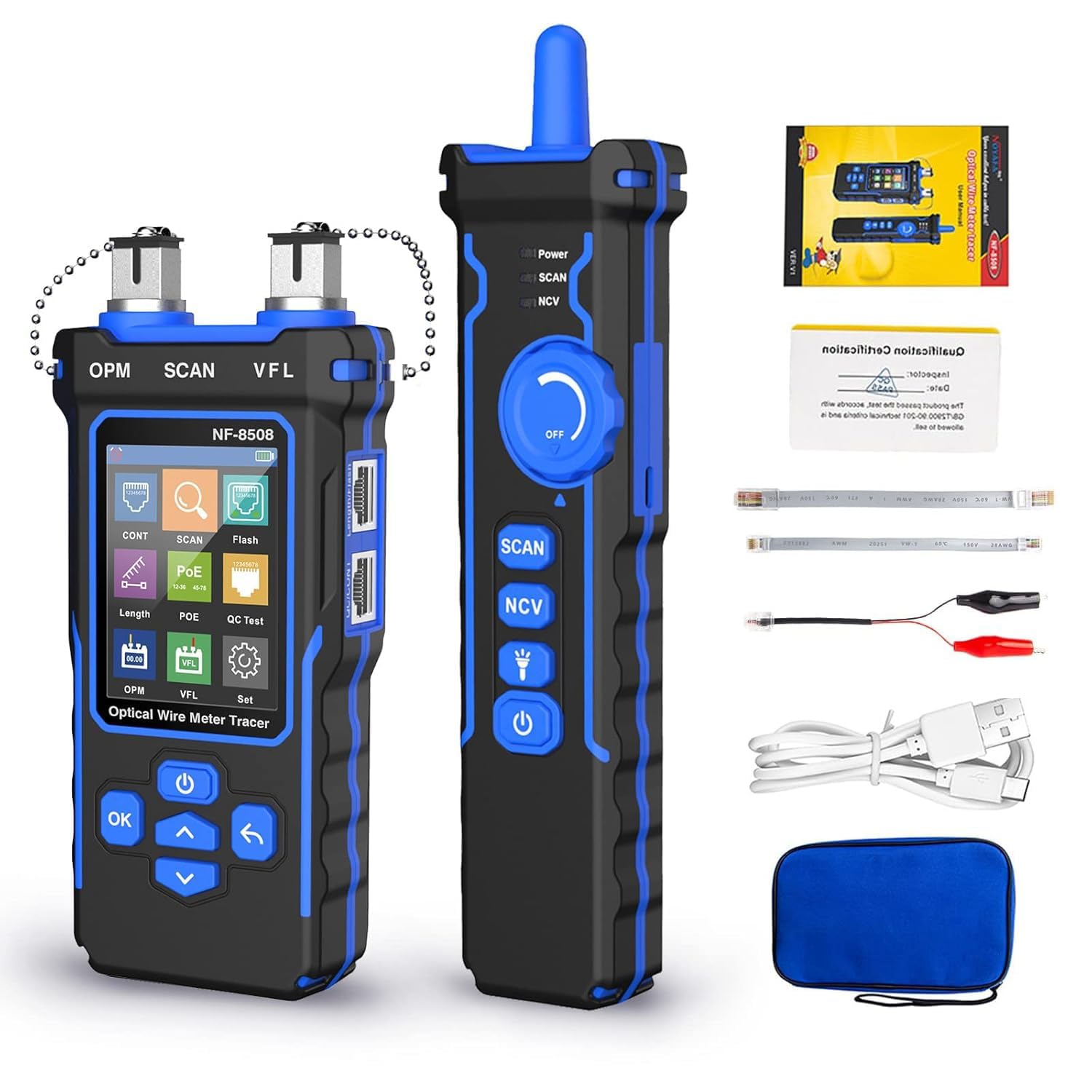
The NOAA NF-8508 combines an optical power meter and visual fault locator with copper cable testing features including continuity, tone, PoE detection, port flashing, and length measurement up to 200 meters. This range of capabilities in one device is unusual at this price point, making it a viable option for techs who occasionally work with fiber installations and don't want to carry a separate tool.

This tester suits IT professionals and network installers who need both copper and basic fiber testing occasionally, and who are comfortable navigating a menu-driven interface. The length and voltage measurements can produce inconsistent readings, especially on shielded cables beyond 250 feet, and the multi-layer operating system takes time to learn. Users who require precise measurements or a pick-up-and-go experience should look at the top pick instead.

Bottom line: A practical all-in-one for techs who need fiber testing alongside copper and can accept occasional measurement quirks, but not the choice for accuracy-focused or simplicity-seeking users.

6

NOYAFA NF-8209

NOYAFA NF-8209

Budget PoE features

Our Score 8.8/10
Check Price

Worth Noting

  • Build quality may not withstand frequent handling over time.
  • Length measurements can vary between cable types, reducing trust in the reading.
Fault Detection
Continuity, wiremap
Cable Type Support
RJ45
Cable Length Measurement
Yes

The NOYAFA NF-8209 combines PoE detection, cable length testing, and tone generation at a low price point, giving home users a multifunction tool without a large investment. Basic continuity checks and cable tracing work well for identifying runs in a typical home network. However, build quality may not hold up to frequent handling over many months, and length measurements can vary between cables, making consistent results uncertain. These tradeoffs mean the NF-8209 suits occasional troubleshooting where a few inaccuracies are acceptable, rather than professional or demanding environments.

Bottom line: Best for a home user who needs occasional cable testing and can accept some variability in length readings and potential early replacement.

7

TESMEN TLP-528C

TESMEN TLP-528C

Cable tracing

Our Score 9.6/10
Check Price

Worth Noting

  • Performance consistency of the toner and continuity functions may vary between units.
  • Long-term durability under regular field use is uncertain given limited user feedback.
Fault Detection
Continuity, wiremap
Cable Type Support
RJ11, RJ45
Cable Length Measurement

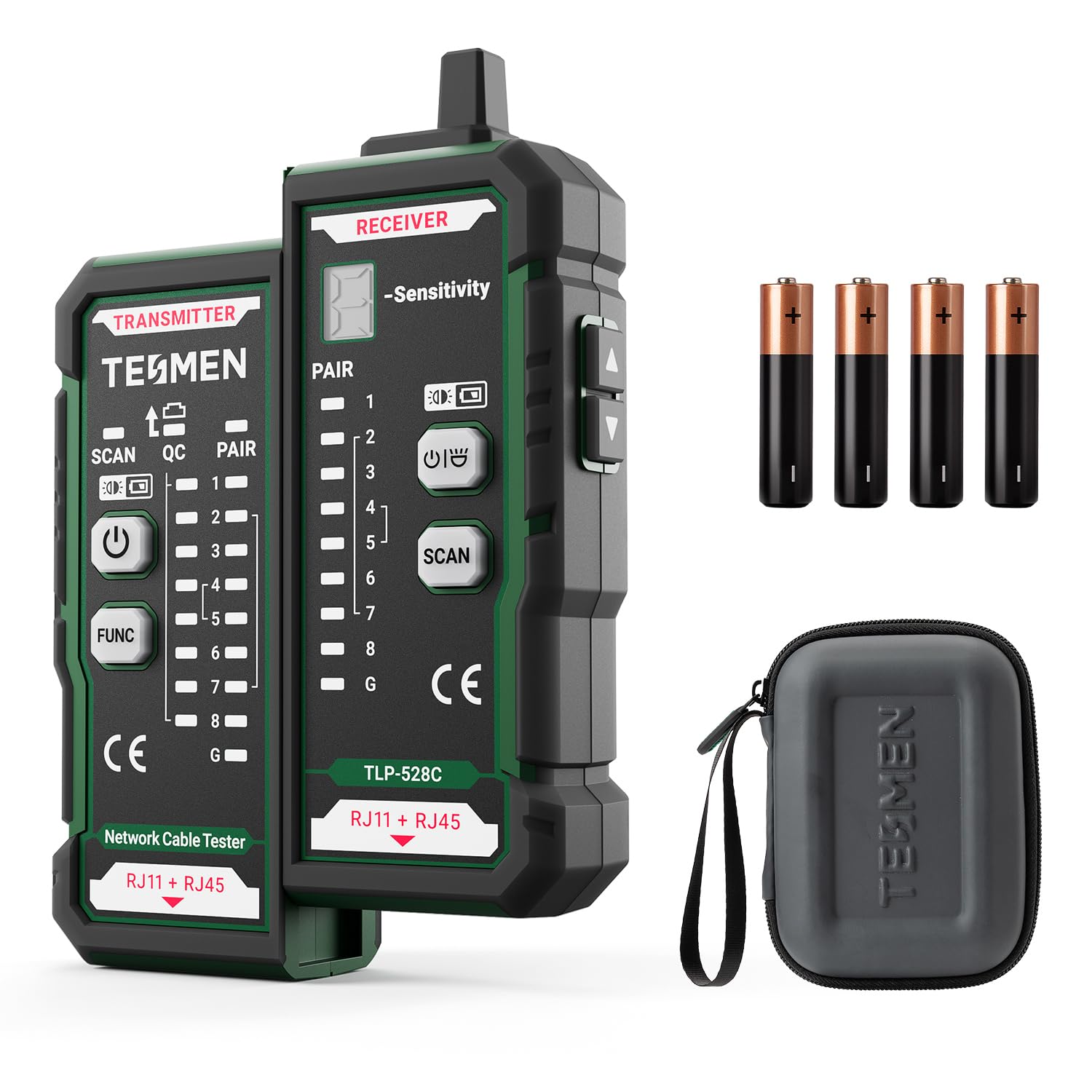
This device combines a toner and continuity tester in one package for sorting cables and checking wiring on RJ11 and RJ45 lines. The detachable remote and anti-interference probe help identify runs without extra gear. However, user experience with this model is limited, so the consistency of its toner and continuity functions hasn't been widely verified. For a buyer who needs basic cable tracing and is willing to accept some uncertainty about long-term performance, this is a low-cost way to get both tools at once.

Bottom line: Fits a budget-conscious buyer who needs basic cable tracing and continuity checking and is comfortable with some performance uncertainty.

8

Fluke LIQ-100

Fluke LIQ-100

Enterprise certification

Our Score 8.8/10
Check Price

Worth Noting

  • Premium-priced tool that requires a significant budget allocation.
  • Advanced features are unnecessary for continuity or basic cable mapping tasks.
Fault Detection
Performance, wiremap
Cable Type Support
RJ45
Cable Length Measurement
Yes

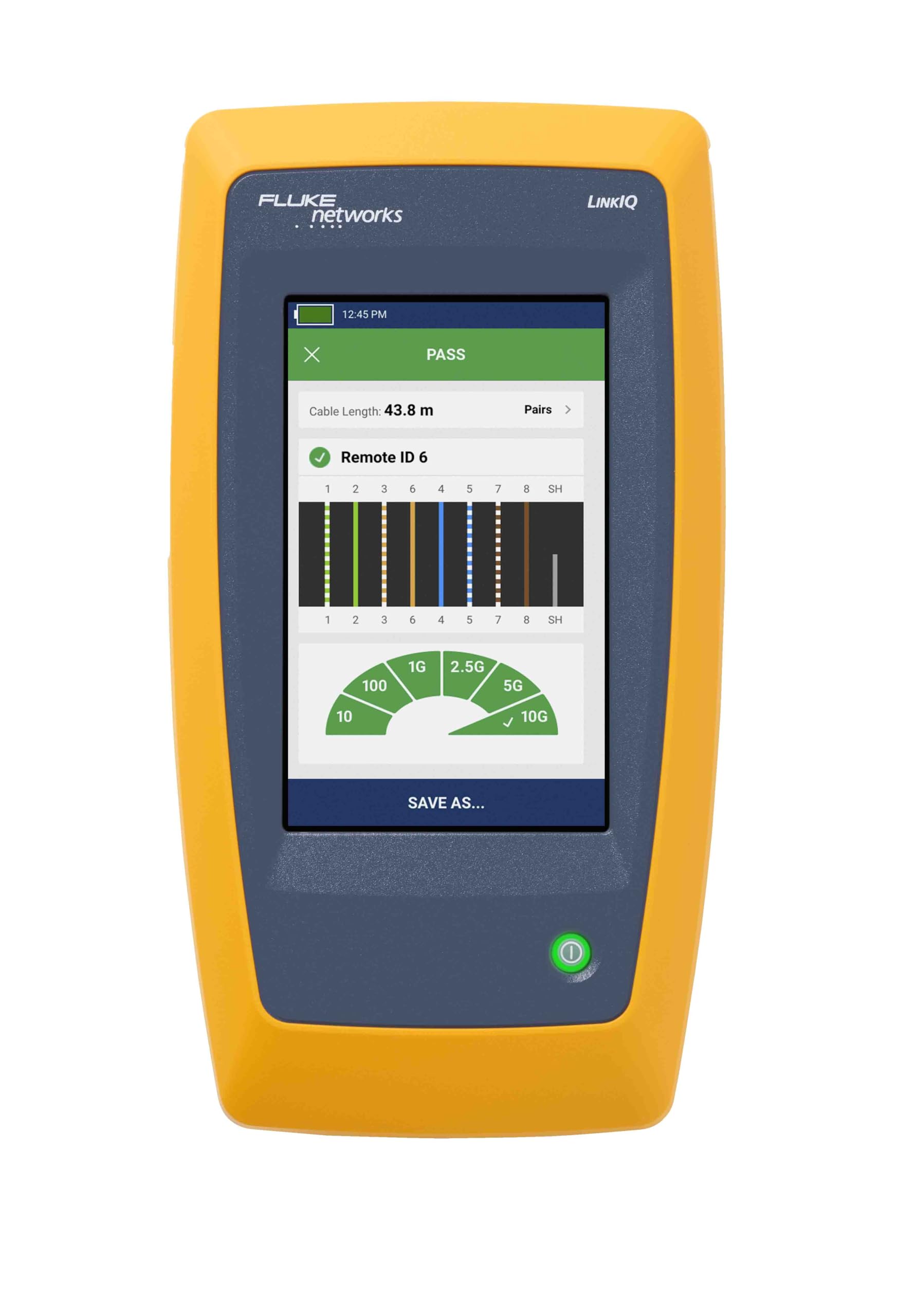
The Fluke LIQ-100 delivers certified performance testing for 10GBASE-T links, plus PoE class 1-8 verification and network diagnostics like ping and switch identification. These capabilities are necessary for data center technicians and enterprise network engineers who require documented cable performance. However, the investment is substantial – the unit costs more than many complete toolkits – and its feature set far exceeds what most cable installers or IT generalists need for everyday continuity testing or cable mapping. For routine pass/fail checks, a simpler tool like the MicroScanner2 covers the same ground at a fraction of the cost.

Bottom line: Best suited for network engineers who need certified 10GBase-T performance and PoE diagnostics in a single handheld tool – and have the budget to match.

How to Choose

Cable Type Support

Testers are often specialized: some only handle RJ45 Ethernet, while others add RJ11 for phone and F-connector for coax. If you work exclusively with Cat5e/6 cables, a simple Ethernet-only tester saves money and reduces complexity.

For installers dealing with mixed cable plants, a multi-type tester avoids carrying separate tools. But the trade-off is that multi-type testers are bulkier and often sacrifice some Ethernet-specific features like detailed split-pair detection.

Fault Detection

Most testers detect opens, shorts, and miswires, but not all differentiate between T568A and T568B wiring standards. A generic 'miswire' indicator can be confusing if you use both standards – you'll need to manually check the pinout.

Higher-end testers show exact wire-to-wire mapping, which speeds up troubleshooting on complex runs. For basic patch cables, simple pass/fail is sufficient.

Cable Length Measurement

Length measurement on cheaper testers uses capacitance and can be wildly inaccurate – don't rely on it for certification. Accurate length reading requires time-domain reflectometry (TDR), found in mid-range and professional testers.

If you only need to verify continuity, skip length measurement altogether. It adds cost and often misleads when measuring through patch panels or couplers.

PoE Testing

PoE detection tells you if a switch port is supplying power and at what voltage. This is useful when troubleshooting devices that won't power up, but most continuity testers ignore PoE entirely.

For home networks, PoE is rarely critical. Professional installers managing IP cameras or access points will benefit from a tester that verifies both data and power delivery.

Number of Remote Identifiers

Mapping multiple cable runs to a patch panel requires a tester with several unique remote identifiers. Basic testers come with one remote, forcing you to label cables one at a time.

Kits with 5, 10, or even 36 remotes let you plug in all cables at once and identify each end at the panel. The trade-off is cost and remote storage – you'll need to keep track of small pieces.

Frequently Asked Questions