Tools & DIY

10 Best Circuit Breaker Finder of 2026: Map Your Breaker Panel Without the Guesswork

Which circuit breaker finder accurately identifies outlets without false positives? Find the right tool for your panel.

The most common frustration with breaker finders isn't that they don't work — it's that they beep on multiple breakers at once. That false-positive problem usually isn't a defective tool; it's a technique issue. A slow, deliberate two-pass sweep is the difference between guesswork and a correctly labeled panel.

This roundup covers models from budget to pro, each matched to a specific use case. Whether you're mapping an unlabeled home panel, tracing underground wires, or building a full electrical test kit, the right tool exists. The challenge is knowing which trade-offs matter for your job — and which ones you can ignore.

1

Klein ET310

Top Pick
Klein ET310

Homeowners & DIYers

Our Score 9.4/10
Check Price

Worth Noting

  • Can produce false positives on adjacent breakers when scanned too quickly, requiring a slower technique to confirm.
Voltage
90-120V AC
GFCI Tester
Built-in

Klein's ET310 makes circuit hunting simple: plug the transmitter into the outlet, scan the panel with the receiver, and listen for the tone. The compact receiver clips onto the transmitter for neat storage, and the built-in GFCI tester adds outlet wiring checks without extra tools. Users find the process intuitive and much faster than manually flipping breakers one by one.

This device suits homeowners and DIYers who need to label an unmarked panel or isolate a circuit for repairs. The catch: accuracy requires a slow, deliberate two-pass sweep to avoid false positives on adjacent breakers. For those willing to adopt that technique, the ET310 delivers consistent results — making it the safe recommendation for the widest range of users.

Tip: Sweep the receiver slowly across the breakers; making a second pass in the opposite direction reduces the chance of false readings.

Bottom line: A mid-range priced tool that handles typical home panel mapping tasks when used with patience — no hidden complexity.

2

Fluke BK120

Fluke BK120

Accuracy-focused users

Our Score 9.4/10
Check Price

Worth Noting

  • Does not include adapters for light sockets or bare wires
  • Premium price for a basic feature set compared to full kits from Klein
Voltage
110V AC
GFCI Tester
Yes

Fluke's BK120 delivers noticeably fewer false positives than the category-leading Klein ET310 — the dual-sensitivity NCV and bright flashlight speed up identification on well-labeled panels. Build quality matches what professionals expect from the brand: the transmitter and receiver feel solid, and the GFCI tester works without fuss. The tradeoff is a stripped-down kit: no adapters for light sockets or bare wires, and the premium price buys accuracy rather than accessories. This suits users who already own those adapters or only need to map standard three-prong outlets.

Tip: If you work with light sockets or bare wires, order the adapter accessory kit alongside the BK120.

Bottom line: Pick the Fluke BK120 if accuracy is your top priority and you don't need extra adapters; otherwise, Klein offers more for the money.

3

Klein ET450

Klein ET450

Professional electricians

Our Score 9.4/10
Check Price

Worth Noting

  • Expensive and overkill for simple outlet-to-breaker mapping tasks
  • Wire tracing can be inconsistent on shielded or underground cables
Voltage
12-480V AC/DC
GFCI Tester
No

The Klein ET450 traces both energized and non-energized circuits, and can follow wires underground or through walls — a capability that sets it apart from standard breaker finders. Its adjustable sensitivity helps pinpoint specific wires behind drywall or inside conduit.

This is a professional-grade tool for electricians and facility technicians who need to troubleshoot complex wiring scenarios. It is not suited for homeowners just mapping outlets to breakers — the cost and complexity are excessive. Additionally, tracing can be inconsistent on shielded or underground cables, requiring careful technique.

Tip: On shielded underground cables, slow sweeping and multiple passes may be needed for accurate results.

Bottom line: For electricians who regularly trace underground or dead circuits, this tool pays for itself — but for standard outlet-to-breaker mapping, the Klein ET310 is a more cost-effective choice.

4

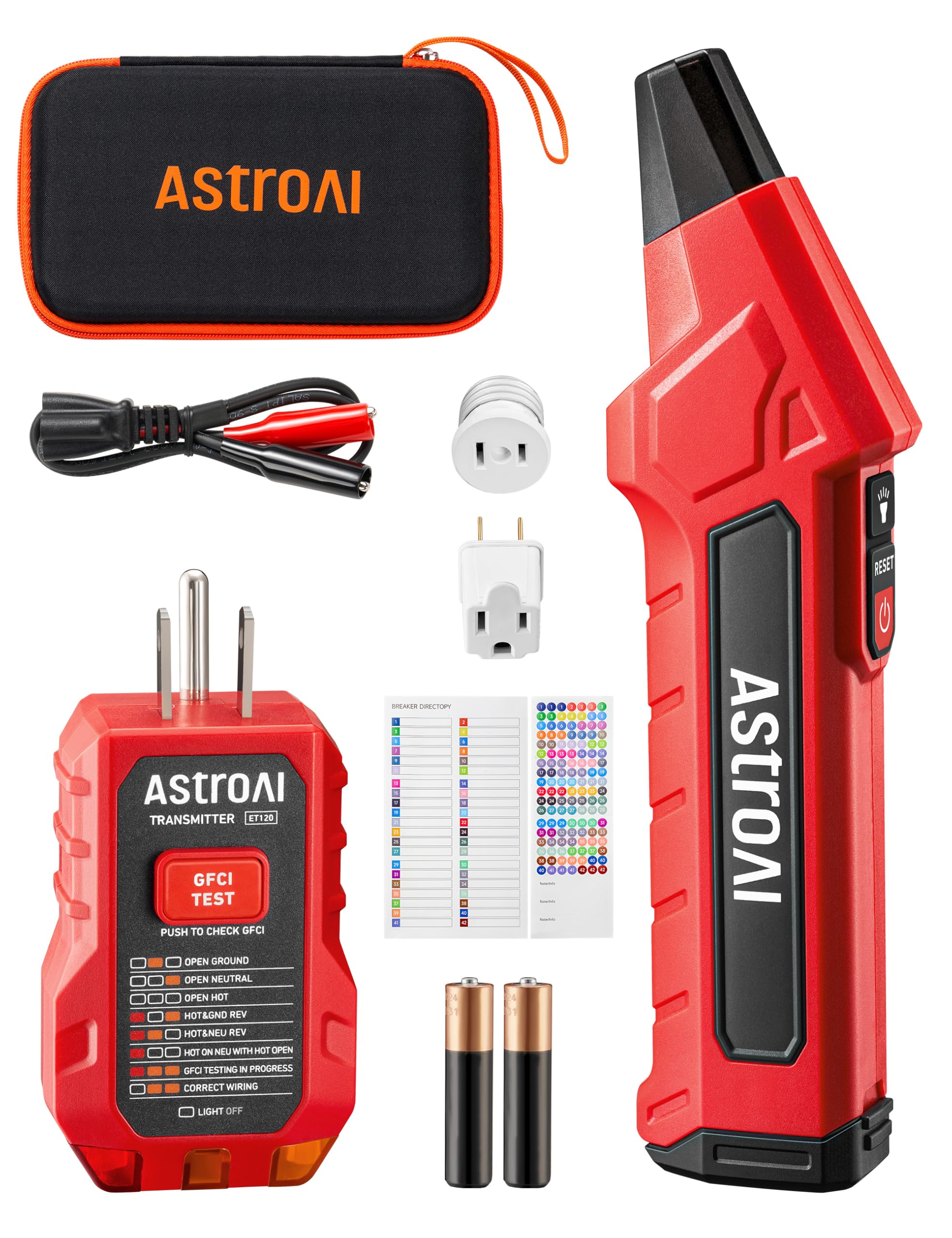
AstroAI Breaker Finder

AstroAI Breaker Finder

Budget-conscious DIYers

Our Score 9.2/10
Check Price

Worth Noting

  • Sensitivity may trigger on adjacent breakers, requiring careful technique to identify the correct one
Voltage
90-120V AC
GFCI Tester
Yes

This kit includes a light socket adapter, alligator clips, and a 2-prong plug – items often sold separately with pricier models. The receiver's indicators are clear, and the GFCI tester is a useful addition for outlet checks.

For homeowners mapping out outlets on a budget, this works well as long as you accept that the sensor may pick up adjacent breakers. Slowing down and sweeping multiple times helps isolate the correct circuit. It's best suited for simple panels and occasional use.

Tip: Move the receiver slowly across breakers – rapid scanning increases false positives.

Bottom line: Right for light DIY on a budget, but verify the breaker by toggling it before labeling.

5

Klein 80101 Kit

Klein 80101 Kit

Full kit users

Our Score 9.6/10
Check Price

Worth Noting

  • Breaker finder accuracy depends on careful technique; dedicated models offer simpler operation
  • Multimeter covers standard measurements but lacks advanced features like capacitance or frequency
Voltage
12-1000V AC
GFCI Tester
No

The Klein 80101 kit combines four essential electrical tools into one purchase, saving space and money compared to buying each separately. The included breaker finder identifies circuit breakers with the same ET310 base, which requires slow sweeping to avoid false positives — a known tradeoff for this category. This kit suits homeowners and DIYers who need a multimeter, NCVT, and outlet tester alongside basic breaker identification. If you already own those tools, the breaker finder alone isn't worth the premium.

Tip: For breaker identification, sweep the receiver slowly over the panel and make two passes to minimize false readings.

Bottom line: A practical all-in-one for homeowners who need more than just a breaker finder, but overkill if you only want to map breakers.

6

Klein ET30 Kit

Klein ET30 Kit

DIYers with adapters

Our Score 9.6/10
Check Price

Worth Noting

  • False positives can occur if the receiver is moved too quickly
Voltage
90-120V AC
GFCI Tester
Yes

This kit pairs the ET310's consistent circuit identification with adapters for light sockets, alligator clips, and 3-prong outlets. Build quality is solid. The ET310KIT offers a similar bundle with more reviews, and this unit can produce false positives if you sweep too quickly.

Bottom line: For DIYers who need the included adapters for light sockets and bare wires, this kit offers the same ET310 performance at a competitive price — just be prepared to sweep slowly.

7

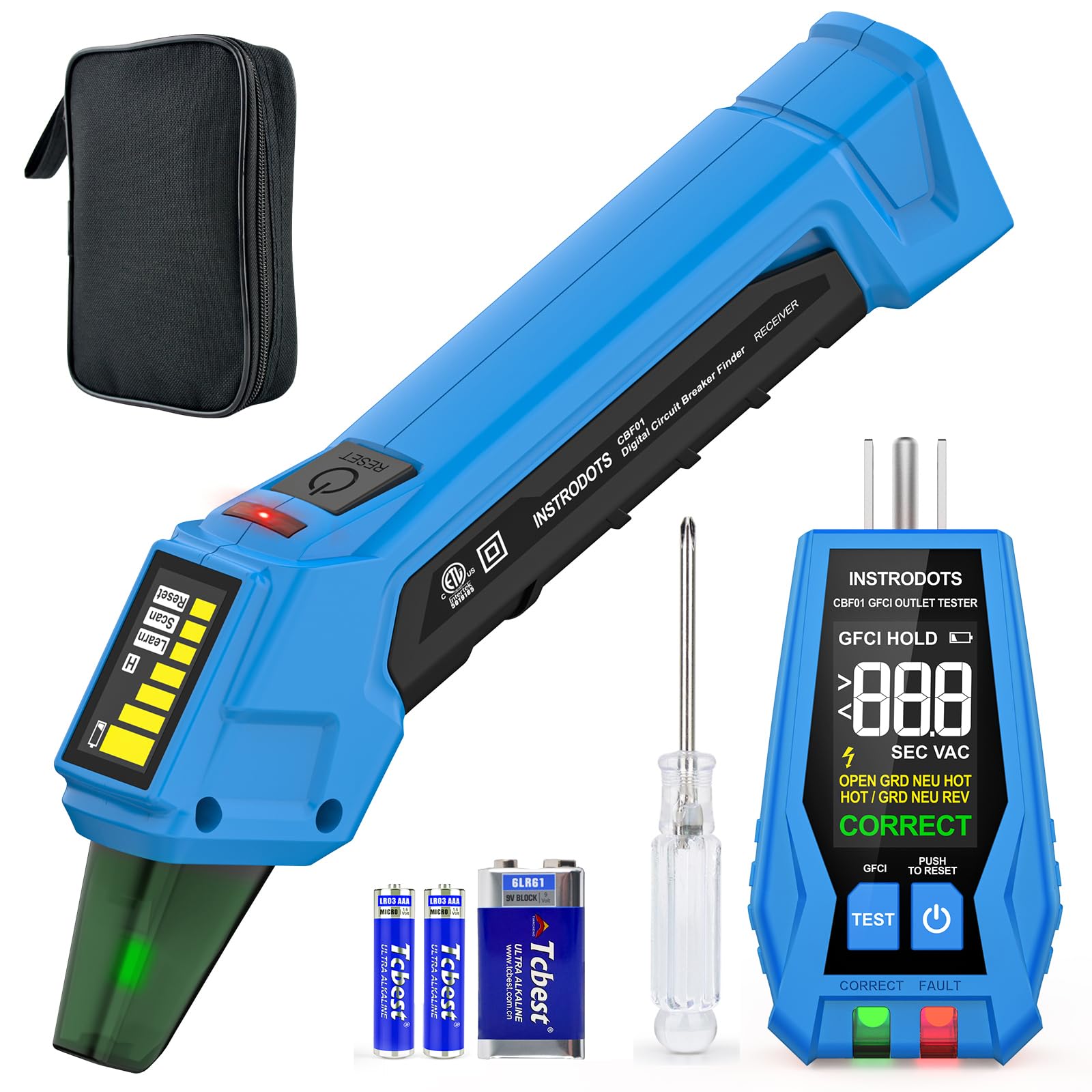
Instrodots CBF01

Instrodots CBF01

Budget LCD buyers

Our Score 9.0/10
Check Price

Worth Noting

  • Readings may occasionally jump to adjacent breakers, requiring careful technique.
Voltage
90-135V AC
GFCI Tester
Yes

The Instrodots CBF01 delivers a clear color LCD that shows voltage readings and wiring status, plus a full kit with batteries and carrying case. For mapping outlets to breakers, occasional false positives can occur — requiring slower sweeping technique. This makes it a sensible pick for budget-minded homeowners who want a bright display, but less ideal for precision work.

Bottom line: Worth considering if you prioritize a color display and complete kit over maximum accuracy — best for casual home use.

8

Ideal 61-534

Ideal 61-534

Traditional no-frills users

Our Score 9.0/10
Check Price

Worth Noting

  • No included adapters for light sockets or bare wires; accuracy requires careful two-pass sweeps.
Voltage
120V AC
GFCI Tester
Yes

The Ideal 61-534 is a consistent tool that identifies breakers accurately after a deliberate two-pass sweep, but its bare-bones package lacks the adapters and carrying case that modern competitors include. It suits traditionalists who prefer a simple device without extra accessories.

Bottom line: A worthwhile option if you already own basic adapters and prefer a no-frills tool from a legacy electrical brand.

9

Klein 80064 Kit

Klein 80064 Kit

Homeowners with NCVT

Our Score 9.4/10
Check Price

Worth Noting

  • The included NCVT may not detect voltage on some GFCI outlets, unlike dedicated pens
Voltage
90-120V AC
GFCI Tester
Yes

The Klein 80064 bundles a breaker finder with a non-contact voltage tester and zipper bag for easy transport. The NCVT is less sensitive than standalone pens, so it may not detect lower voltages on GFCI outlets. The breaker finder works with careful sweeping, but false positives can occur. It is a decent value if you need both tools and a case, but the NCVT's limits make it better for basic checks.

Bottom line: Best suited for homeowners who need a basic breaker finder and also want a voltage tester for quick checks, as long as GFCI sensitivity is not critical.

10

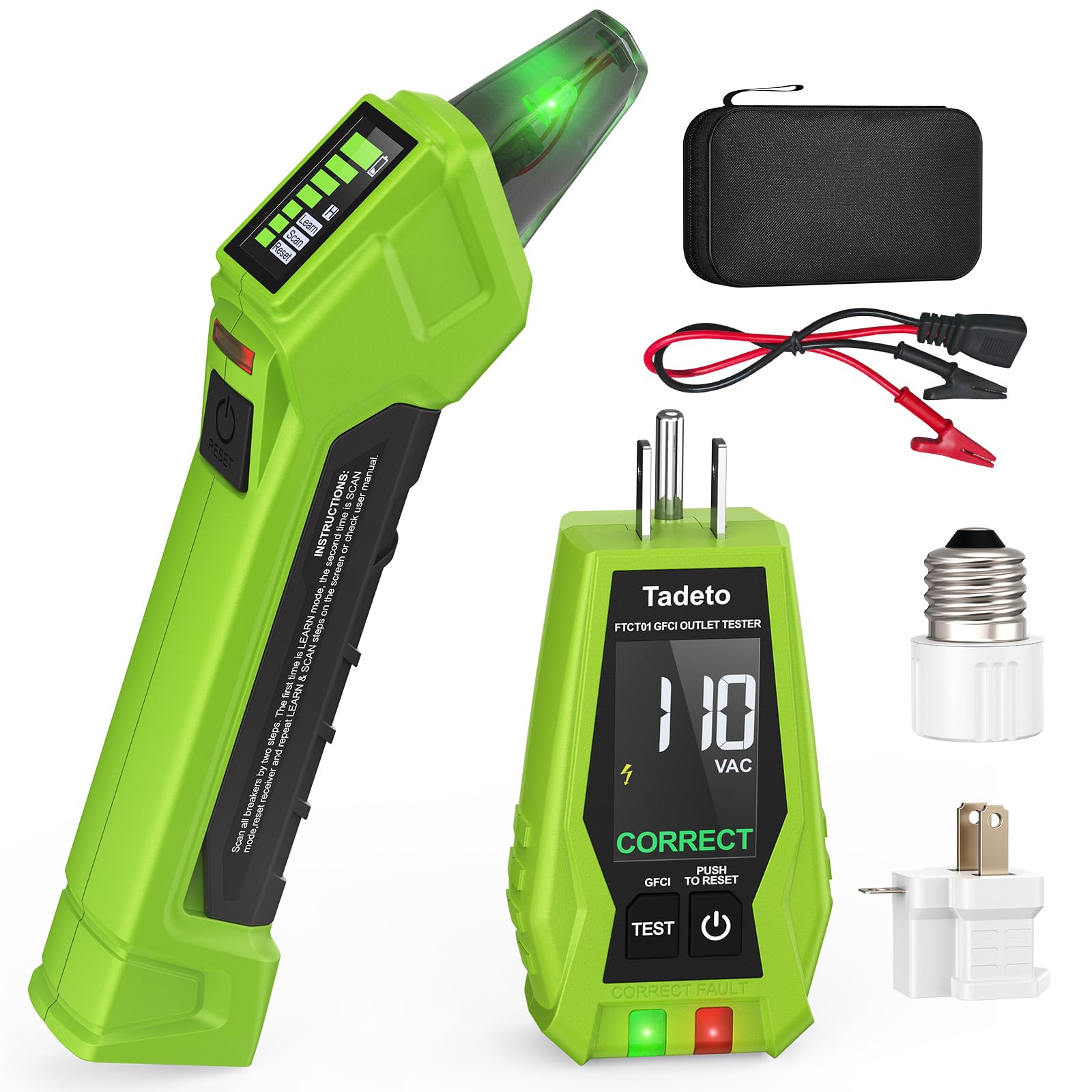
Tadeto FTCT01

Tadeto FTCT01

DIYers with dual LCD

Our Score 9.0/10
Check Price

Worth Noting

  • Minor build quality concerns; some units may have issues over time
Voltage
90-135V AC
GFCI Tester
Yes

The Tadeto FTCT01 gives you dual LCDs that show both voltage and signal strength during breaker hunting, and the kit includes a light socket adapter, alligator clips, and a 2-prong adapter for different fixture types. At this price point, the added displays help confirm what you are touching before flipping breakers. The catch is that build quality can vary between units, so consistent long-term durability is not a given — this suits DIYers who want a complete, low-cost setup and can accept some QC variance.

Bottom line: Best for DIYers who want a complete adapter set and dual displays on a tight budget, provided they can tolerate occasional QC quirks.

How to Choose

Voltage Compatibility

Most residential breaker finders work on standard 90-120V AC circuits. If you need to trace higher-voltage lines (240V or more) or DC circuits, look for a model like the Klein ET450 that handles up to 480V AC/DC. Using a standard finder on out-of-range voltages either produces no reading or damages the transmitter.

For typical home use, any 90-120V AC unit works fine. But if your panel includes subpanels or commercial equipment, verify the voltage range before buying.

GFCI Testing Capability

A built-in GFCI tester lets you trip and reset GFCI outlets directly from the breaker finder transmitter. This is convenient for verifying outlet protection without carrying a separate tester. Models without this feature still identify the breaker but require a standalone GFCI tester for outlet safety checks.

If you frequently work in kitchens, bathrooms, or garages — where GFCI outlets are common — the built-in tester saves time and reduces tool swaps.

Receiver Sensitivity and Adjustability

Receiver sensitivity determines how precisely the tool discriminates between adjacent breakers. Fixed-sensitivity models either work well on straightforward panels or struggle on crowded ones. Adjustable sensitivity, found on the Klein ET450 and some others, lets you dial down the range to isolate a single breaker from its neighbors.

For panels with more than 20 breakers or tight spacing, adjustable sensitivity significantly reduces false positives. On simpler panels, a fixed-sensitivity receiver is sufficient.

Included Adapters

Adapters expand the transmitter's reach beyond standard three-prong outlets. A light socket adapter is essential for tracing ceiling fixtures, and alligator clips let you connect to bare wires or switches. Kits that include these adapters (like the AstroAI or Klein ET310KIT) cost a bit more upfront but avoid separate purchases.

If you only need to map outlets, the base transmitter works. But for any work involving light fixtures or ungrounded circuits, the adapters are nearly indispensable.

Audible and Visual Alerts

Breaker finders use beeps, flashing LEDs, or both to signal a match. Audible alerts are helpful when working alone, especially in noisy panel rooms. Visual indicators (LCD screens or bright LEDs) are better in quiet environments or when you want a clear reading without sound.

The choice is largely personal, but ensure the alerts are distinct enough to differentiate a strong signal from ambient noise. Some budget models have weak beeps that get drowned out by nearby equipment.

Frequently Asked Questions