Computers & Accessories

7 Best Trackball Mouse of 2026: Save Your Wrists and Your Wallet

Which trackball mice actually deliver lasting ergonomic relief without breaking down after months of use — and which to avoid.

Trackball mice promise wrist relief, but many buyers discover a cruel irony: the buttons that should last years often start double-clicking after months. This isn't a brand-specific flaw — it's a category-wide reality that makes choosing the right model more about managing trade-offs than chasing specs.

The real decision comes down to how much you value tilt adjustability versus upfront cost, and whether you can tolerate a scroll ring that may need a break-in period. Our picks focus on models that balance ergonomic payoff with realistic longevity, so you don't end up replacing your mouse every year.

If you prioritize consistent button feel and a scroll wheel that works out of the box, some models will serve you better than others regardless of price tag. The key is matching the mouse to your usage pattern, not the marketing pitch.

1

Logitech MX Ergo S

Top Pick
Logitech MX Ergo S

Precision & comfort

Our Score 9.0/10
Check Price

Worth Noting

  • In some units, button switches may develop double-click or scroll-wheel issues after months of use
  • Quiet-click mechanism feels softer than traditional clicks, which some may find less satisfying
Durability
Double-click
Tilt Angle
20° fixed
Connectivity
Bluetooth + USB-A
Control Type
Thumb

The MX Ergo S takes the familiar M575 shape and adds a 20-degree fixed tilt that naturally rotates your forearm, reducing the inward twist that often aggravates wrist strain. In daily use, this angled platform feels deliberate and supportive - you don't have to adjust your posture, the mouse does it for you. Combined with the thumb-operated trackball, precise cursor movements for CAD or photo editing become a smooth, low-effort motion rather than a shoulder-tensing drag.

Build quality stands out immediately: the magnesium-infused chassis feels dense and well-seated on the desk, with a soft-touch coating that resists fingerprints. The USB-C rechargeable battery lasts up to four months on a single charge, and a one-minute top-up gives you a full day of use. Dual connectivity via Bluetooth or the included Logi Bolt USB-A dongle lets you switch between three devices with a button press.

This is the right choice for right-handed office workers or designers who currently experience wrist fatigue from conventional mice and want a thumb-driven alternative with a tilt that encourages a more relaxed grip. However, the fixed 20-degree angle means left-handed users can't use it, and those who need extra adjustability (like the MX Ergo Plus wedge) will want the older model. The button mechanism - while quiet and low-force - can develop double-click behavior after several months of heavy use, a known vulnerability in Logitech switches that isn't unique to this model.

Tip: To minimise the chance of switch wear, avoid using the mouse in high-click applications (like gaming) or consider mapping common clicks to the trackball itself via Logitech Options+.

Bottom line: If you want tilt-driven wrist relief combined with multi-device flexibility and USB-C charging, this is the most polished thumb trackball at its price - just keep in mind that button longevity has variability over time.

2

Logitech M575

Logitech M575

Ergonomic comfort

Our Score 9.2/10
Check Price

Worth Noting

  • Left-click may become sticky or double-register after months of use.
  • Some units may become unresponsive or develop connection errors within the first year.
Durability
Button sticking
Tilt Angle
None
Connectivity
Bluetooth + USB-A
Control Type
Thumb

The M575 delivers the same core thumb-trackball ergonomics as Logitech's premium MX Ergo S at a mid-range price, with Bluetooth and Logi Bolt wireless and up to 18 months of AA battery life. This makes it the cost-effective choice for right-handed users who don't need the adjustable tilt of the higher-end model.

Setup takes seconds, and the sensor provides consistent tracking across Windows, Mac, Chrome, and Linux. The compact graphite shape fits most hand sizes without forcing a change in grip.

This trackball suits office workers and home users wanting to reduce wrist strain — but button sticking and double-click have been observed after several months in some units. It's a tradeoff that matters most for those planning heavy daily use.

Tip: If left-click becomes intermittent, cleaning around the button with compressed air may restore normal behavior.

Bottom line: For right-handed users seeking thumb-trackball ergonomics at a reasonable price, the M575 is a strong fit — just keep an eye on button wear that can surface over time.

3

Kensington Expert Wired

Kensington Expert Wired

Ambidextrous use

Our Score 8.6/10
Check Price

Worth Noting

  • Scroll ring can feel gritty or inconsistent out of the box
  • Ball movement may feel uneven initially for some users
Durability
Scroll ring roughness
Tilt Angle
None
Connectivity
Wired USB-A
Control Type
Finger

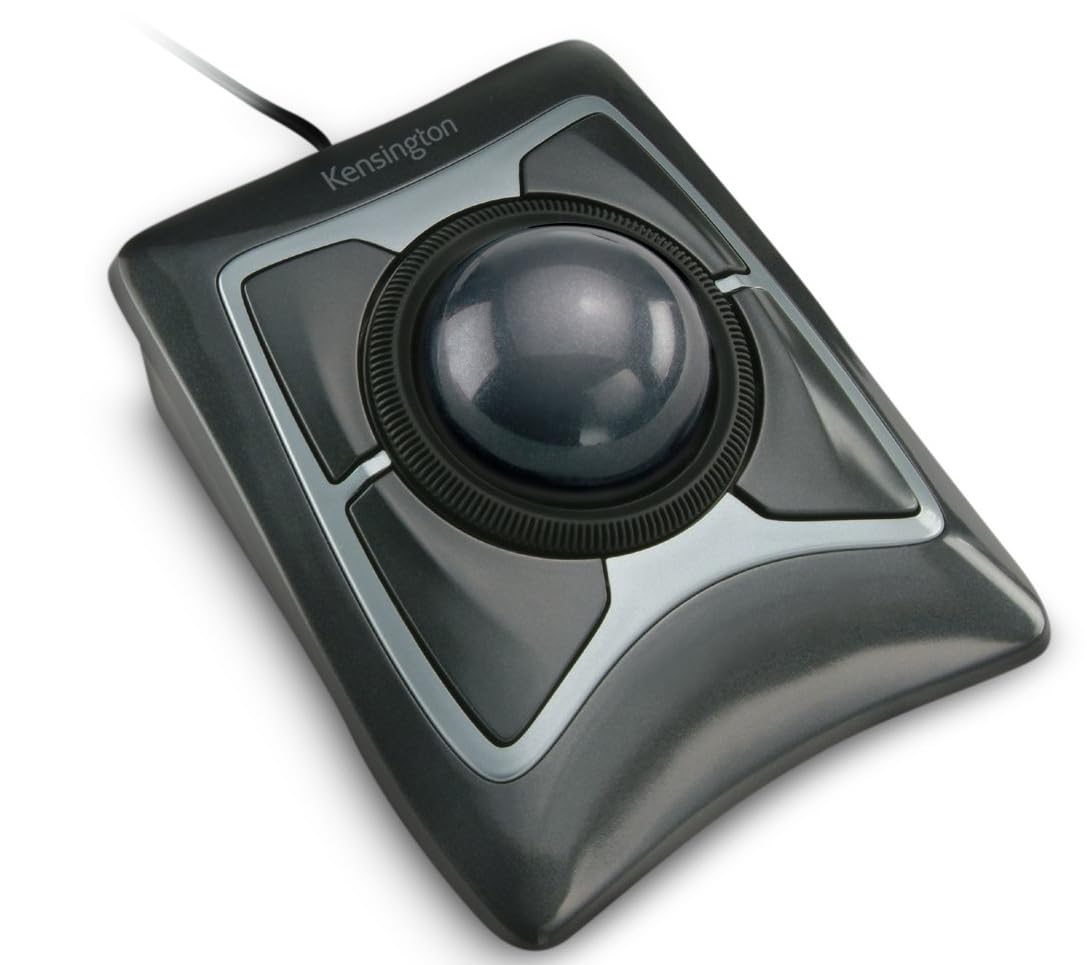
The Kensington Expert Trackball stands as a classic, ambidextrous wired finger trackball with a generous 55mm ball and an included wrist rest. Unlike newer finger trackball models that use twist-to-scroll mechanisms, the Expert relies on a patented scroll ring — a design that can feel gritty or inconsistent when new.

This trackball suits office workers who want a stationary wired device, left-handed users, and anyone who prefers finger-operated rather than thumb-operated controls. The scroll ring roughness is a known tradeoff: some units may need a break-in period or even a replacement for a consistently smooth experience.

Beyond the scroll ring, the trackball delivers accurate cursor control thanks to its large ball, and the wrist rest effectively reduces fatigue during long sessions. Build quality is robust — many users report years of service. The ball itself may feel a bit sticky initially, but this often resolves with regular use.

Tip: The scroll ring may require a break-in period of several weeks or a replacement if it remains rough — some users find cleaning the ring improves performance.

Bottom line: For buyers prioritizing ambidextrous design and a wired, stationary setup over adjustable tilt or wireless, the Expert offers solid build and comfort despite the scroll ring's initial roughness.

4

ProtoArc EM01 NL

ProtoArc EM01 NL

Adjustable tilt

Our Score 8.6/10
Check Price

Worth Noting

  • Button feel may be too sensitive or mushy for precise clicking
  • Trackball smoothness can be inconsistent, with some grittiness after short use
  • Occasional cursor freezes or complete stoppage possible in some units
Durability
Freezing
Tilt Angle
0-20° adjustable
Connectivity
Bluetooth + 2.4GHz
Control Type
Thumb

An adjustable hinge that tilts up to 20 degrees is rare in this price bracket, and the ProtoArc EM01 NL delivers it alongside Bluetooth and 2.4GHz connectivity. The build feels sturdy for its cost, and the thumb-operated trackball suits right-handed users with small to medium hands. This provides ergonomic customization that typically costs significantly more from established brands.

This mouse fits budget-conscious right-handed users who need tilt adjustability to reduce wrist strain during long sessions. However, the button feel can be polarizing — some find the clicks too sensitive or mushy, which may affect precision tasks. The target buyer is someone who prioritizes adjustable ergonomics over tactile feedback and is willing to work around that compromise.

For the price, the feature set is compelling: a rechargeable battery, six buttons, and wireless flexibility. But users should expect that the trackball smoothness may vary between units, occasionally feeling gritty after extended use. The value proposition holds up best for those who need the tilt adjustment and can accept some inconsistency in feel.

Tip: Periodic cleaning of the trackball and its socket helps maintain smooth movement.

Bottom line: If adjustable tilt is your priority and you can work around button feel and potential tracking quirks, the ProtoArc EM01 NL delivers that feature at a fraction of the cost of premium options.

5

Nulea M501

Nulea M501

Budget starter

Our Score 8.8/10
Check Price

Worth Noting

  • Bluetooth connectivity can be intermittent, with occasional pairing drops.
  • Some units may stop charging or lose cursor control after several months of use.
Durability
Charging issues
Tilt Angle
None
Connectivity
Bluetooth + 2.4GHz
Control Type
Thumb

For first-time trackball buyers on a strict budget, the Nulea M501 offers a solid ergonomic shape for right-handed users, wireless connectivity via Bluetooth or USB receiver, and a rechargeable battery with USB-C charging. The build quality feels robust for the cost, and the adjustable DPI adds flexibility. However, some units have experienced connectivity drops during Bluetooth use, and over several months of daily operation, charging or cursor control issues may arise. This makes the M501 a good starting point for light office work, but not a long-term investment for heavy use.

Bottom line: Best suited for budget-conscious first-time trackball users who can accept the possibility of early replacement; light office use is its comfort zone.

6

Kensington SlimBlade Pro

Kensington SlimBlade Pro

Wireless finger

Our Score 8.4/10
Check Price

Worth Noting

  • Buttons produce a loud click and can occasionally stick with use
  • Wireless connectivity can drop intermittently; some units may stop working entirely
Durability
Disconnects
Tilt Angle
None
Connectivity
Bluetooth + 2.4GHz + USB-C
Control Type
Finger

The Kensington SlimBlade Pro stands out with its high-quality construction, exceptionally smooth 55mm ball, and sleek, space-saving design. The twist-to-scroll mechanism is a functional trade-off: it frees up space but requires a deliberate learning curve that some find unnatural. While the build feels premium, the overall refinement in button feel and wireless reliability doesn't match the top pick in this category.

Bottom line: This trackball suits buyers who value a smooth, large ball and premium aesthetics and are comfortable adapting to twist-to-scroll; those needing quiet, consistent buttons and rock-solid wireless should consider alternatives.

7

Kensington Orbit

Kensington Orbit

Minimalist wired

Our Score 8.4/10
Check Price

Worth Noting

  • No dedicated scroll wheel; scrolling requires holding a button and dragging the ball
  • Ball can pop out when the mouse is tilted, making it unsuitable for mobile use
Durability
Ball pops out
Tilt Angle
None
Connectivity
Wired USB-A
Control Type
Finger

The Kensington Orbit offers reliable plug-and-play performance across Windows, macOS, and Linux, and its compact ambidextrous shape is comfortable for smaller hands. However, it lacks a physical scroll wheel — scrolling requires holding a button while moving the ball, a cumbersome workaround. The ball also pops out easily when the mouse is tilted, so this is best used in a stationary setup. For users who rarely need to scroll and want a budget-friendly entry point, it gets the job done, but most will find the missing scroll wheel and ball retention a dealbreaker.

Bottom line: Only consider this if you almost never scroll and keep the mouse stationary on a desk — otherwise the missing scroll wheel and loose ball will frustrate.

How to Choose

Thumb vs Finger Control

Thumb-operated trackballs (like Logitech's MX Ergo) feel intuitive because your thumb naturally rests on the ball, but they require a different muscle group than finger-operated models. The unintended consequence: thumb fatigue can set in during extended sessions if the ball requires too much force to roll. Finger-operated balls (like Kensington's Expert) distribute the load across multiple fingers but need a larger hand motion and often a dedicated wrist rest to prevent dangling.

If you have existing wrist pain, finger models are often better because they keep your wrist in a neutral position. Thumb models can aggravate the base of the thumb joint. Choose based on where your pain lives.

Scroll Mechanism

The scroll mechanism is the first component to degrade on most trackballs. Physical scroll wheels (Logitech) are familiar but prone to double-click and encoder failure after months of use. Scroll rings (Kensington Expert) are durable but often come gritty from the factory and need a break-in period. Twist-to-scroll (SlimBlade Pro) eliminates moving parts but requires you to twist the entire ball, which can feel unnatural.

The trade-off: a scroll ring that stays smooth over years versus a wheel that wears out faster but feels more precise new. For heavy scrolling, a traditional wheel with a metal construction is preferable.

Connectivity

Wired trackballs offer zero latency and never need battery changes, but they tether you to the desk. Wireless models (Bluetooth or RF) give freedom but introduce potential dropouts and battery anxiety. Bluetooth is convenient for multi-device switching but can be flaky on older laptops. A dedicated USB receiver (Logi Bolt or 2.4GHz) offers more stable connections across crowded airwaves.

If you use multiple computers, look for models with easy-switch buttons. Budget wireless trackballs often have flaky Bluetooth that disconnects randomly—check reviews for connection complaints.

Adjustability / Tilt Angle

A fixed tilt angle (like 20 degrees on MX Ergo S) forces your hand into a single position. Adjustable tilt (ProtoArc EM01 NL) lets you find the exact angle that aligns your forearm and wrist, but the hinge adds complexity and potential wobble. The hidden trade-off: more adjustability can mean more play in the structure over time.

For most people, a 15-20 degree tilt is ideal. If you have large hands, you may need a more vertical angle. Test if you can.

Durability and Button Reliability

Button microswitches are the weakest link across all price tiers. Logitech's Omron switches are known to develop double-click after a few months in high-use scenarios. Budget brands use cheaper switches that may fail unpredictably. The hidden truth: no trackball manufacturer guarantees switch longevity; even premium models can fail.

The scroll encoder is equally vulnerable. If you rely on precise scrolling, look for models with optical or magnetic scroll mechanisms (like some Logitech ones) instead of mechanical encoders. Plan for a 12-18 month replacement cycle unless you buy a model with a reputation for lasting longer.

Frequently Asked Questions