Audio & Headphones

7 Best Stereo Receiver of 2026: Real RMS Power Without the Hype

Which stereo receiver delivers clean sound and lasting reliability? Find the right match for your turntable, Bluetooth, or streaming setup.

Many stereo receivers boast impressive wattage numbers, but peak power ratings often mask underwhelming real-world performance. The gap between marketing claims and actual output can leave you with a system that runs out of steam when you turn up the volume.

Reliability is another hidden variable. Even well-known brands have models that develop issues after a year or two of use. The right choice depends on matching the receiver's strengths to your specific needs, not just the price tag.

This guide focuses on what actually matters: clean RMS power, dependable connectivity, and features that work in your setup. Whether you need a phono input for vinyl, Bluetooth for streaming, or a tuner for radio, the picks here balance performance and longevity.

1

Sony STRDH190

Top Pick
Sony STRDH190

All-around music

Our Score 9.0/10
Check Price

Worth Noting

  • Proprietary FM antenna connector limits upgrade options
  • Some units may stop functioning after months to years of use; power shutdowns have been noted
Tuner
FM (30 presets)
Bluetooth
Yes
RMS Power
100W x 2 (8 ohms)
Streaming
Bluetooth only

The STRDH190 delivers clear, natural sound across a wide frequency range. Its 100W per channel (8 ohms) provides ample headroom for most bookshelf and tower speakers. The combination of Bluetooth and a built-in phono preamp covers both modern wireless listening and vinyl playback without extra components.

Bluetooth pairing is simple and stable, maintaining a consistent connection even with devices in adjacent rooms. The phono input handles moving magnet cartridges well, making this a practical single-box solution for turntable owners. A/B speaker switching allows for two pairs of speakers, useful for multi-room setups.

This receiver fits budget-conscious music lovers who prioritize sound quality and ease of use over high-resolution streaming or multi-room networking. Some units may experience power-related issues after extended use, so a warranty extension is worth considering — a common tradeoff at this price point.

Priced in the mid-range, it offers 30 FM presets, a front-panel headphone jack, and a clean design. For listeners who don't need Wi-Fi or hi-res audio, this is a straightforward way to power a stereo system without unnecessary complexity.

Tip: Register the product and consider an extended retailer warranty for added peace of mind.

Bottom line: For buyers who need Bluetooth, phono, and good sound without spending on extras, the STRDH190 delivers. Consider an extended warranty if long-term durability is a priority.

2

Yamaha R-S202BL

Yamaha R-S202BL

Budget Bluetooth

Our Score 8.8/10
Check Price

Worth Noting

  • No phono input means turntable users must buy an external preamp or skip this model.
  • Some units may lose power intermittently or get stuck in standby mode, requiring a manual reset.
Tuner
FM/AM (40 presets)
Bluetooth
v4.1
RMS Power
85W x 2 (rated)
Streaming
Bluetooth only

The Yamaha R-S202BL outputs a genuine 85 watts per channel into 8 ohms, enough to drive most bookshelf speakers to satisfying volumes. Bluetooth 4.1 pairing is quick, and the front-panel controls are laid out clearly. Sound quality is notably clean for the price, with a neutral presentation that lets good speakers shine.

This receiver suits buyers who want a basic stereo setup with Bluetooth and FM/AM tuning, without needing a built-in phono stage for a turntable. The absence of a phono input is a firm boundary — vinyl enthusiasts will need an external preamp or choose a different model. For those driving efficient speakers and prioritizing simplicity, the R-S202BL offers a low-cost path to decent sound.

Some units may enter standby unexpectedly or fail to power on after a period of use. This occasional behavior is worth factoring into a purchasing decision, though most owners report consistent performance over years. The receiver's overall reliability pattern is similar to other entry-level receivers in this class.

Tip: If the receiver becomes unresponsive or stuck in standby, unplug it for 30 seconds to reset the internal circuitry.

Bottom line: The Yamaha R-S202BL is a straightforward value pick for budget-conscious listeners who want clean stereo sound without extra frills — just be aware of the missing phono input and the occasional power hiccup.

3

Cambridge AXR100

Cambridge AXR100

Audiophile sound

Our Score 8.6/10
Check Price

Worth Noting

  • Bluetooth range is short, under 10 feet in typical use
  • Cooling fan noise can be distracting during quiet music passages
Tuner
FM/AM
Bluetooth
Yes
RMS Power
100W x 2
Streaming
Bluetooth only

Wide soundstage and clean 100W amplification set this apart from more mainstream receivers. The Cambridge AXR100 delivers the kind of clarity and separation that listeners with higher-end speakers appreciate, with a sound that feels open rather than compressed.

This receiver suits audiophiles who prioritize two-channel fidelity over streaming features and network connectivity. However, the Bluetooth range is limited to about 10 feet, and the internal cooling fan can be audible during quiet passages. These tradeoffs matter most in close-quarters or silent listening environments.

Build quality matches the audio performance — a solid metal chassis and classic front-panel controls that feel deliberate. At this price point, the value lies in the sound quality rather than feature density, making it a focused choice for music-first setups.

Tip: If listening at low volumes in a quiet room, position the unit away from the listening area or consider a fan silencer to minimize distraction.

Bottom line: Choose this when soundstage and amplifier clarity matter more than Bluetooth range or silent operation.

4

Onkyo TX-8470

Onkyo TX-8470

Network streaming

Our Score 8.2/10
Check Price

Worth Noting

  • Setup instructions are minimal, making first-time configuration time-consuming.
  • App-based setup may introduce connectivity hiccups during initial pairing.
Tuner
Bluetooth
Yes
RMS Power
100W x 2
Streaming
Wi-Fi + Bluetooth

The Onkyo TX-8470 delivers clear, detailed sound with 100W per channel, and packs modern streaming features like Wi-Fi, Roon Ready, and HDMI ARC that many rivals lack at this price. Where the top pick focuses on straightforward Bluetooth and phono, the Onkyo adds network streaming and TV integration via HDMI, making it a more versatile hub for a connected audio system.

This receiver suits buyers who want a single unit to handle streaming, vinyl, and TV audio, and are comfortable navigating an app-based setup process. The instructions are sparse, and initial configuration can take time – a frustration for those expecting plug-and-play. Early feedback indicates stable performance once set up, but long-term durability under heavy use is less documented than with the Sony.

Sound quality is consistently praised: the amplifier drives most speakers with authority, and the built-in phono stage handles both MM and MC cartridges without an external preamp. For music listeners who prioritize network streaming and future expansion, the Onkyo offers a compelling feature set that justifies the extra setup effort.

Tip: Download the Onkyo Controller app and have your Wi-Fi password ready before unboxing – most setup issues stem from missing network details.

Bottom line: Best for tech-savvy listeners who want a feature-rich hub for streaming, vinyl, and TV – and don't mind a bit of setup friction.

5

Yamaha R-N800A

Yamaha R-N800A

High-end network

Our Score 8.4/10
Check Price

Worth Noting

  • Bluetooth connection can drop in crowded wireless environments; the MusicCast app may feel clunky
  • Plastic knobs on an otherwise well-constructed receiver feel less premium than the price suggests
Tuner
Bluetooth
Yes
RMS Power
120W x 2
Streaming
Wi-Fi (MusicCast)

The Yamaha R-N800A puts its ESS SABRE ES9080Q DAC and 120W per channel to work delivering a spacious, detailed soundstage that fills medium to large rooms without strain. Its Wi-Fi streaming via MusicCast opens multi-room playback for households already in Yamaha’s ecosystem, and the onboard phono input means vinyl listeners can plug in directly.

The silver chassis has a clean, understated look that blends with most setups, though the plastic knobs are a tactile mismatch for a device at this price. Bluetooth streaming can drop out in congested wireless environments, and the MusicCast app is less fluid than some competitors — but these are inconveniences rather than dealbreakers for users who prioritize wired or Wi-Fi connections.

This receiver suits dedicated listeners who want high-resolution DAC performance, multi-room capability, and a phono input in one box, and who value the silver aesthetic. The Bluetooth hiccups and plastic details are noticeable but won’t bother those who rely on MusicCast or wired sources most of the time. For someone seeking a simple Bluetooth-only receiver, a more affordable option like the entry-level Sony is a better fit.

Tip: For consistent streaming, use the Wi-Fi MusicCast connection rather than Bluetooth.

Bottom line: A capable network receiver for Yamaha loyalists and those who want a high-quality DAC and multi-room streaming, provided Bluetooth reliability isn’t your primary use case.

6

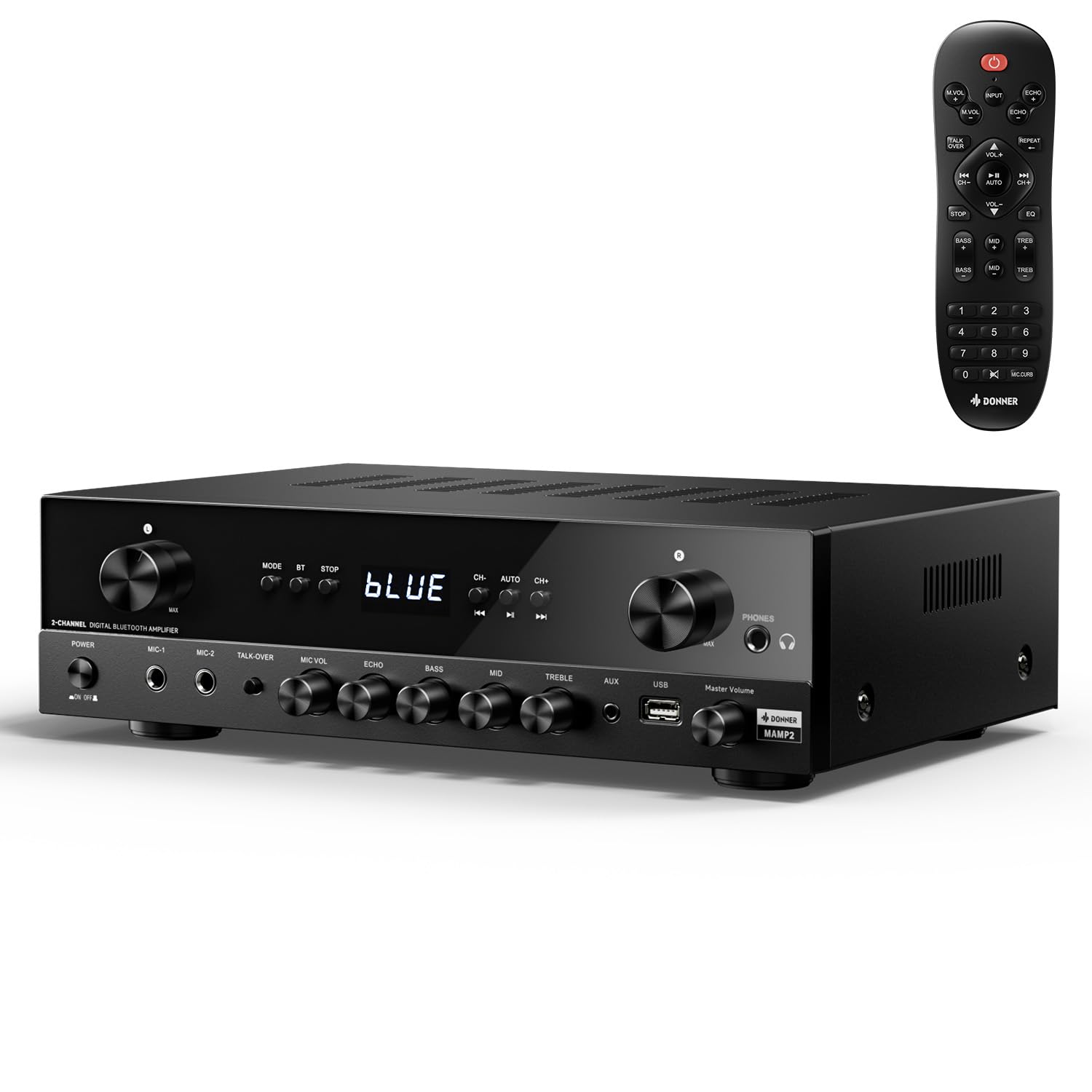
Donner MAMP2

Donner MAMP2

Budget feature-packed

Our Score 8.2/10
Check Price

Worth Noting

  • During quiet music, the cooling fan noise may be noticeable
  • In quiet rooms, a hum or static may be audible, making it unsuitable for critical listening
Tuner
FM
Bluetooth
v5.3
RMS Power
60W x 2 RMS
Streaming
Bluetooth only

The Donner MAMP2 packs an extraordinary range of inputs—phono, optical, coaxial, USB, Bluetooth 5.3, and dual microphone jacks—at a budget-friendly price. However, the audio quality carries an audible noise floor and the cooling fan adds a hum during quiet passages. This makes it a better fit for karaoke sessions, garage workshops, or casual listening where background noise is less critical. For the feature density, the compromises in sonic refinement are expected, but those seeking clean sound for critical music listening should consider mid-range options like the top pick in this set.

Bottom line: This receiver fits best in settings where feature density matters more than audio purity—garage workshops, karaoke parties, or casual background listening.

7

Pyle PDA29BU.5

Pyle PDA29BU.5

Ultra-budget

Our Score 8.4/10
Check Price

Worth Noting

  • Audible hum and static may appear at higher volumes, especially in quiet spaces
  • Power output is overstated; actual amplification is modest
Tuner
FM
Bluetooth
Yes
RMS Power
100W RMS
Streaming
Bluetooth only

The Pyle PDA29BU.5 delivers Bluetooth, FM radio, USB and SD playback in a remarkably small and inexpensive package. It powers a pair of speakers for background music in a garage or outdoor setting without fuss. For the price, it offers basic functionality that works. However, sound quality takes a back seat: audible hum and distortion may surface at higher listening levels, and the claimed power output is optimistic. Anyone looking for clean, detailed music reproduction or pairing with quality speakers will find the audio performance lacking. This is strictly a utility amp for undemanding environments where fidelity is not the goal.

Bottom line: Only consider this if your sole priority is the lowest possible cost for basic amplified audio in a shop, garage, or outdoor area where sound quality doesn't matter.

How to Choose

RMS Power Per Channel

RMS (root mean square) wattage is the honest measure of sustained output. A receiver rated at 100W RMS per channel will drive most bookshelf speakers to room-filling levels without distortion. Peak power claims like 600W are often measured at a single frequency for a split second and don't reflect real-world music.

For a typical living room, 50-100W RMS is sufficient for moderate listening with speakers of 86dB sensitivity or higher. Lower sensitivity speakers (83dB or less) will need more power to reach the same volume. If you plan to host parties or use inefficient speakers, aim for 100W RMS or more.

Phono Input

A built-in phono preamp allows you to connect a turntable directly without an external box. Receivers with a phono input apply the RIAA equalization and gain needed for modern cartridge outputs. Without it, you'll need a separate phono preamp — usually $20 to $100.

If you own a moving magnet (MM) cartridge, any phono input will work. Moving coil (MC) cartridges require a different gain stage, found only in select receivers like the Onkyo TX-8470. Check your cartridge type before buying.

Bluetooth

Bluetooth version affects range and audio quality. Version 4.1 is fine for close-range streaming; v5.0+ offers longer range and better power efficiency. The codec matters more — most receivers support SBC, a few add AAC for iPhones or aptX for Android. None offer high-res codecs like LDAC at this price range.

Bluetooth range can be surprisingly short. The Cambridge AXR100, for example, drops connection beyond 10 feet. If your listening position is far from the receiver, look for models with confirmed 30+ feet range or use a wired connection.

Streaming Capabilities

Wi-Fi streaming provides superior stability and range compared to Bluetooth, and enables multi-room audio with services like MusicCast. Receivers with Wi-Fi can stream directly from Tidal, Deezer, or a NAS drive without needing a phone as a relay.

Bluetooth-only receivers are simpler to set up but are limited to the phone's range and subject to interference. If you plan to stream lossless audio or use high-resolution files, a Wi-Fi network receiver with a built-in DAC is the better choice.

Tuner (FM/AM)

A built-in tuner gives you access to over-the-air radio without an external box. Most receivers offer 30-40 presets for quick station recall. Some use a proprietary antenna connector that limits upgrades — the Sony STRDH190 uses a non-standard port, so you cannot replace the small wire antenna with a standard F-type outdoor antenna.

If you rely on FM for news or music, check the antenna type. Models with a standard coaxial connector let you attach a better antenna for stronger reception. Digital-only receivers (e.g., Onkyo TX-8470, Yamaha R-N800A) skip the tuner entirely, relying on internet radio instead.

Frequently Asked Questions