Audio & Headphones

8 Best Headphone Amplifier of 2026: Real Power & Quiet Background

Which headphone amps actually deliver clean power without hissing with sensitive earphones? This guide separates the quiet performers from the noisemakers.

Many headphone amps claim sky-high power ratings, but that number often comes with an asterisk: a noise floor that hisses with sensitive IEMs or a USB connection that picks up computer hum. The real challenge isn't finding an amp that goes loud — it's finding one that stays quiet while driving your headphones.

This guide cuts through the spec sheet hype to surface the amps that balance real-world output with a clean background, at every price point. We picked a desktop generalist that handles both balanced and single-ended gear, a portable option for on-the-go volume, and a gaming-focused unit with mic input — because the right amp depends on how you listen.

The most overlooked factor? Input reliability. Optical ports and USB connections are common failure points across brands, so we've noted where warranties and return policies matter more than a chip name.

1

FiiO K11

Top Pick
FiiO K11

Desktop high-impedance

Our Score 9.2/10
Check Price

Worth Noting

  • Optical input can be unreliable; some units may not detect or hold a signal with certain sources
Form Factor
Desktop
Output Power
1400mW@32Ω
Input Options
USB, optical, coaxial
Balanced Output
Yes (4.4mm)

The FiiO K11 resolves audio with a level of clarity and separation that turns familiar tracks into new listening experiences. Its DAC handles up to 384kHz/24-bit and DSD256, while the amplifier section supplies 1400mW into 32Ω via the 4.4mm balanced output — enough headroom to drive most high-impedance headphones to their full potential.

In practice, the K11 remains free of audible noise or hiss even with sensitive IEMs, and the all-metal chassis keeps interference at bay. Build quality feels dense and premium; the volume knob turns with a smooth, weighted resistance that inspires confidence for daily desktop use.

This unit is best suited for desktop listeners who want a single device to power headphones from 8Ω to 350Ω without reaching for a separate amp. The optical input can be unreliable in some cases — a known limitation that makes USB-C or coaxial the safer connection path. If you plan to use optical, test it early and verify compatibility with your source.

At a mid-range price, the K11 outclasses many alternatives in its class, offering a balanced output that is often reserved for more expensive gear. It is a straightforward, no-fuss solution for anyone who values sound quality and build over portability or extra features like Bluetooth.

Tip: If you plan to use optical input, test it early and confirm compatibility with your source to avoid surprises.

Bottom line: For desktop listening with high-impedance headphones, the FiiO K11 is the well-rounded pick that avoids common budget DAC tradeoffs without demanding a premium.
2

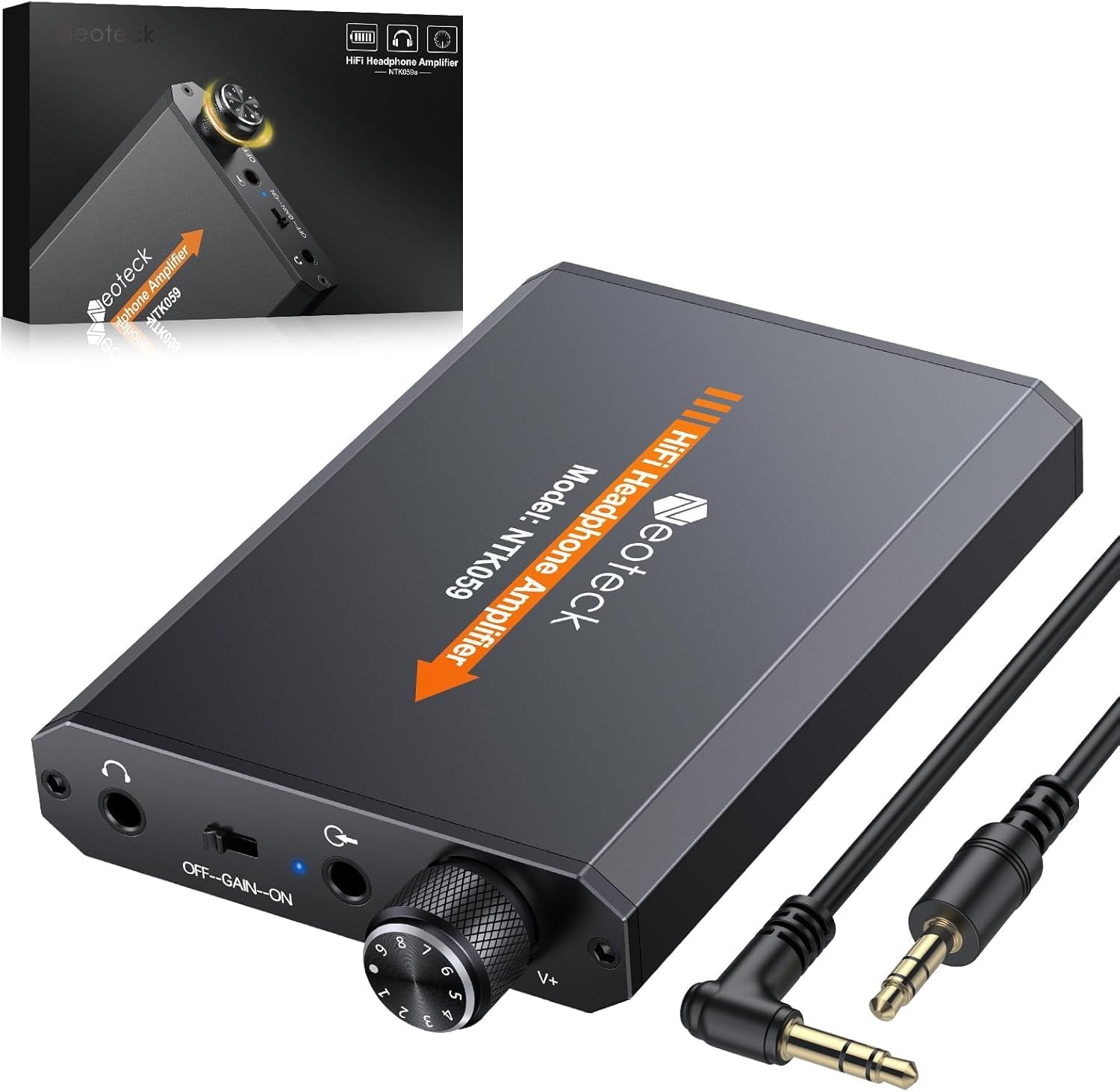
Neoteck Portable Amp

Neoteck Portable Amp

Budget portable boost

Our Score 8.6/10
Check Price

Worth Noting

  • Noise floor is audible with sensitive IEMs or in quiet rooms, showing up as a hiss or buzz.
Form Factor
Portable
Output Power
~120mW@32Ω
Input Options
3.5mm line in
Balanced Output
No

The Neoteck Portable Amp packs a two-stage gain switch and a metal body into a pocket-sized chassis, delivering a straightforward volume increase for headphones that laptops and phones struggle to drive. Its 1500mAh battery supports a full day of casual listening, and the simple controls make it a grab-and-go accessory for portable rigs.

This amp works best paired with moderate-impedance headphones (32–80 ohms) where its noise floor remains unobtrusive. Budget-conscious listeners who need extra headroom for genres like rock or orchestral will find the volume boost effective. However, users with low-impedance, high-sensitivity IEMs will hear a persistent hiss, especially in quiet environments or near fluorescent lighting — better suited for the top pick's cleaner background.

Tip: Keep gain low when using moderately sensitive headphones; high gain increases hiss. For best results, pair with headphones above 32 ohms.

Bottom line: A capable volume booster for the price, but the noise floor limits its appeal for critical listening or quiet settings.

3

Fosi Audio K5 Pro

Fosi Audio K5 Pro

Gaming mic support

Our Score 8.4/10
Check Price

Worth Noting

  • Some units may cease functioning after a few months of use; buying from a seller with a good return policy covers this risk.
Form Factor
Desktop
Output Power
500mW@32Ω
Input Options
USB, optical, coaxial
Balanced Output
No

The K5 Pro targets gamers who want more control than typical budget DAC/amps provide. A 3.5mm mic input and two knobs for bass and treble adjustment let users tailor game audio and voice chat without exiting a game. Setup on PS5 and PC is immediate — no drivers to configure.

The internal DAC improves detail over motherboard audio, with clearer instrument separation and directional cues like footsteps. The bass and treble knobs respond smoothly, offering a quick tonal shift for different games or music.

This unit suits PC and PS5 gamers using headphones under 300Ω who need microphone support and simple tone changes. The known variation in build quality — some units may stop working after several months — means the K5 Pro is best bought from a seller with a flexible return policy.

Tip: Power down the unit when not in use for extended periods to avoid potential power light issues.

Bottom line: For budget-minded gamers who want mic support and tone shaping without driver hassles, the K5 Pro delivers — just make sure you have a return option ready.

4

Fosi Audio ZH3

Fosi Audio ZH3

Balanced desktop system

Our Score 9.2/10
Check Price

Worth Noting

  • Menu navigation without the remote is cumbersome
  • Compact chassis warms up during long listening sessions
Form Factor
Desktop
Output Power
2570mW@32Ω (bal.)
Input Options
USB, optical, coaxial, RCA
Balanced Output
Yes (4.4mm, XLR)

The Fosi Audio ZH3 brings XLR balanced outputs and a swappable op-amp design to the desktop DAC/amp category, pairing an AKM4493SEQ chip with 2570mW into 32Ω balanced. It is a direct step up for audiophiles who want a modular signal path, distinct from the simpler all-in-one approach of the FiiO K11.

This is built for listeners who run balanced headphones and active speakers from a single hub, and who enjoy tinkering with op-amp rolling to tune the sound. The tradeoff comes in daily operation: the front-panel menu system requires the remote for smooth navigation — heavy users should keep it within reach. The chassis does run warm during long sessions, but that is a result of the compact enclosure rather than a functional flaw.

Sound quality is the headline here: stereo imaging is spacious, dynamic range is wide, and power reserves are enough to drive planar headphones without strain. The ability to adjust bass and treble via physical EQ filters, plus six DAC filter options, gives the ZH3 a flexibility that the K11 lacks.

Tip: Stash the remote next to your listening position — menu navigation is much smoother with it.

Bottom line: If your system relies on XLR balanced outputs and you want the flexibility to experiment with op-amps, the ZH3 is the focused choice — the K11 is simpler, but the ZH3 gives you the modularity.

5

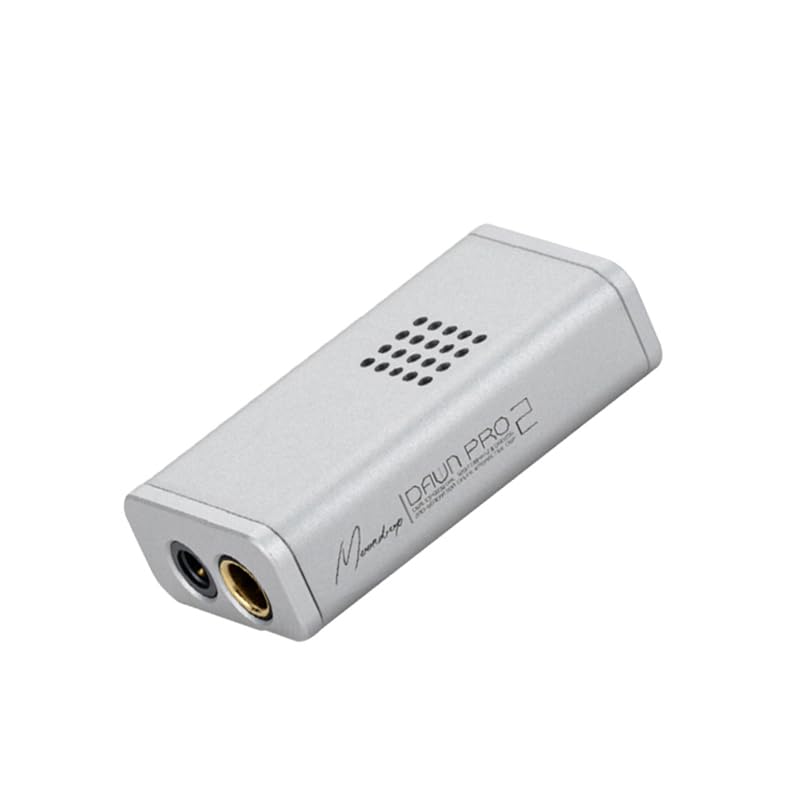
Moondrop Dawn Pro 2

Moondrop Dawn Pro 2

Mobile app EQ

Our Score 9.0/10
Check Price

Worth Noting

  • Buttons may develop double-click or cutout issues if the unit is jostled daily
Form Factor
Dongle
Output Power
124mW@32Ω (bal.)
Input Options
USB-C only
Balanced Output
Yes (4.4mm)

The Moondrop Dawn Pro 2 is an ultra-compact dongle that pairs dual CS43198 DACs with a smartphone app offering a full parametric EQ — a level of tuning flexibility not found in basic volume-boost dongles. Clean, detailed output makes it a clear step up from standard phone headphone jacks, especially with sensitive in-ear monitors.

This is a good fit for mobile listeners who enjoy tweaking frequency response curves and want a portable upgrade without carrying a desktop amp. The 124mW balanced output handles most IEMs and low-impedance headphones easily, but high-impedance over-ears will need more power. The flip side is build quality: the buttons can feel flimsy, and some units have exhibited audio cutouts or double-click behavior — less of a concern if the dongle stays on a desk or in a padded bag rather than rattling around in a pocket or backpack.

Sound presentation is open and airy with good separation, and the app’s parametric EQ gives precise control beyond simple bass/treble knobs. Power is sufficient for its intended use, but the lack of analog inputs or a battery means it draws power from the source device — fine for phones and laptops, though some older phones may see faster battery drain.

Tip: Keep the Dawn Pro 2 in a desk drawer or laptop bag pocket rather than loose in a pocket to avoid button strain and possible cutout issues.

Bottom line: For listeners who want a tunable portable DAC/amp with clean output for IEMs and aren’t rough on their gear, the Dawn Pro 2 delivers app-controlled EQ in a tiny package.

6

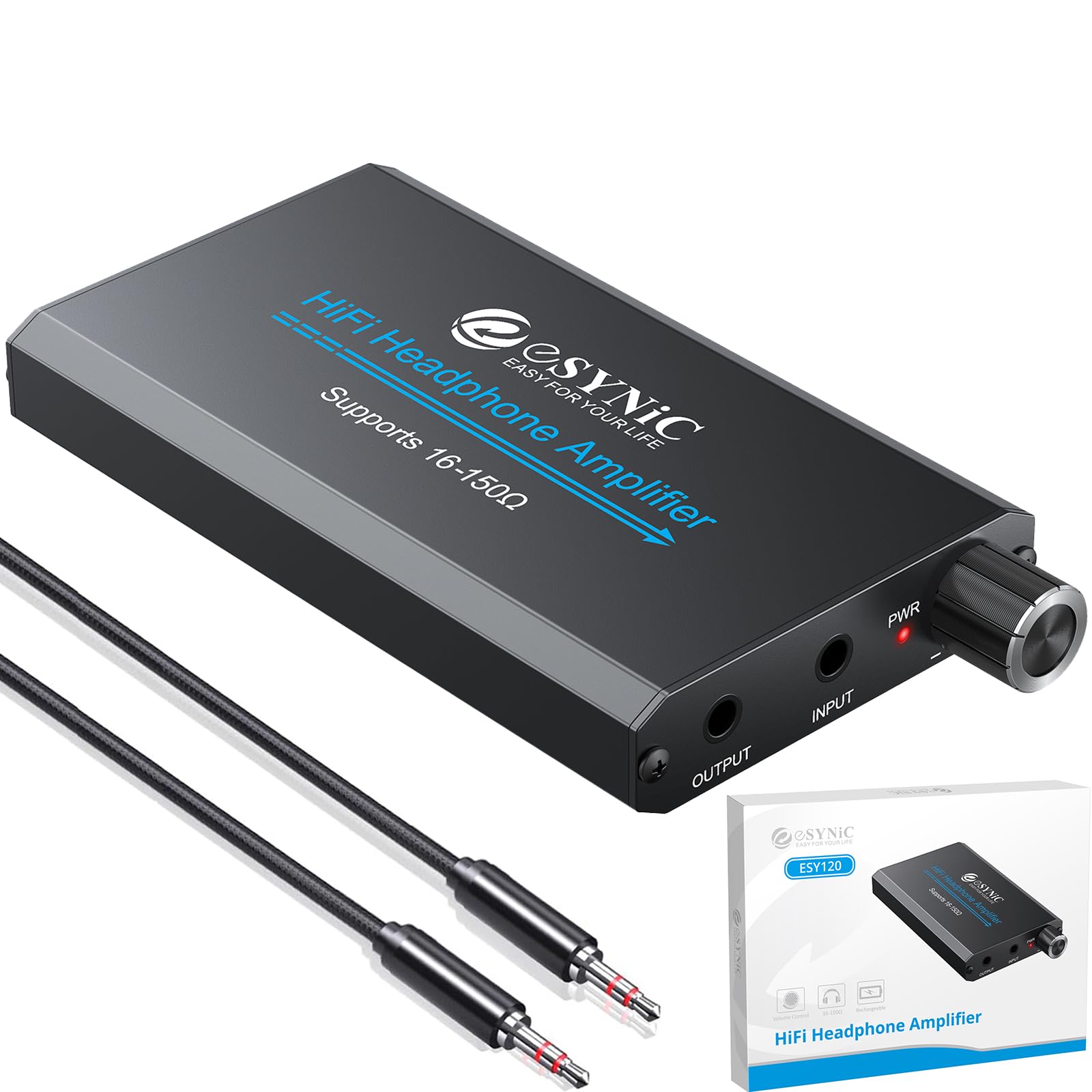
eSynic Portable Amp

eSynic Portable Amp

Ultra-budget portable

Our Score 8.8/10
Check Price

Worth Noting

  • Battery runtime can be 4-5 hours in real-world portable sessions, not the advertised 8.
  • Charging cable uses mini-USB instead of the more common USB-C.
Form Factor
Portable
Output Power
30mW@150Ω
Input Options
3.5mm only
Balanced Output
No

For listeners needing extra power for lower-impedance headphones, this amp provides a clear volume increase with a sturdy metal build. Battery life may run 4-5 hours rather than the advertised eight, and charging uses an outdated mini-USB port. These cost-cutting measures, along with fewer features than the Neoteck, make it a secondary choice for portable use.

Bottom line: This amp suits budget-focused buyers who need a simple volume boost for shorter listening sessions and can accept the older connector and variable battery life.

7

Douk Audio U3

Douk Audio U3

DIY op-amp rolling

Our Score 8.8/10
Check Price

Worth Noting

  • In quiet listening spaces, a hum may be audible without a high-quality power supply.
  • Sound clarity can vary between units, with occasional reports of distortion or a high-pitched noise.
Form Factor
Desktop (mini)
Output Power
1300mW claimed
Input Options
RCA
Balanced Output
No

This mini amp delivers strong power for high-impedance headphones and encourages tinkering with its socketed op-amp. Noise and sound consistency, however, depend on the power supply used; a clean adapter is needed to avoid hum. A newer variant claims even higher power but has limited user feedback to confirm real-world performance.

Tip: Using a linear power supply or a high-quality wall adapter can reduce hum.

Bottom line: Best suited for DIY tinkerers who enjoy op-amp rolling and have a clean power supply; less ideal for straightforward desktop listening.

8

Douk Audio U3 PRO

Douk Audio U3 PRO

High power budget

Our Score 9.0/10
Check Price

Worth Noting

  • No built-in DAC
  • Single-ended output only; no balanced connectivity for listeners who prefer it.
Form Factor
Desktop (mini)
Output Power
1500mW@32Ω
Input Options
RCA, 3.5mm aux
Balanced Output
No

The Douk Audio U3 PRO offers an attractive combination of high power and op-amp rolling capability at a budget price. Its 1500mW output into 32Ω can drive most headphones, and the replaceable op-amps invite DIY tuning. However, the amp lacks a built-in DAC, so you must pair it with an external source. More importantly, real-world performance and long-term reliability are not widely documented, making it a speculative choice compared to the established original U3 or other well-reviewed budget amps. This is best suited for tinkerers who are willing to accept some uncertainty in exchange for potential value.

Bottom line: Buy this if you are a DIY enthusiast comfortable with some unknowns and want to experiment with op-amp rolling on a budget. Otherwise, stick with the original U3 or a verified alternative.

How to Choose

Output Power

Output power (measured in milliwatts at a given impedance) determines how loud your headphones can go. A rule of thumb: 100mW into 32 ohms is enough for most portable headphones, but high-impedance cans like the Sennheiser HD 600 (300 ohms) need 500mW or more to reach satisfying levels without clipping.

The catch: many budget amps list peak power with high distortion levels. Real-world clean output is often 30-50% lower. Look for specs that state THD+N under 0.01%, and check user reports on how the amp handles your specific headphone impedance.

Balanced vs. Single-Ended

A balanced output (usually 4.4mm or XLR) doubles the voltage swing and separates ground from signal, reducing crosstalk and common-mode noise. In practice, this means lower noise floor and more headroom — especially useful with high-impedance or planar magnetic headphones.

But balanced only matters if your headphones have a balanced cable. For most budget IEMs, single-ended is fine. The real benefit in desktop setups is eliminating ground-loop hum from connected devices. If you run multiple USB-powered gear, a balanced amp can be a noise-fix shortcut.

Input Options

USB is universal, but optical and coaxial inputs let you connect CD players, game consoles, or TV audio without relying on the computer's potentially noisy USB power. However, optical inputs are a common failure point across brands — some units arrive dead or die within weeks.

If you depend on optical, buy from a retailer with a hassle-free return policy. Bluetooth is a growing addition but adds latency and compression; only consider it for casual listening, not competitive gaming or critical audio work.

DAC Chip Type

The DAC chip (ESS, AKM, or R2R) influences sound signature but matters less than implementation. ESS chips tend to be detailed and neutral, AKM offers slightly warmer tonality, and R2R (resistor ladder) gives an analog-like smoothness with subtle bass roll-off.

For most buyers, the difference is marginal compared to the amplifier stage and power supply quality. Chasing chip names without considering the overall circuit design leads to spending more for minimal audible gain.

Form Factor

Desktop amps plug into a wall outlet and offer higher power and cleaner sound, but lock you to a desk. Portable amps run on internal batteries and trade power for convenience. USB dongles sit between — small enough for mobile use but limited in output.

A hidden trade-off: USB-powered desktop amps inherit noise from the computer's ground, which can manifest as a whine or hiss. A dedicated wall adapter or a powered USB hub often solves this. If you value absolute silence at medium volume, a desktop amp with an external power supply is safer.

Frequently Asked Questions