PC Components & Storage

7 Best NVMe SSDs of 2026: Gen4 Performance for Every Build

Best NVMe SSDs: Find the drive that matches your gaming or work needs without overpaying for speeds you won't notice.

Many shoppers assume the newest PCIe 5.0 drives are the only way to get fast storage. For most gaming and productivity tasks, Gen4 drives deliver nearly identical load times at a fraction of the cost. The real difference shows in sustained writes and heavy workloads where Gen5 pulls ahead.

Reliability matters more than peak speeds. Some budget drives claim high read numbers but use slower NAND that heats up under load, causing throttling. The best NVMe SSD for your build stays cool, lasts years, and matches your system's PCIe generation without overpaying for unused bandwidth.

This guide focuses on drives that balance speed, endurance, and value – from top-tier Gen4 options to budget-friendly alternatives for every use case, whether gaming, workstation, or handheld expansion.

1

WD_BLACK SN850X 1TB

Top Pick
WD_BLACK SN850X 1TB

High-end gaming

Our Score 9.6/10
Check Price

Worth Noting

  • Compatibility with older motherboards may require a BIOS update to detect the drive
  • Firmware updates can, in rare cases, lead to data corruption if interrupted
Capacity
1 TB
Interface
PCIe 4.0 x4
Read/Write Speeds
7300/6300 MB/s

The WD_BLACK SN850X delivers sequential read speeds up to 7,300 MB/s, placing it among the fastest Gen4 drives available. The included WD_BLACK Dashboard with Game Mode 2.0 provides real-time performance tweaks and game profile optimization, giving it an edge over drives that rely solely on raw hardware.

With a large install base across gaming and workstation builds, the SN850X maintains consistent performance under sustained loads. The drive's NAND and controller design handle heavy write workloads without significant throttling, though thermal management benefits from motherboard heatsinks for prolonged transfers.

This drive targets builders of high-end gaming PCs and professional workstations who want maximum Gen4 throughput and software support. It suits users comfortable with PCIe 4.0 motherboards; compatibility with older boards may require a BIOS update. The rare possibility of firmware-related data loss means backups are prudent – a standard practice for any primary drive.

The SN850X's combination of raw speed, software ecosystem, and wide user adoption makes it a strong candidate for anyone building a new Gen4 system. For those willing to pay extra for features like Game Mode 2.0 and high endurance, it outperforms many similarly priced competitors.

Tip: Confirm your motherboard supports PCIe 4.0 and check for BIOS updates before installation to avoid detection issues.

Bottom line: The SN850X is the right pick for gamers and professionals building new PCIe 4.0 systems who prioritize speed and software features over lower cost.
2

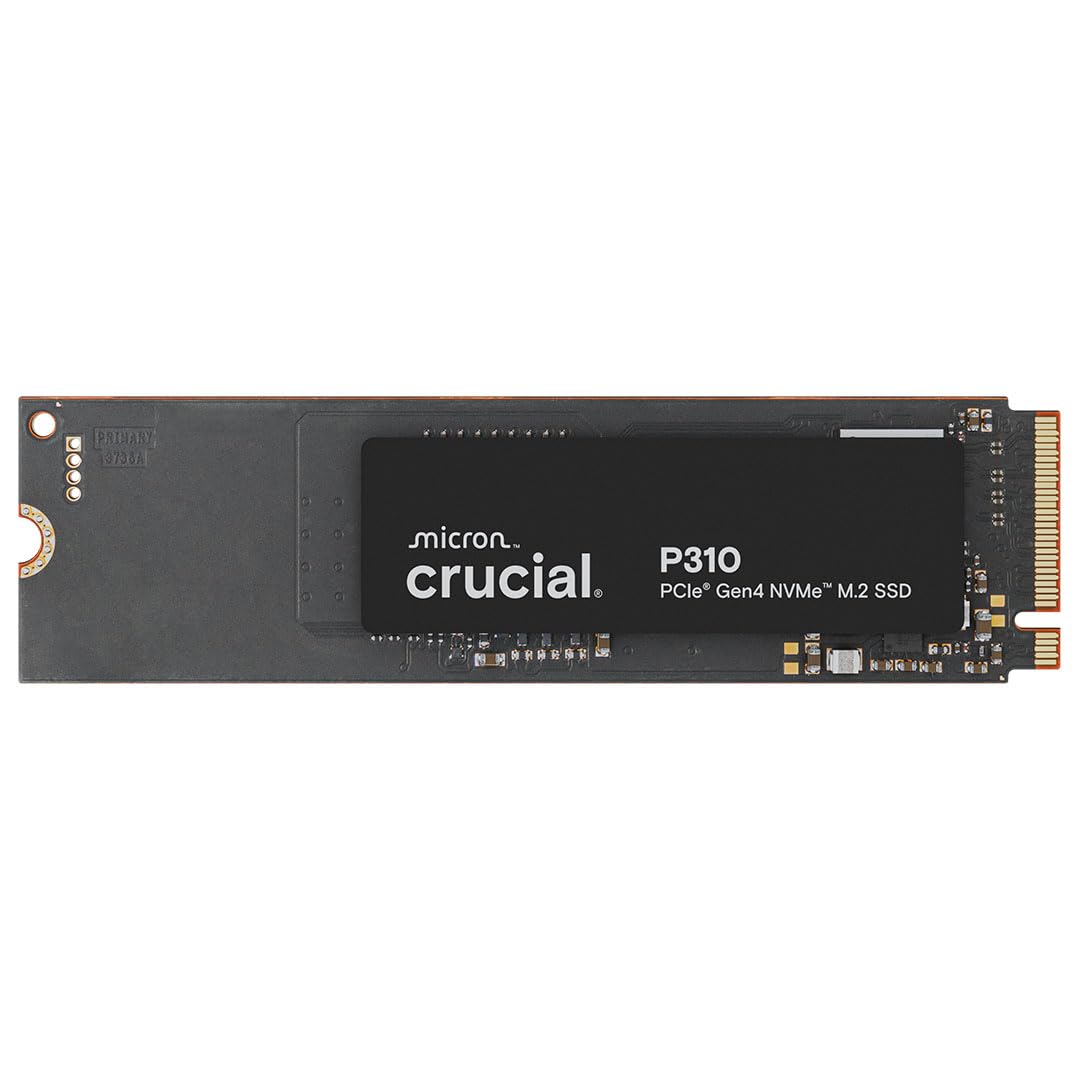
Crucial P310 1TB

Crucial P310 1TB

Casual gamers

Our Score 9.6/10
Check Price

Worth Noting

  • Write speeds (6000MB/s) lag behind premium Gen4 drives
  • A minority of units have stopped functioning within months of installation; backups are advisable
Capacity
1 TB
Interface
PCIe 4.0 x4
Read/Write Speeds
7100/6000 MB/s

The Crucial P310 delivers Gen4 read speeds close to top-tier drives at a significantly lower price point. Sequential reads hit 7100MB/s, matching premium options for game loading and everyday application launch times. Write speeds cap at 6000MB/s – slightly behind the fastest Gen4 drives – but for typical gaming and home use, that gap rarely matters. Most buyers see a clear performance uplift without paying flagship prices.

This SSD suits anyone upgrading a laptop, desktop, or handheld console (like the Steam Deck or ROG Ally) where read-heavy workloads dominate. The lower write speed only becomes a bottleneck during sustained large file transfers or heavy creative exports. A small number of units have become unusable within months of installation, so keeping backups of essential data is prudent – though the vast majority run without issues.

Installation is plug-and-play: the M.2 2280 form factor fits most modern boards, and the drive is automatically recognized by Windows, macOS, and Linux without additional drivers. The lack of an included heatsink means it runs warm under sustained load, but typical gaming sessions stay within safe limits.

Tip: Keep regular backups of important files – while most units run without issue, a small number have stopped working early, so a secondary backup drive or cloud storage adds peace of mind.

Bottom line: A cost-effective Gen4 upgrade that handles gaming and daily tasks well – just don’t rely on it for peak write performance or critical data without a backup plan.

3

Samsung 9100 PRO 1TB

Samsung 9100 PRO 1TB

Gen5 enthusiasts

Our Score 9.6/10
Check Price

Worth Noting

  • Price per gigabyte is notably higher than typical Gen4 drives, especially at the 1TB capacity.
  • Under sustained writes, the drive can throttle if the motherboard's M.2 heatsink is inadequate.
  • Without a PCIe 5.0 motherboard, the drive operates at Gen4 speeds, reducing the value of its Gen5 speed advantage.
Capacity
1 TB
Interface
PCIe 5.0 x4
Read/Write Speeds
14700/13300 MB/s

The 9100 PRO delivers sequential read speeds up to 14,700MB/s—more than double the bandwidth of current Gen4 drives—making large project file transfers and real-time 8K video editing noticeably snappier. This places it ahead of the Gen4-based top pick for specific workstation tasks, but only if your system supports PCIe 5.0.

To maintain those speeds under heavy loads, the drive requires robust cooling. Users with high-end motherboard heatsinks or active fans report consistent performance; those using stock laptop slots may see thermal throttling during extended writes.

This drive targets early adopters building a new Gen5 PC for AI training, video production, or data analysis. The high cost per gigabyte and cooling demands mean it is overkill for gaming or routine storage upgrades where a Gen4 drive would suffice.

Tip: Install the drive under a thick thermal pad or use a third-party M.2 active cooler to avoid thermal throttling.

Bottom line: An early Gen5 performance leader for professionals with the right motherboard and cooling setup.

4

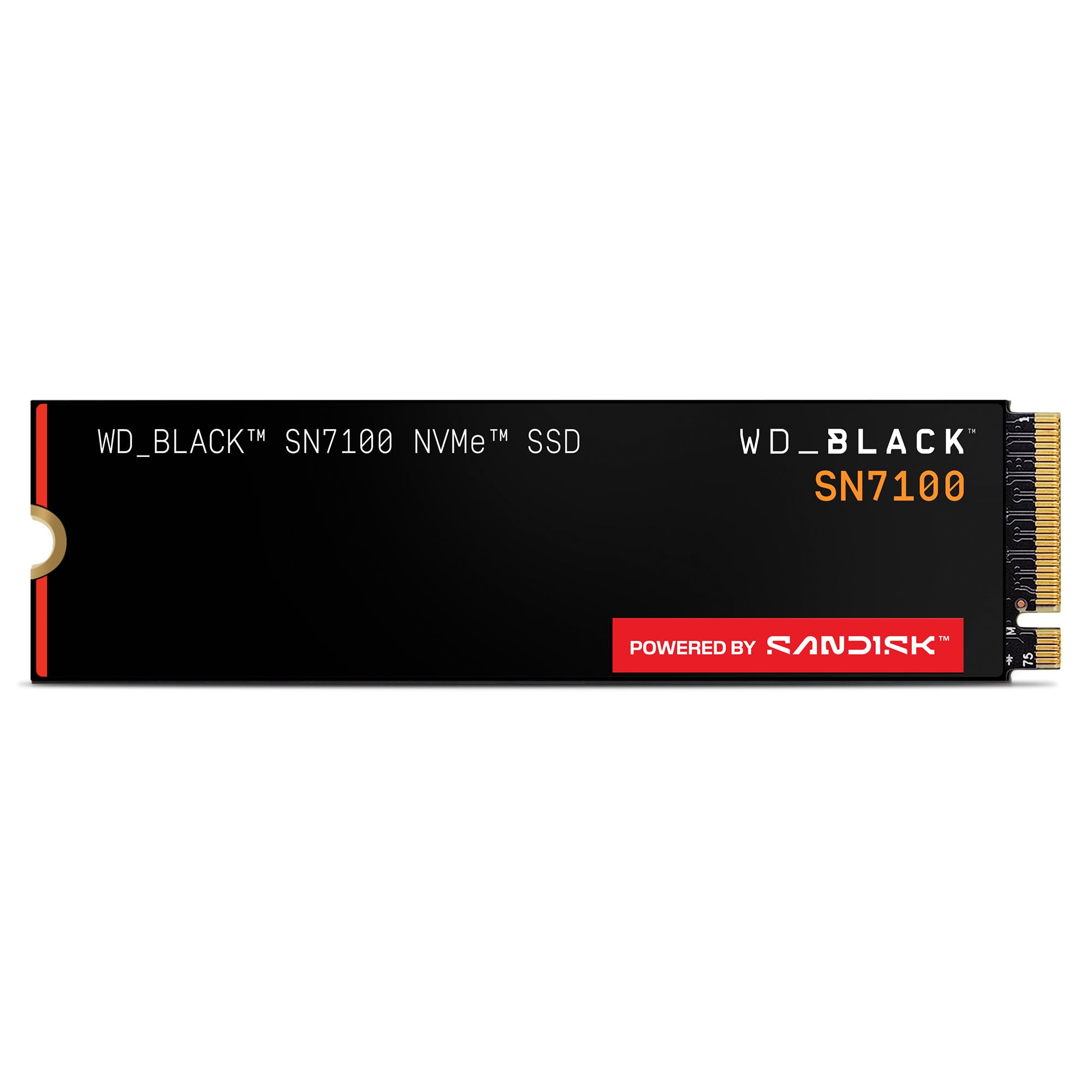
WD_Black SN7100 2TB

WD_Black SN7100 2TB

Large capacity gaming

Our Score 9.4/10
Check Price

Worth Noting

  • Some units may stop functioning prematurely, so regular backups are wise.
Capacity
2 TB
Interface
PCIe 4.0 x4
Read/Write Speeds
7250/6900 MB/s

The SN7100 packs 2TB of storage into a power-efficient Gen4 package that runs cooler than many competitors, making it a strong match for portable systems where thermal headroom and battery life matter. While the SN850X leads in peak sequential speeds and software features, the SN7100 offers double the capacity at a similar price, and its power efficiency is a clear advantage for notebooks and devices like the Steam Deck.

This drive suits gamers upgrading laptops or handhelds who need fast storage without draining the battery or adding excessive heat. Under sustained heavy write workloads, heat can build up — adding a heatsink helps keep performance consistent in those scenarios.

Tip: For sustained heavy writes (e.g., video editing), a heatsink is recommended to keep temperatures in check.

Bottom line: A smart pick for portable gamers who value capacity and efficiency over pure speed.

5

Samsung 990 PRO 2TB

Samsung 990 PRO 2TB

High-end gaming

Our Score 9.6/10
Check Price

Worth Noting

  • Premium pricing
  • Not ideal for systems that only need 1TB or less
  • Some units may run warmer under sustained writes compared to competitors.
Capacity
2 TB
Interface
PCIe 4.0 x4
Read/Write Speeds
7450/6900 MB/s

The Samsung 990 PRO matches the top-pick WD_BLACK SN850X for sequential read/write speeds while adding a 2TB capacity and a controller design with notably low failure rates. The premium price reflects that added durability and the Samsung Magician software — a capable toolset for drive management.

This drive suits high-end gaming rigs and creative workstations where sustained write performance and data integrity take priority over cost. If your system needs 2TB of fast storage and you intend to keep it for years, the 990 PRO is a sound investment. For budgets that can't stretch to the premium, the SN850X offers comparable speed at a lower price.

Under sustained load, the 990 PRO maintains its rated speeds thanks to Dynamic Thermal Guard and a nickel-coated controller that dissipates heat effectively. Samsung Magician allows easy firmware updates and health checks. Some units may run warmer than competing drives under heavy use, but the temperature stays within safe limits.

Bottom line: If your priority is long-term durability and you need 2TB, the 990 PRO is the Gen4 drive to buy. For most others, the SN850X offers comparable speed at a lower price.

6

BIWIN NV7400 1TB

BIWIN NV7400 1TB

Budget gamers

Our Score 9.4/10
Check Price

Worth Noting

Capacity
1 TB
Interface
PCIe 4.0 x4
Read/Write Speeds
7450/6500 MB/s

The BIWIN NV7400 achieves read speeds up to 7450 MB/s and writes up to 6500 MB/s, placing it alongside premium Gen4 drives at a fraction of the cost. For game loading, file transfers, and everyday tasks, this drive keeps pace with far more expensive alternatives. Its short market presence means endurance data is sparse; for a primary OS drive in a mission-critical build, a model with a longer field history is a safer bet. As secondary storage or for budget-minded gamers who prioritize raw performance, the NV7400 offers exceptional speed per dollar.

Bottom line: Best suited as a high-speed secondary drive or for budget-conscious gamers who want Gen4 speed without the premium price.

7

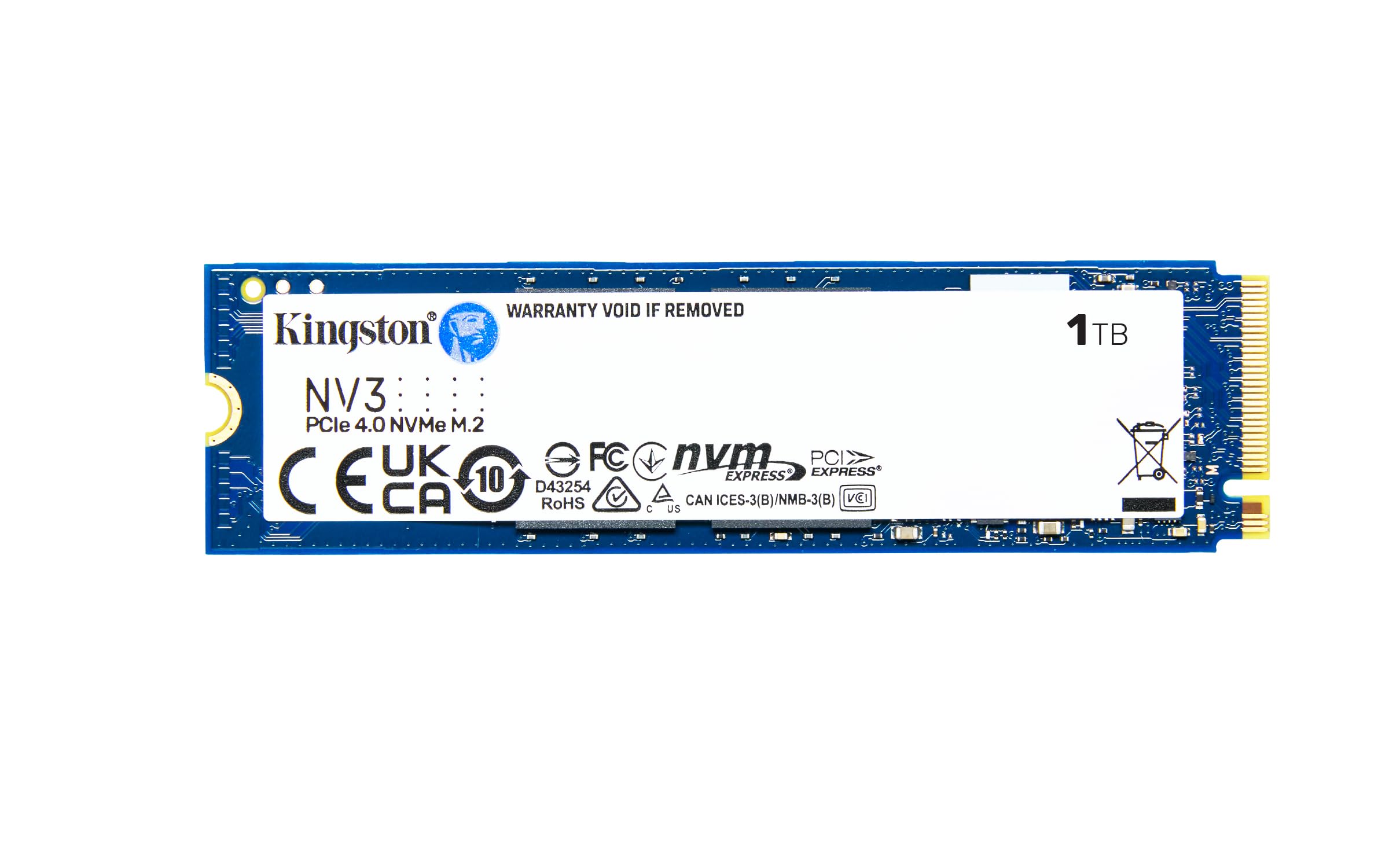
Kingston NV3 1TB

Kingston NV3 1TB

Extreme budget

Our Score 9.4/10
Check Price

Worth Noting

  • Some units may experience reduced lifespan under sustained use
  • Compatibility with certain systems, including PS5, is not guaranteed
Capacity
1 TB
Interface
PCIe 4.0 x4
Read/Write Speeds
6000/4000 MB/s

The Kingston NV3 delivers genuine Gen4 read speeds at the lowest price in its class, making it tempting for extreme budget builds. Durability is limited — some units show reduced lifespan under sustained load — and compatibility can be inconsistent across motherboards. It is not a candidate for primary OS or PS5. For secondary storage of games and non-critical files, its low cost is a fair trade for the higher risk.

Bottom line: A viable choice for ultra-budget secondary storage, provided data backups are maintained and the drive is not used for critical workloads.

How to Choose

Sequential Read/Write Speeds

Read speed determines how fast games and applications launch. Write speed matters when transferring large files like video projects. Most users are bottlenecked by random I/O in everyday use, not sequential throughput. For gaming, read speeds above 5000 MB/s offer diminishing returns; a 7300 MB/s drive won't launch Windows noticeably faster than a 6000 MB/s one. Focus on write speed only if you regularly move big datasets.

Interface Generation

PCIe 4.0 is the sweet spot for 2026: it saturates current game load times and is backward compatible with PCIe 3.0 slots (though at reduced speeds). PCIe 5.0 doubles bandwidth but demands a compatible motherboard and active cooling to avoid throttling. If your system lacks Gen5 support, a Gen4 drive is the most cost-effective choice. Only invest in Gen5 if you plan to upgrade your platform and work with AI or 8K video.

Capacity

Modern AAA games exceed 100 GB each, so a 1TB drive fills quickly. For a boot drive plus a few titles, 1TB suffices. For a game library without constant uninstalling, 2TB is the practical minimum. Higher capacities cost more per GB but reduce the hassle of managing space. If your budget allows, stepping up to 2TB on a reliable Gen4 drive is a better long-term investment than a smaller Gen5 drive.

Endurance & Warranty

Endurance is measured in TBW (terabytes written). A 1TB drive rated for 600 TBW can handle writing 1TB daily for over 1.5 years. For a boot drive with light use, even 300 TBW is fine. For heavy write workloads (video editing, databases), look for 600+ TBW. Warranty length often correlates with expected lifespan: 5-year warranties are standard on premium drives, while budget models may offer only 3 years. Shorter warranties and lower TBW increase the risk of premature failure.

Thermal Management

NVMe SSDs throttle performance when they exceed their temperature limits, typically around 80°C. Gen4 drives often produce enough heat to benefit from a heatsink, especially in laptops or compact cases with limited airflow. Some drives (like the WD_BLACK SN7100) are designed to run cool without one, while others (like the Samsung 9100 PRO) require active cooling. In a desktop, a motherboard heatsink is usually sufficient. In a handheld or slim laptop, prioritize a low-heat drive to avoid random slowdowns during long sessions.

Frequently Asked Questions