Tools & DIY

10 Best Multimeter of 2026: Which Budget Meters Match Pro Performance

Find a reliable multimeter for DIY, home, and automotive tasks without spending pro money. We spotlight meters that stay accurate and durable, even under $40.

A multimeter that looks professional on paper can leave you stranded when a repair job goes sideways. Many budget-friendly options boast impressive specs but falter on accuracy or simply stop working a few weeks after the return window closes.

The good news: you don’t need to spend $250 to get a meter you can trust. By understanding a few key specs — like safety ratings, True RMS, and whether AC current measurement matters for your tasks — you can avoid the unreliable clones and find a meter that performs.

This guide highlights the features that actually predict long-term durability and consistent readings, so you can pick the right tool for your specific projects without guesswork.

1

KAIWEETS HT118A

Top Pick
KAIWEETS HT118A

Automotive & home diagnostics

Our Score 9.2/10
Check Price

Worth Noting

  • Some units may stop working within the first few months of use.
True RMS
Yes
Auto‑Ranging
Auto‑Ranging
Display & Counts
6000-count, backlight
Current Measurement
AC/DC

With a 6000-count display, true RMS, and CAT IV 600V certification, the HT118A brings safety and precision that rival meters costing significantly more. It measures capacitance, frequency, and temperature (probe included), adds non-contact voltage detection and a built-in flashlight, and its voltage and resistance readings stay consistently close to reference meters. Overload protection on all ranges and dual ceramic fuses back up the certifications. Some units may stop working within the first few months, but the generous 36-month warranty provides a long safety net.

DIYers, hobbyists, and automotive users who want a full-featured meter without a professional Fluke price will find the HT118A hits the sweet spot. The feature set covers everything from home wiring to parasitic draw checks, and the high safety rating lets you work confidently on residential and vehicle circuits. The possibility of an early defect makes it less suitable for someone who cannot tolerate a return or exchange, but for non-critical tasks the warranty absorbs that risk — and the capability per dollar remains hard to match.

Bottom line: For DIYers and automotive hobbyists who want pro-level safety and a full feature set at a mid-range price, the HT118A is the stand-out pick — just keep the warranty in mind and consider a backup meter if a defect would stall your project.

2

AstroAI 6000

AstroAI 6000

Hands-free bench work

Our Score 9.2/10
Check Price

Worth Noting

  • The plastic case and kickstand feel less robust than premium-brand equivalents; the stand may be stiff and fiddly.
True RMS
Yes
Auto‑Ranging
Auto‑Ranging
Display & Counts
6000-count, backlight
Current Measurement
AC/DC

The AstroAI 6000 sets itself apart with a magnetic strap that sticks to any ferrous surface, freeing your hands while you probe — a convenience the top pick lacks. It delivers true RMS, auto-ranging, capacitance, and temperature measurement at a mid-range price, giving hobbyists pro-level functions without the pro-level cost.

This meter suits DIY electronics and automotive hobbyists who work at a bench or under a hood and want accurate readings without a premium. Build quality doesn't feel as durable as higher-end brands, and the kickstand can be fiddly, but for indoor environments where drops are rare, the magnetic convenience and value outweigh the tradeoff.

Tip: The rear kickstand is stiff out of the box; gently exercise it a few times to loosen it without snapping.

Bottom line: For bench work or under-hood diagnostics where the magnetic strap gets used daily and rough handling is minimal, the AstroAI 6000 packs a full set of measurement functions at a price that leaves room for a second accessory.

3

Fluke 115

Fluke 115

Field service & pro use

Our Score 9.6/10
Check Price

Worth Noting

  • The premium price can be hard to justify for light home use.
True RMS
Yes
Auto‑Ranging
Auto‑Ranging
Display & Counts
6000-count
Current Measurement
AC/DC

Unlike the pocket-sized Fluke 101, which is a secondary meter for quick checks, the 115 is a full-function workhorse with true RMS, 6000-count resolution, and every essential measurement — voltage, current, resistance, frequency, capacitance, diode. This tank-like precision is built for field service techs and electricians who need lab-grade repeatability and a tool that withstands daily abuse. Its premium price, however, puts it out of reach for casual DIY users; if you only need to confirm outlet voltage or test batteries, a less expensive meter will serve you fine.

Bottom line: For professionals and advanced hobbyists who demand consistent accuracy and decades of use, the Fluke 115 justifies its cost; it's overkill for occasional household checks.

4

Klein MM325

Klein MM325

Rugged DIY durability

Our Score 9.4/10
Check Price

Worth Noting

  • Manual ranging requires dialing in the range yourself, which is slower than auto‑ranging.
True RMS
No
Auto‑Ranging
Manual‑Ranging
Display & Counts
Current Measurement
DC only

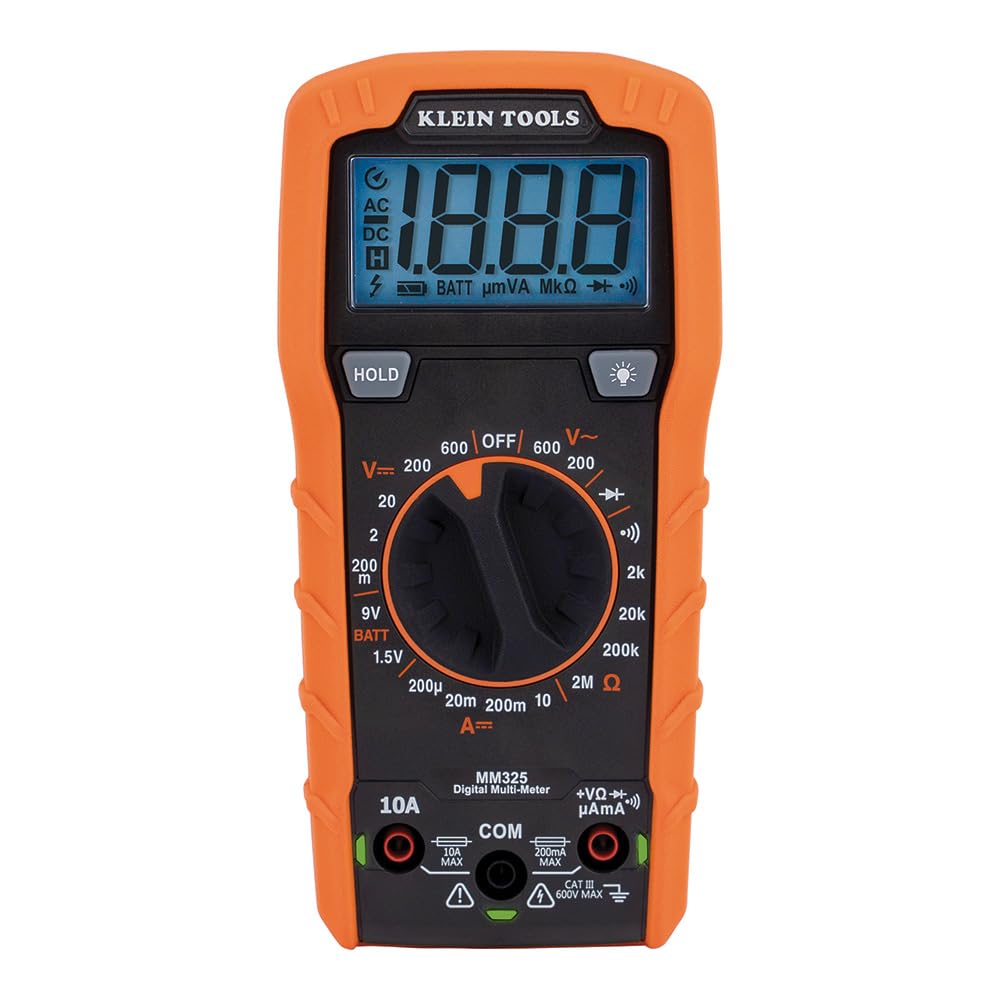
Where auto-ranging models chase tap-and-go convenience, the MM325 builds on drop-rated resilience and deliberate manual control. A 6.6‑foot drop rating, lead‑alert LEDs, and a kickstand for ladders or crawlspaces separate it from the typical budget meter. Dedicated 1.5V, 9V, and 12V battery test modes load-test cells, offering an honesty a simple voltage readout can't match. Manual ranging means you select the range before measuring — slower, but predictable. This suits homeowners who value physical toughness and don't mind a hands‑on workflow, provided they know their expected voltages.

Tip: Knowing the approximate voltage before you start speeds up manual range selection.

Bottom line: A rugged, no‑nonsense manual‑ranging meter that will last for years, ideal for users who value durability over automatic convenience.

5

KAIWEETS KM100

KAIWEETS KM100

Basic budget checks

Our Score 9.0/10
Check Price

Worth Noting

  • Voltage readings may be slightly off on some units, reducing suitability for precision diagnostics.
  • Cannot measure AC current
True RMS
No
Auto‑Ranging
Manual‑Ranging
Display & Counts
Backlight, 2000-count
Current Measurement
DC only

The KAIWEETS KM100 intentionally omits true RMS, temperature measurement, and auto-ranging to reach a price where a basic meter becomes a low-risk purchase. You still get a backlit display and a protective carry case, making it convenient to grab for quick checks around the house.

The lack of AC current measurement limits its scope to DC tasks and continuity. Accuracy can drift slightly on some units, so it is not suited for precision work. For testing batteries, fuses, and light switches, those tradeoffs are easy to accept — this is a meter for the occasional user who just needs to know if something is on or off, not for diagnostic analysis.

Bottom line: The KM100 fits those who need a cheap, simple checker for batteries, fuses, and basic DC circuits, and nothing more.

6

Fluke 101

Fluke 101

Pocket quick checks

Our Score 9.4/10
Check Price

Worth Noting

  • Current measurement is entirely absent; handles only voltage, resistance, and continuity.
True RMS
No
Auto‑Ranging
Auto‑Ranging
Display & Counts
Current Measurement
No current

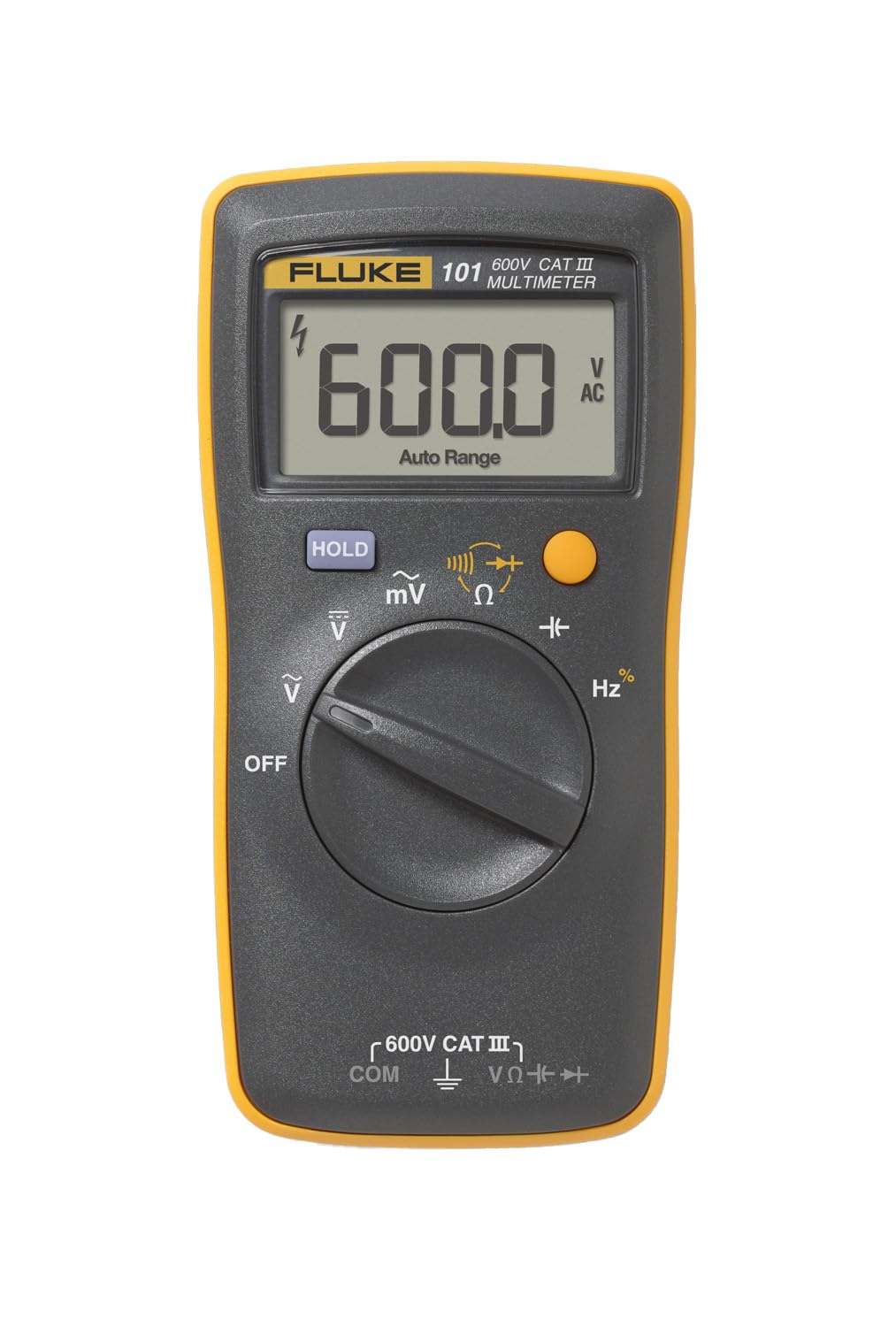
The Fluke 101 packs the brand's accuracy and CAT III 600V safety into a 160g meter that fits in a pocket. Auto-ranging simplifies quick voltage and continuity checks. It cannot measure current, so it suits technicians needing a go-anywhere voltage checker and homeowners wanting professional-grade assurance for outlets—but it won't serve as a primary multimeter for fuse testing or parasitic draw.

Tip: Use the Fluke 101 alongside a clamp meter or a full-function multimeter; it excels as a go-anywhere voltage companion.

Bottom line: For quick checks and portability, it's a flawless secondary meter. Pair it with a full-function multimeter for any job that needs current readings.

7

TESMEN TM‑510

TESMEN TM‑510

Simple voltage checks

Our Score 9.2/10
Check Price

Worth Noting

True RMS
No
Auto‑Ranging
Auto‑Ranging
Display & Counts
4000-count
Current Measurement
No current

The TM-510's smart auto mode automatically selects voltage or resistance, making quick battery and outlet checks foolproof for non-technical users. Compact with a carry case, it lives easily in a glovebox. But it cannot measure current, excluding any automotive diagnostics or circuit troubleshooting. For simple voltage and continuity tasks, it's a low-cost, foolproof option.

Bottom line: For basic battery, outlet, and continuity checks, the auto mode makes the TM-510 the simplest meter to use. If your Saturday projects ever involve current — like testing a car's parasitic draw — look for a meter that can handle amps.

8

Crenova MS8233D

Crenova MS8233D

Hobby electronics tinkering

Our Score 9.2/10
Check Price

Worth Noting

  • Accuracy can be slightly off on individual units, limiting its use to non-critical hobby work.
True RMS
No
Auto‑Ranging
Auto‑Ranging
Display & Counts
6000-count
Current Measurement
AC/DC

The MS8233D packs functions like temperature, capacitance, frequency, and non-contact voltage detection that are rare at this price. A carry case and extra leads round out a ready-to-tinker kit. Accuracy can vary between units, so it's best suited to breadboard projects and household checks, not lab-grade measurements.

Bottom line: A sensible budget choice for hobbyists who need temperature, capacitance, and frequency at a low cost, provided they don't require precision readings.

9

AstroAI DM130B

AstroAI DM130B

Battery testing

Our Score 9.2/10
Check Price

Worth Noting

  • Probe leads and clips may feel average and can exhibit occasional defects such as exposed wiring.
True RMS
No
Auto‑Ranging
Auto‑Ranging
Display & Counts
2000-count
Current Measurement
AC/DC

The DM130B's auto-ranging and its built-in battery tester for 1.5V, 9V, and 12V cells make quick work of household diagnostics and dead battery checks. Lower count resolution limits precision for electronics work, but for casual home testing, it's a practical budget option.

Bottom line: If you regularly test household batteries and want an auto-ranging meter on a budget, the DM130B's built-in tester fits the bill. For daily pro use or precision electronics, the top pick's higher resolution and warranty are worth the upgrade.

10

Fieldpiece SC260

Fieldpiece SC260

HVAC technician

Our Score 9.6/10
Check Price

Worth Noting

  • No DC current measurement, and readings can be jumpy before settling
True RMS
Yes
Auto‑Ranging
Auto‑Ranging
Display & Counts
Current Measurement
AC only

The magnetic back holds the meter to a panel while it reads temperature and microfarad capacitance, key for HVAC/R work. However, readings can be slow to stabilize and the lack of DC current rules out automotive diagnostics and electronics. That makes it a poor fit for the general-purpose DIY and home user searching for an all-round multimeter.

Bottom line: For HVAC technicians who need an in-panel clamp meter with temperature and capacitance, this is a specialized tool. DIYers and automotive users will find it limited without DC current.

How to Choose

True RMS Measurement

True RMS meters accurately read non‑sinusoidal waveforms common in modern electronics, variable‑speed motors, and dimmer switches. Standard averaging meters assume a pure sine wave and can show errors of 10–40% on distorted AC signals.

If you only measure pure DC circuits, batteries, or purely resistive AC loads like space heaters, a non‑TRMS meter is adequate. For everything else, True RMS prevents misdiagnosis.

Auto‑Ranging vs. Manual‑Ranging

Auto‑ranging meters select the proper measurement scale automatically, saving time for general troubleshooting. They can occasionally overshoot or lag on noisy signals, but for most homeowners and DIYers they eliminate guesswork.

Manual‑ranging meters cost less and give experts direct control, but require you to know the expected voltage or resistance range. If you set the wrong range, you might see a blank screen and waste time — a minor frustration for pros who swap ranges deliberately.

CAT Safety Rating & Voltage

The CAT rating defines how much transient energy a meter can handle without failing dangerously. CAT III 600V is sufficient for household outlets and distribution panels; CAT IV 600V or higher is needed for outdoor mains or industrial feeders.

A meter marked simply '600V' without a CAT rating cannot be trusted on live circuits. The rating also protects you if a voltage spike hits while you're probing, so never substitute a CAT II meter for mains work.

Current Measurement Capability

Current measurement is where many budget meters cut corners — either omitting it entirely or supporting only DC amps. For automotive diagnostic work (parasitic draw, starter current), you need a meter that measures DC current, preferably with a clamp for non‑intrusive testing.

If your work involves household appliances or circuit breakers, AC current measurement is non‑negotiable. Check whether the clamp meter you're buying uses a Hall effect sensor for DC current; many entry‑level clamps only sense AC.

Display & Count Resolution

Count resolution — 2000, 4000, 6000 — determines how fine a voltage or resistance change you can see. A 6000‑count meter can display 3.999V on a 4V range, while a 2000‑count meter might only show 3.99V. For electronics troubleshooting, the extra digit helps spot tiny drifts.

A backlit display is essential in dim cabinets or under dashboards. Some budget meters scrimp here, forcing you to hold a flashlight with your third hand.

Frequently Asked Questions