Power & Charging

9 Best Home Backup Battery of 2026: Which Models Run Appliances and Last Longer

Compare UPS units and portable power stations to find which backup battery keeps your fridge, lights, and electronics running during outages without wasting money on undersized or short-lived models.

Choosing a home backup battery for power outages often comes down to a trade-off between short-term cost and long-term reliability. Many buyers pick a lead-acid UPS for their computer only to find it can't power a refrigerator or dies within two years.

LiFePO4 portable power stations now change that calculation — they last over 3,000 charge cycles and can start appliances that a standard UPS can't. But the decision between a fixed-capacity unit and an expandable system affects both portability and future cost.

This guide focuses on two critical specs: surge power for starting appliances and battery chemistry for lifespan. Whether you need a UPS for a home office or a station for whole-house essentials, the right choice matches your actual loads and outage frequency.

1

EcoFlow DELTA 2

Top Pick
EcoFlow DELTA 2

Home & camping

Our Score 9.4/10
Check Price

Worth Noting

  • At 27 lb, weight becomes noticeable if you move it frequently between locations.
  • Occasional AC output shutdowns have been reported even when not overloaded
AC Output
1800W cont, 2200W surge
Expandability
Up to 3kWh
Recharge Time
50 min to 80%
Battery Capacity
1024Wh

The Delta 2 refuels from a wall outlet in under 50 minutes — fast enough to top up between grid outages. Its 1024Wh LiFePO4 battery is rated for over 3000 full cycles, meaning this station should outlast lead-acid alternatives by years. Continuous output sits at 1800W with a 2200W surge, enough to start most refrigerators and run lights, routers, and small electronics simultaneously.

Expandability is the Delta 2's hidden advantage: snap on an extra battery to reach up to 3kWh, scaling from a day of backup to two or three. The lithium iron phosphate chemistry also tolerates partial discharges better than standard lithium-ion, so you don't need to drain it fully every cycle to maintain health. For buyers who plan to keep a backup unit for years, this chemistry alone justifies the mid-range price.

In use, the station powers a typical home backup load without complaint — a fridge, a few lights, a router, and phone charging. The UPS mode switches in under 30ms, which is fine for most electronics but not instantaneous enough for sensitive desktop computers; a dedicated UPS is safer there. A small number of units have been noted to cut AC output without an overload trigger, so it's worth testing the unit under load soon after purchase.

This station fits best in households that want a single backup unit for essential circuits or occasional off-grid trips. The 27 lb weight is manageable for carrying from garage to living room but not for hiking; it lives well in a fixed spot near the breaker panel. If you need whole-house coverage without expansion, consider a larger station. For the vast majority of home backup and camping uses, the Delta 2's blend of speed, capacity, and longevity is hard to beat.

Tip: Test the unit under your typical load soon after purchase to confirm consistent AC output; most units perform without issue, but this check can avoid surprises.

Bottom line: The Delta 2 is the most balanced option in its class for anyone who needs fast turnaround, room to grow, and a battery that will hold up for years.

2

APC BR1500MS2

APC BR1500MS2

Home office PC

Our Score 9.0/10
Check Price

Worth Noting

  • Coil whine may be present in quiet environments, distracting for some users.
  • Some units may experience internal shorts leading to complete failure or smoke
AC Output
900W cont
Expandability
Fixed
Recharge Time
Battery Capacity

Pure sine wave output ensures compatibility with active PFC power supplies found in modern PCs and gaming consoles. The automatic voltage regulation (AVR) keeps output stable during brownouts, and the LCD display shows runtime and load at a glance.

Compared to the best-selling pure sine wave UPS in this class, the APC offers a user-replaceable battery that extends usable life beyond typical lead-acid degradation. However, some units have exhibited coil whine and, in rare cases, internal shorts — issues that are absent in the top competitor's track record.

This UPS fits home offices and gaming setups where pure sine wave is required and where the user is comfortable with periodic battery replacement. It is not suitable for mission-critical systems that cannot tolerate any risk of failure, given the possibility of unit failure or safety incidents.

Tip: The sealed lead-acid battery may need replacement within 1-2 years depending on discharge cycles; keep a spare if extended runtime is critical.

Bottom line: For home office and gaming protection where pure sine wave is essential and you can accept some variance in long-term performance, the APC BR1500MS2 delivers the necessary features at a mid-range price.

3

Jackery Explorer 2000 v2

Jackery Explorer 2000 v2

Home & RV

Our Score 9.2/10
Check Price

Worth Noting

  • At 39.5 lbs, repositioning between rooms takes effort - better suited to a dedicated location
  • Higher upfront cost compared to similarly sized stations; value is clearest when found on sale
AC Output
2200W cont, 4400W surge
Expandability
Fixed
Recharge Time
66 min to 80%
Battery Capacity
2042Wh

The Jackery Explorer 2000 v2 delivers 2,042Wh of LiFePO4 capacity and 2,200W continuous output, enough to run a fridge, freezer, and lights simultaneously. Its 20ms UPS switchover keeps sensitive electronics online during grid flickers - a feature typically found on dedicated UPS units. From zero to 80% in 66 minutes means you can top up during a short window of grid availability.

At 39.5 lbs, this station is best placed semi-permanently near your essential circuits rather than lugged around daily. That tradeoff buys you a 10-year battery lifespan and enough power to start a sump pump or well pump. If you need a lighter option for camping, the Anker SOLIX C1000 (23.8 lbs) is easier to move but offers half the capacity and no UPS-level switching.

Where the top pick (EcoFlow DELTA 2) offers expandable capacity and a longer track record, the Jackery v2 competes with a slightly larger built-in capacity and the same fast recharge. It's a direct alternative for buyers who want a one-box solution without expansion modules.

Tip: Position the station near your essential circuits and consider a wheeled cart if you need to move it occasionally.

Bottom line: A strong home-backup option if you want UPS-level switching and fast charging without the need for expandable battery packs.

4

Anker SOLIX C1000

Anker SOLIX C1000

Home & camping

Our Score 9.4/10
Check Price

Worth Noting

  • Fixed capacity
AC Output
1800W cont, 2400W surge
Expandability
Fixed
Recharge Time
43 min to 80%
Battery Capacity
1056Wh

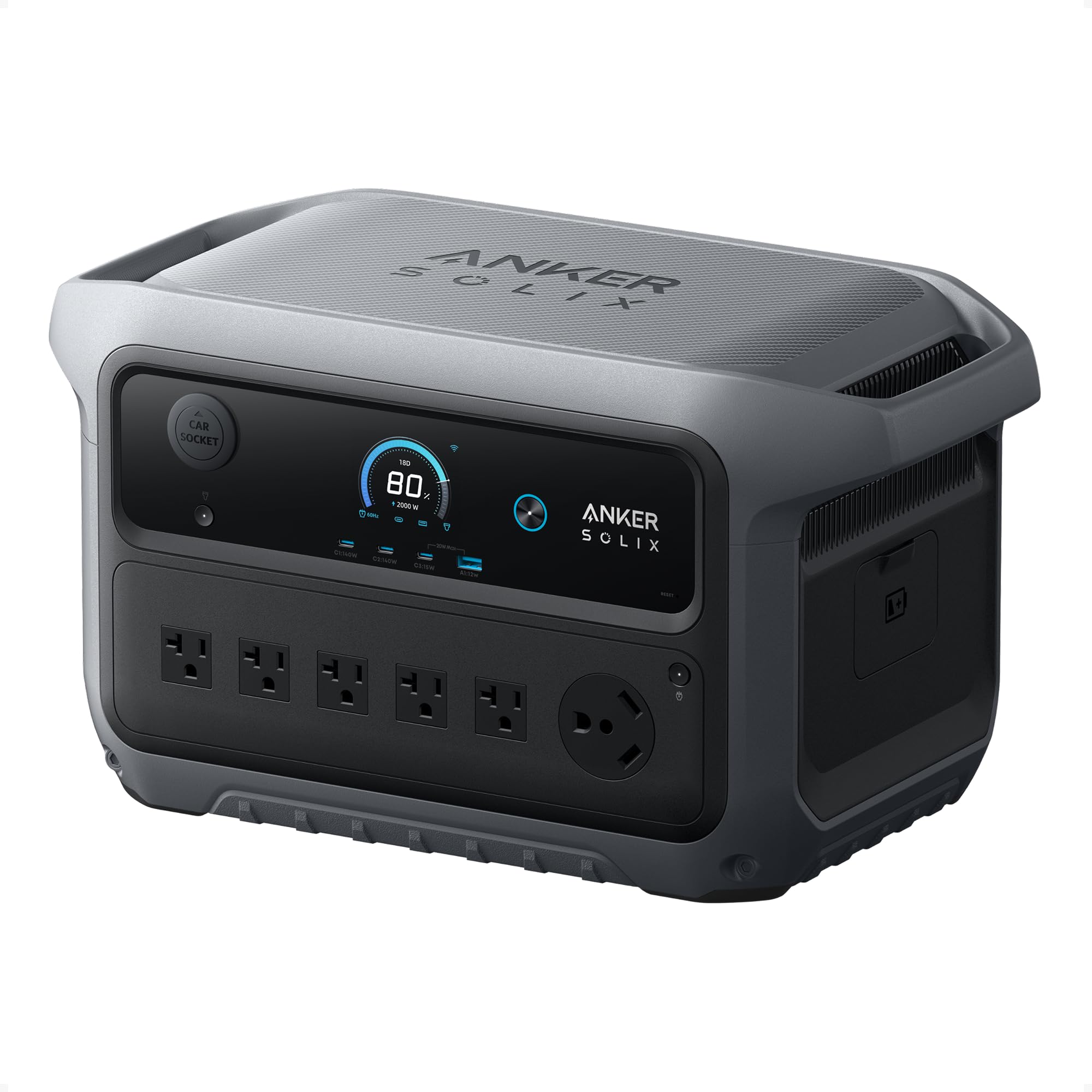
The SOLIX C1000 recharges from zero to eighty percent in 43 minutes — faster than the top pick’s 50-minute sprint. That speed, combined with 1,800W continuous and 2,400W surge output, covers fridges, lights, and small appliances without hesitation. The LiFePO4 battery pack is rated for 3,000 cycles, which translates to roughly a decade of regular use. Build quality feels dense and well-sealed, with no rattles or cheap plastic.

This fixed 1,056Wh capacity suits buyers who know their power needs today and don’t plan to scale later — powering a camping trip or keeping a refrigerator running through a medium outage fits perfectly. At 27.6 lbs it’s portable enough for car travel, though not a lightweight carry-on. The main tradeoff against the expandable EcoFlow Delta 2 is the lack of battery expansion ports; if you need more capacity down the road, you’d have to buy a second unit. For short- to medium-duration backup and outdoor trips, the C1000’s rapid recharge and solid build make it a strong alternative.

Tip: Its fixed capacity is fine for medium outages; if you anticipate needing more power later, consider an expandable model like the EcoFlow Delta 2.

Bottom line: For buyers who prioritize charging speed and portability over future expansion, the SOLIX C1000 delivers exceptional value in the 1kWh class.

5

BLUETTI AC200L

BLUETTI AC200L

Home & RV

Our Score 9.4/10
Check Price

Worth Noting

  • Initial setup requires app pairing and Wi-Fi connection, adding a step for those who prefer direct operation.
  • Expanding capacity requires purchasing separate battery packs, increasing the total investment beyond the initial price.
AC Output
2400W cont, 3600W peak
Expandability
Up to 8kWh
Recharge Time
45 min to 80%
Battery Capacity
2048Wh

The AC200L stands out by allowing users to begin with 2kWh of storage and add up to 8kWh with external battery packs, a level of expansion rarely seen at this price. It also includes a 30A RV output, enabling direct connection to heavy appliances or RV power systems without adapters.

This unit is best suited for home backup buyers who have a dedicated space for a heavy (61 lb) station and plan to grow their capacity over time. The 30A outlet adds bulk, making it less suitable for tight storage. Firmware updates can address occasional AC output hiccups, but the need for manual intervention is worth noting. Users who prefer a simple plug-and-play experience without an app should look elsewhere.

Tip: Install the BLUETTI app and complete the initial pairing to access remote control and firmware update features.

Bottom line: If capacity expansion and the 30A RV outlet are your priorities and you have a fixed location for a heavy unit, the AC200L is a strong runner-up. Most home backup buyers will prefer the lighter, more portable top pick.

6

CyberPower CP1500PFCLCD

CyberPower CP1500PFCLCD

Home office

Our Score 9.2/10
Check Price

Worth Noting

  • In quiet environments, the beeping during power loss may be distracting
  • Battery lifespan is typical for lead-acid units
AC Output
1000W cont
Expandability
Fixed
Recharge Time
Battery Capacity

The CyberPower CP1500PFCLCD delivers pure sine wave backup and automatic voltage regulation for computers and network gear, with a clear LCD display for monitoring power conditions. Its capacity handles home office and gaming setups but cannot run large appliances like refrigerators. Beeping during outages may be noticeable in quiet rooms, and battery life follows typical lead-acid longevity — a few years before replacement is needed. Compared to similar pure sine wave UPS units, this model lacks expandability and offers fewer outlets, narrowing its role to dedicated electronics protection rather than whole-home backup.

Bottom line: Best suited as a dedicated UPS for a home office or gaming PC, not for running large appliances.

7

Jackery Explorer 1000 v2

Jackery Explorer 1000 v2

Camping, home

Our Score 9.4/10
Check Price

Worth Noting

  • The 1,500W AC output may not start larger appliances like some refrigerators or pumps.
  • Battery capacity is fixed
AC Output
1500W cont, 3000W surge
Expandability
Fixed
Recharge Time
1 hour emergency
Battery Capacity
1070Wh

This power station handles mid-power needs like running a fridge, lights, and CPAP for a few hours during an outage, and its 1-hour emergency recharge gets it back to full quickly. However, its 1,500W continuous AC output may not start some fridge compressors, and the fixed battery capacity means you cannot add extra modules later. That trade-off makes it less suited for whole-home backup compared to expandable models like the EcoFlow Delta 2, but its portability and build quality make it a strong option for occasional use or trips.

Bottom line: If you need a portable backup for short outages and outdoor activities, and you don't plan to power heavy appliances, this Jackery is a lightweight, practical choice.

8

Anker SOLIX C2000 Gen 2

Anker SOLIX C2000 Gen 2

Home & RV

Our Score 9.4/10
Check Price

Worth Noting

  • At 41.7 lbs, the weight can be cumbersome for regular relocation between rooms or trips.
  • Long-term performance under sustained heavy loads is not yet established for this newer model.
AC Output
2400W cont, 4000W peak
Expandability
Up to 4kWh
Recharge Time
58 min to 100%
Battery Capacity
2048Wh

This 2kWh station stands out for its 4,000W peak power, enough to start most RV AC units and power tools. It recharges fully in under an hour and draws only 9W on standby, minimal for a unit this size. However, its $900 price is higher than comparable 2kWh options like the Jackery 2000 v2, and the long-term durability of its LiFePO4 battery under regular heavy-discharge cycles is not yet well-documented given its recent introduction.

Bottom line: This station fits buyers who need extreme surge capability for intermittent heavy loads like RV AC and are willing to pay a premium for the fastest recharge, with the understanding that its long-term track record is still being written.

9

APC BE600M1

APC BE600M1

Budget backup

Our Score 9.0/10
Check Price

Worth Noting

  • In a quiet home office, the constant beeping during normal operation can be distracting; there is no way to silence it
  • Some units may stop providing backup power within the first year, making it a risk for critical equipment
AC Output
330W cont
Expandability
Fixed
Recharge Time
Battery Capacity

The APC BE600M1 is the most affordable way to add battery backup for a computer and router. Its 600VA/330W capacity handles basic electronics during short outages, and setup is immediate — plug in devices and it works. However, the simulated sine wave output is unsuitable for sensitive electronics with active PFC power supplies, and the unit audibly beeps during normal operation — a sound that can be disruptive in quiet rooms. Some units may stop providing backup power within the first year, making this a candidate for temporary or non-critical setups rather than reliable home office protection.

Bottom line: For a garage or basement router needing basic outage protection, this UPS works at the lowest cost. Not suitable for quiet spaces or devices that must stay online.

How to Choose

Battery Capacity (Wh)

Watt-hours tell you how long the battery can deliver a given load. A 1,000Wh station will run a 100W light for 10 hours, but a fridge that cycles at 150W average may only last 4-5 hours. The hidden trade-off: battery capacity is often measured at ideal temperatures; actual runtime drops 20-30% in freezing or hot conditions.

For home backup, aim for at least 1,000Wh per essential circuit (fridge, lights, router). Larger stations (2,000Wh+) give you a full day of moderate use, but they are heavier and take longer to recharge unless you prioritize fast charging.

Continuous AC Output (W)

Continuous output must exceed the combined running wattage of everything plugged in. The catch is surge power: many appliances, especially motors in fridges, pumps, and fans, need 2-5x their rated wattage for the first few seconds. A station rated 1,500W continuous may trip when a fridge compressor kicks in because its surge rating is only 2,000W.

Check the surge rating explicitly. For a typical fridge (600W running, 1,800W surge), choose a station with at least 2,000W surge. If you plan to run a sump pump, look for 3,000W+ surge or a 30A outlet like the BLUETTI AC200L offers.

Battery Chemistry

Lead-acid UPS batteries are cheap upfront but degrade in 2-3 years, especially if cycled often. They also lose capacity when not fully charged. LiFePO4 (lithium iron phosphate) costs more but lasts 3,000-6,000 cycles — effectively 10+ years for most homes. The trade-off: LiFePO4 stations are heavier than lead-acid units of similar capacity.

For occasional outage backup, lead-acid can be fine. For regular use (weekly camping or frequent outages), LiFePO4 pays for itself in fewer replacements. Also note that LiFePO4 performs better in cold weather than other lithium chemistries, though still loses some capacity below freezing.

Recharge Time

Fast recharge matters when you have multiple short outages or need to recharge from solar during the day. The best stations can go from 0-80% in under an hour using a standard AC wall outlet. Slower units may take 4-6 hours to fully charge, which can leave you without backup if power returns briefly then drops again.

The trade-off: faster charging requires more robust internal electronics and cooling fans, which can add noise and slight bulk. For most home users, a recharge time under 2 hours is sufficient. Solar charging speed depends on panel size and sun exposure, so check the maximum solar input wattage.

Expandability

Some power stations allow you to add extra battery packs to increase capacity later. This is useful if you want to start with a basic setup and grow. Expandable stations often have a higher upfront cost but can scale to whole-home backup (up to 8kWh or more). Fixed-capacity stations are lighter, more portable, and simpler to set up.

The catch: expansion batteries are often proprietary and may cost nearly as much as the main unit. If you never add capacity, you pay extra for unused capability. For most people, a fixed 1-2kWh station is sufficient; only invest in expandability if you anticipate needing more than 3kWh in the future.

Frequently Asked Questions