PC Components & Storage

5 Best Graphics Card of 2026: Choose the Right GPU for Your Resolution

Stuck choosing between VRAM, ray tracing, and noise? This guide helps you pick the best graphics card for your budget and resolution.

Choosing a graphics card today means balancing VRAM capacity, noise levels, and upscaling features — not just raw FPS. A card that delivers smooth 1440p with high textures may struggle in 4K, while another runs quietly but lags in ray tracing.

The mid-range sweet spot around $500 to $750 offers the best value for most gamers, but the details matter. 12GB of VRAM handles current titles well, while 16GB adds future-proofing for texture-heavy games. Equally crucial is the cooling solution: some cards run whisper-quiet out of the box, while others require a fan curve adjustment to stay tolerable.

This guide focuses on matching the right GPU to your actual resolution and budget, so you avoid overpaying for features you won't use or underspending on longevity.

1

ASUS Prime 5070 12G

Top Pick
ASUS Prime 5070 12G

1440p gaming

Our Score 9.4/10
Check Price

Worth Noting

  • 12GB VRAM may be insufficient for future titles with ultra texture packs at 1440p, though current games handle fine
VRAM
12 GB GDDR7
Cooling
3-fan Axial-tech, phase-change pad
GPU Arch
NVIDIA RTX 5070

The ASUS Prime RTX 5070 delivers high frame rates at 1440p with DLSS 4 upscaling, keeping demanding titles smooth without forcing settings down. The triple-fan Axial-tech cooling and phase-change pad keep temperatures well controlled even during extended sessions, and noise stays modest — audible but not distracting in a typical mid-tower or compact SFF case.

Compared to AMD alternatives with 16GB VRAM and raw raster focus, the Prime 5070 offers a quieter, cooler experience and access to Nvidia's latest upscaling technology. For many 1440p gamers, the balance of features and day-one reliability makes it the more practical choice over a louder, higher-VRAM competitor.

This card is built for mainstream 1440p gamers who want modern features like DLSS 4 and quiet operation in a compact build. It is not suited for 4K ultra gaming or AI workloads requiring more than 12GB VRAM. While 12GB handles current 1440p titles well, future texture-heavy games may push that limit — a tradeoff worth noting before committing.

Tip: If you plan to keep the card for 3+ years and play heavily modded textures, consider a 16GB alternative. For standard 1440p gaming, the 12GB is sufficient.

Bottom line: For 1440p gamers who prioritize quiet operation and DLSS 4, the ASUS Prime RTX 5070 is the card to get — with a single long-term VRAM caveat worth planning around.

2

ASUS 5060 8GB

ASUS 5060 8GB

1080p gaming

Our Score 9.4/10
Check Price

Worth Noting

  • 8GB VRAM limits this card to 1080p gaming - not for 1440p or 4K
  • VRAM capacity may become a bottleneck for future texture-heavy titles at higher settings
VRAM
8 GB GDDR7
Cooling
GPU Arch
NVIDIA RTX 5060

The ASUS Dual RTX 5060 is the most affordable route to DLSS 4 and GDDR7 memory, delivering high-refresh 1080p gaming at a price that makes the ASUS Prime RTX 5070 seem like a luxury. Its 2565 MHz boost clock keeps frame rates high in competitive shooters, while DLSS 4's frame generation stretches performance further in demanding titles.

This card is strictly for 1080p gaming. While the market is moving toward 16GB VRAM, the 8GB on this RTX 5060 will become a bottleneck for future texture-heavy titles at higher resolutions. For budget builds or secondary PCs focused solely on 1080p, the price-to-performance ratio is unbeatable. Creators needing large VRAM should look elsewhere.

Tip: Pair with a 1080p monitor to fully leverage the card's performance; avoid 1440p or higher.

Bottom line: The ASUS Dual RTX 5060 is the go-to option for budget 1080p gamers who prioritize value over future-proofing.

3

GIGABYTE RX 9060 XT OC

GIGABYTE RX 9060 XT OC

1440p budget

Our Score 9.4/10
Check Price

Worth Noting

  • Ray tracing performance drops noticeably compared to similarly priced Nvidia cards
  • Lacks DLSS 4 features such as frame generation and enhanced upscaling
VRAM
16 GB GDDR6
Cooling
WINDFORCE, Hawk Fan
GPU Arch
Radeon RX 9060 XT

The GIGABYTE RX 9060 XT Gaming OC 16G delivers some of the best price-to-performance in the mid-range market, pairing a capable 1440p raster engine with a quiet WINDFORCE cooler. While the ASUS Prime RTX 5070 brings DLSS 4 and stronger ray tracing, this Gigabyte card offers 4GB more VRAM and lower noise for a lower price — a clear win for raw frame rates.

This card is built for budget-conscious 1440p gamers who prioritize smooth performance in standard rendering over ray-traced effects. It's also a good match for anyone looking to get 16GB VRAM without paying a premium. Ray tracing performance is lower than Nvidia equivalents, and the card lacks DLSS 4 features — so it's best reserved for gamers who don't prioritize those.

Bottom line: For price-conscious 1440p gamers, the GIGABYTE RX 9060 XT OC is the smarter buy if ray tracing isn't a priority — it trades DLSS 4 for more VRAM and lower noise at a lower cost.

4

GIGABYTE 9070 XT OC

GIGABYTE 9070 XT OC

1440p & 4K

Our Score 9.2/10
Check Price

Worth Noting

  • Fan noise under load can be audible, requiring a custom curve for quieter operation.
VRAM
16 GB GDDR6
Cooling
WINDFORCE, Hawk Fan, vapor chamber
GPU Arch
Radeon RX 9070 XT

The Gigabyte 9070 XT OC leverages AMD's latest architecture to deliver strong 1440p and capable 4K performance, with 16GB VRAM as a buffer for texture-heavy titles. While the top pick in this roundup prioritizes quiet operation and DLSS 4, this card targets gamers who value raw frame rates and memory capacity over upscaling features.

This card fits best for AMD ecosystem users building a 1440p or entry-level 4K gaming rig who want to maximize raster performance per dollar. The fan noise under load is real — expect a noticeable whoosh during extended gaming sessions. A manual fan curve adjustment significantly reduces audibility without sacrificing cooling.

The WINDFORCE cooling system with vapor chamber keeps GPU temperatures in check even after hours of gaming, though the stock fan profile prioritizes cooling over silence. For buyers willing to spend a few minutes in Radeon Software, the tradeoff becomes minimal.

Tip: Set a custom fan curve in Radeon Software to reduce noise; the card stays cool even with gentler fan speeds.

Bottom line: A raw raster workhorse that trades whisper-quiet operation for 16GB VRAM and competitive pricing.

5

PNY 5080 Epic-X

PNY 5080 Epic-X

4K gaming

Our Score 8.8/10
Check Price

Worth Noting

  • Fan noise may be noticeable under load, especially in quiet environments
  • Fan control software can be inconsistent, potentially requiring manual adjustment
VRAM
16 GB GDDR7
Cooling
Triple fan, ARGB
GPU Arch
NVIDIA RTX 5080

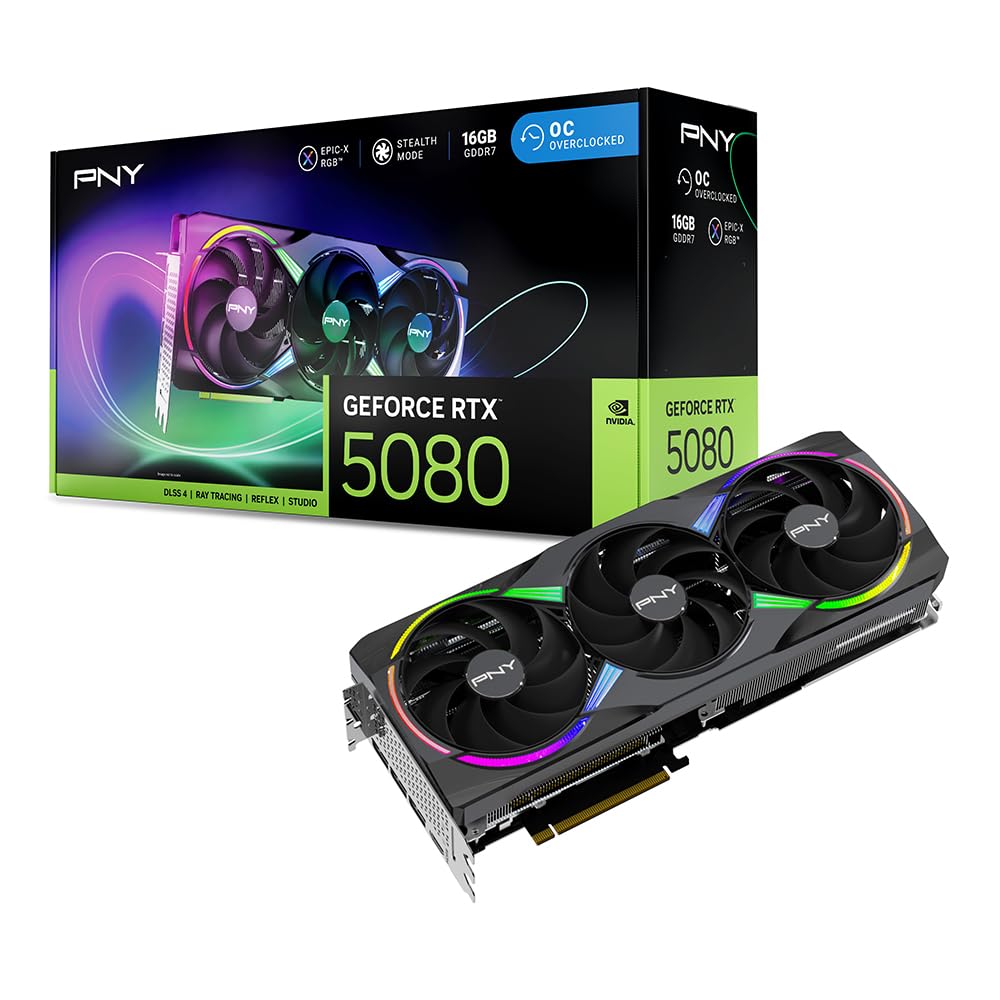
The PNY RTX 5080 Epic-X delivers the raw performance expected from a 5080 at a price that undercuts many rivals, while adding customizable ARGB lighting. For buyers who prioritize RGB and lower cost over premium build materials, this card hits a sweet spot compared to pricier alternatives like the ASUS TUF.

At 1440p and entry-level 4K, the card handles modern titles smoothly, and the triple-fan cooling keeps temperatures under control during extended sessions. The ARGB lighting is bright and customizable, matching most builds without feeling gaudy.

This card suits gamers who want a 5080 with ARGB at a slightly lower price than ASUS or Gigabyte models, and who primarily game at 1440p with high refresh rates. However, if you plan a quiet PC or prefer best-in-class build quality, the fan noise and control inconsistencies may be a concern. Some units exhibit louder fan operation, and the fan control software can be finicky — worth factoring into your decision.

Tip: Adjusting the fan curve via the PNY utility can reduce noise, though results vary by unit.

Bottom line: For 1440p gamers who want a 5080 with RGB but are willing to trade quiet operation for a lower price, this card delivers.

How to Choose

VRAM: How Much Do You Really Need?

8GB is the entry-level floor for 1080p gaming, but texture-heavy titles already push past that limit at higher settings. 12GB handles today's 1440p games comfortably, though ultra texture packs in 2026 releases can strain it. 16GB provides a safe buffer for 1440p high-refresh and entry-level 4K, while 24GB is reserved for professional workloads.

Choosing less VRAM saves money upfront but risks needing an upgrade in two to three years. Matching VRAM to your target resolution and expected longevity avoids that costly swap.

GPU Architecture: Newer Isn't Always Faster

GPU architecture determines ray tracing efficiency and upscaling support. Nvidia's RTX 50-series brings DLSS 4 with improved frame generation, while AMD's RX 9000-series relies on FSR 4 and raw raster performance. DLSS 4 offers a bigger visual boost in supported titles, but AMD cards often deliver higher raw FPS at the same price.

For ray tracing enthusiasts, Nvidia's architecture provides smoother performance at lower resolution overheads. AMD's raster advantage matters most in competitive shooters where upscaling input lag is undesirable.

Cooling and Noise: The Quiet Upset

Two cards with the same chip can differ by 10 dB under load due to heatsink design and fan curves. Dual-fan models are compact but often louder, while triple-fan solutions with vapor chambers run cooler and quieter. Some cards ship with aggressive fan profiles that need manual adjustment via software.

Noise matters in open-bed desks or quiet rooms. A card that hits 70°C silently is far more pleasant than one that reaches 65°C but sounds like a hairdryer. Check user feedback on specific models for real-world noise levels.

Size and Power Connectors

Many modern cards exceed 300mm in length and take up three or more slots. SFF cases require careful dimension checks and may need low-profile power adapters. The new 12VHPWR connector is standard on RTX 50-series, but older PSUs may need a separate cable.

Failing to measure clearance can result in a card that doesn't fit or blocks front panel connectors. Verify case specifications and power supply wattage before purchasing.

Frequently Asked Questions