Audio & Headphones

14 Best Floorstanding Speakers of 2026: Built-In Atmos That Actually Works

Find the best floorstanding speakers for home theater without hidden costs or underpowered bass. Our guide matches sound quality, build, and features to your room and budget.

Floorstanding speakers promise rich, room-filling sound, but many buyers discover underpowered bass or confusing pricing halfway through setup. The rise of integrated Dolby Atmos adds another layer: up-firing drivers offer convenience, but their height effect varies dramatically by ceiling height and room layout.

The real question isn't whether to buy floorstanders — it's which design matches your actual listening habits. A pair with 8-inch woofers can often skip a subwoofer, while slimmer towers need a sub for deep bass. And per-speaker pricing catches many off guard: a $350 tower quickly becomes $700 for a stereo pair.

This guide breaks down the trade-offs by use case — whether you need integrated Atmos, floor-shaking bass, or neutral accuracy for critical listening. Each pick is chosen for a specific setup, so you won't pay for features you can't use.

1

Klipsch R-26FA Pair

Top Pick
Klipsch R-26FA Pair

Home Theater

Our Score 9.6/10
Check Price

Worth Noting

  • Atmos effect loses impact in rooms with very high ceilings or textured surfaces
  • Up-firing drivers may not produce as precise a height effect as dedicated ceiling speakers
Sold As
Pair
Impedance
8 ohms
Dolby Atmos
Yes
Tweeter Type
Horn

The Klipsch R-26FA combines full-range floorstanding design with built-in Dolby Atmos elevation drivers, delivering immersive height effects without ceiling-mounted speakers. The dual 6.5-inch IMG woofers produce ample bass, while the 1-inch aluminum compression driver handles crisp highs – a balanced soundstage suited for both movies and music. With 400-watt peak handling and 8-ohm impedance, these speakers are compatible with most AVRs and offer headroom for dynamic scenes.

In rooms with flat, reflective ceilings around eight to nine feet, the up-firing drivers create a convincing sense of overhead sound. The effect loses clarity with very high ceilings or textured surfaces, so room suitability directly impacts Atmos performance. Some users note that while the height effect is present, it doesn't fully replicate the precision of dedicated ceiling-mounted speakers – a tradeoff accepted in this convenience-focused design.

This pair is best for home theater enthusiasts who want an Atmos setup without installing ceiling speakers, provided their room has suitable ceiling height. For purist stereo listeners who prefer direct sound without elevation drivers, the integrated Atmos adds unnecessary complexity – those buyers will get cleaner imaging from a dedicated two-channel tower like the Klipsch RP-6000F II. At a mid-range price for a complete pair, the R-26FA offers strong value for those building an Atmos system on a budget.

Setup is straightforward: speaker terminals support bi-amping, and the slim towers fit into most living rooms without dominating the space. The black finish is understated, and the integrated design eliminates the need for separate Atmos modules, simplifying the overall system.

Compared to the Klipsch RP-6000F II, which offers superior clarity for music but lacks Atmos, the R-26FA is the better fit for home theater use where height effects matter. For music-first listeners, the RP-6000F II remains a stronger option – a distinction that underscores why the R-26FA is the clear pick for budget-conscious home theater builders.

Tip: Keep the speakers at least a few inches from the wall to allow the up-firing drivers to reflect properly, and avoid placing them in rooms with vaulted ceilings for best results.

Bottom line: For home theater buyers who want Atmos without ceiling speakers, the R-26FA offers the best value in its class – just confirm your room has a suitable ceiling height for the up-firing drivers to work effectively.

2

Klipsch RP-6000F II Pair

Klipsch RP-6000F II Pair

Dynamic Sound

Our Score 9.8/10
Check Price

Worth Noting

  • No built-in Atmos elevation drivers; add-on modules required for overhead effects
  • Passive design demands a separate amplifier, increasing total system cost
Sold As
Pair
Impedance
8 ohms
Dolby Atmos
No
Tweeter Type
Horn

The RP-6000F II pair delivers the signature Klipsch horn sound with noticeably refined highs and a detailed midrange that makes vocals and instruments stand out. The Cerametallic woofers provide tight, controlled bass that integrates cleanly without overwhelming the room. Build quality is exceptional: the cabinet is rigid, the front baffle is solid, and the finish matches the premium price. Where the top pick (R-26FA) prioritizes integrated Atmos and value, these speakers focus entirely on sound purity — no gimmicks, just direct acoustic performance.

This is a passive design, so you will need a separate amplifier or receiver (8-ohm stable, 50-100W recommended). The lack of built-in Atmos elevation drivers means home theater buyers who want overhead effects must add separate modules — the binding posts for that are present, but it’s an extra cost and speaker placement consideration. Audiophiles and music-first listeners will appreciate the transparent soundstage and dynamic range, while home theater owners wanting a high-end 2-channel base can later expand with a subwoofer and surround speakers.

Tip: These speakers benefit from a high-current amplifier (50-100W) to fully control the 6.5-inch woofers and maintain dynamic headroom.

Bottom line: If your priority is two-channel sound quality and you’re prepared to pair them with a good amp, the RP-6000F II delivers reference-level clarity that few competitors at this price can match.

3

SVS Prime Pinnacle Pair

SVS Prime Pinnacle Pair

Reference Sound

Our Score 9.4/10
Check Price

Worth Noting

  • On uneven flooring, the optional feet may cause stability issues
Sold As
Pair
Impedance
Dolby Atmos
No
Tweeter Type
Dome

The SVS Prime Pinnacle delivers a level of neutrality and detail that few floorstanders at any price achieve, thanks to a three-way design pairing a 1-inch aluminum tweeter, a dedicated 5.25-inch midrange, and three 6.5-inch woofers. The result is an expansive soundstage with pinpoint imaging and bass that fills large rooms without becoming boomy.

Build quality mirrors the acoustic precision — the piano gloss finish and thick cabinet walls minimize resonance, giving the speakers a substantial feel. However, the included feet can cause the speakers to tip on uneven floors; placing them on a level surface or using aftermarket feet resolves this instability without sacrificing performance.

These speakers are for audiophiles who prioritize transparency over convenience features like built-in Atmos, and who have the floor space for a tall, weighty tower. The tradeoff is placement care — but for listeners willing to invest in a no-compromise system, the Prime Pinnacle’s sound quality justifies the premium.

Tip: Use on a level surface or consider aftermarket feet for carpet or uneven floors.

Bottom line: For critical listeners with stable flooring and a willingness to invest, the Prime Pinnacle delivers reference-grade sound that few competitors match.

4

Jamo S809 Pair

Jamo S809 Pair

Budget Value

Our Score 9.0/10
Check Price

Worth Noting

  • Vinyl veneer can look cheaper up close compared to real wood finishes
Sold As
Pair
Impedance
Dolby Atmos
No
Tweeter Type
Dome

The Jamo S809 pair offers a level of sound quality that typically costs more. The 1-inch soft dome tweeter and triple 5-inch woofers produce clean, articulate highs with enough body for action scenes and vocals. The slim profile (just over 7 inches wide) fits tight spaces without crowding the room, and the Walnut vinyl finish gives a modern look from a distance.

This setup suits first-time home theater builders or anyone on a strict budget who wants floorstanding presence without the usual price tag. The Dolby Atmos upward-firing module support means future expansion is possible without changing speakers. However, the vinyl veneer is a clear visual tradeoff: up close the texture looks less premium than real wood — a detail that matters more if speakers sit near eye level in a well-lit room.

Where many budget floorstanders sound thin or hollow, the S809 pair holds its own for casual music listening and home theater dialogue clarity. Bass won't rumble like a dedicated subwoofer, but for general use the triple woofers provide enough low-end weight to avoid a hollow feel. The WaveGuide helps dispersion, keeping the soundstage wide even if you're sitting off-center.

Bottom line: If your budget stops at entry-level floorstanders and you prioritize sound over premium materials, the Jamo S809 pair delivers where it counts — just don't expect a high-end look on close inspection.

5

Fluance Signature Pair

Fluance Signature Pair

Deep Bass

Our Score 8.6/10
Check Price

Worth Noting

  • Passive design requires a separate amplifier or receiver
  • Very large and heavy at over 60 lbs each, demanding substantial floor space
  • Some units may develop woofer cracking or blown drivers under heavy use
Sold As
Pair
Impedance
Dolby Atmos
No
Tweeter Type
Dome

Dual 8-inch woofers produce the kind of low-end most floorstanders can't match, often eliminating the need for a separate subwoofer in large rooms. This 3-way design with a dedicated midrange driver keeps vocals clear and detailed, while the cabinet build and real-wood veneer finish look premium. Compared to powered all-in-one towers, the Fluance demands an external amplifier but rewards with more controlled, impactful bass.

The bass is deep and tight, adding weight to movie explosions and music with sub-bass content. The speakers are substantial: over 60 pounds each and nearly 3.5 feet tall, so they command floor space. Some units have shown woofer deterioration under heavy use, though build quality is generally solid. The outrigger stabilizing feet help on carpet but add to the footprint.

These are for bass lovers with large rooms who want to skip a subwoofer and don't mind the size or the need for a separate amplifier. The tradeoff is that potential durability variance means they are less suited for risk-averse buyers or those with limited floor space. If you prioritize deep bass over compactness and have a dedicated listening area, this pair delivers strong value.

Tip: Plan for a dedicated floor area and ensure your floor can support over 60 lbs per speaker.

Bottom line: If you have the space and want subwoofer-level bass without a separate box, the Fluance Signature pair delivers – just stay aware of possible durability variance under heavy use.

6

ELAC F5.2 Each

ELAC F5.2 Each

Neutral Sound

Our Score 9.0/10
Check Price

Worth Noting

  • Grille pegs may break if removed improperly
  • Sold individually; buying a pair doubles the advertised price
Sold As
Each
Impedance
6 ohms
Dolby Atmos
No
Tweeter Type
Dome

The ELAC F5.2 delivers a flat, uncolored response that prioritizes accuracy over artificial excitement. Its triple 5.25-inch aramid fiber woofers and waveguide produce clean midrange and tight bass, making it a strong choice for critical listening.

For listeners with a quality amplifier (100W or more), the F5.2 reveals a wide soundstage and detailed imaging. It demands careful placement and power to shine, so it suits dedicated listening spaces rather than casual background setups.

The primary caveats: grille pegs may break during removal, and each speaker is sold individually — the price reflects a single unit, not a pair. Budget accordingly if you intend to run stereo.

Tip: Remove the grille by applying even pressure near each peg to reduce the risk of breakage.

Bottom line: For the listener who values neutral accuracy over crowd-pleasing excitement, the F5.2 delivers reference-level clarity at a budget-friendly price — provided you have the amplifier and patience for its quirks.

7

Sony SS-CS3 Pair

Sony SS-CS3 Pair

Clear Sound

Our Score 9.0/10
Check Price

Worth Noting

  • Bass response is light; a subwoofer is nearly essential for full-range listening.
Sold As
Pair
Impedance
6 ohms
Dolby Atmos
No
Tweeter Type
Dome

The Sony SS-CS3’s super tweeter extends high frequencies well beyond typical budget floorstanders, delivering crisp vocal detail and airy cymbal crashes. This clarity makes them a strong choice for music listeners who prioritize treble and midrange precision over deep bass. However, the 5.12-inch woofers produce only modest low-end output — a powered subwoofer is required for any sense of full-range impact.

These towers suit buyers in small to medium rooms who already plan to add a subwoofer or own one from a previous setup. The light bass is a deliberate design trade-off for cost and cabinet size, not a flaw — it trades low-end extension for clean, uncolored mid and high performance. Pair them with any decent subwoofer and you get a balanced system that outperforms many similarly priced all-in-one towers.

At this price point, few floorstanders match the Sony’s ability to resolve fine details in high-resolution recordings. The dual tweeter array (1-inch dome plus 3/4-inch super tweeter) creates a spacious soundstage that remains clear even at higher volumes. Just be aware that for home theater explosions or bass-heavy genres, a subwoofer is mandatory — these are not capable of shaking the room on their own.

Tip: Pair with a powered subwoofer for full-range sound — these towers excel at mid and high frequencies on their own.

Bottom line: Best picked by budget-conscious listeners who want shimmering high frequencies and plan to add a subwoofer for the low end.

8

Klipsch R-620F Pair

Klipsch R-620F Pair

Klipsch Horn

Our Score 9.4/10
Check Price

Worth Noting

  • Plastic feet and screws can be fragile during assembly
Sold As
Pair
Impedance
Dolby Atmos
No
Tweeter Type
Horn

The Klipsch R-620F pair delivers the signature horn-loaded sound — lively highs and punchy bass — that has made the brand a favorite for home theater on a budget. For the price, you get a pair of floorstanders that fill a small to medium room with authority. However, this model lacks the built-in Dolby Atmos elevation drivers found in the step-up R-26FA, and the build quality reflects the cost savings: the plastic feet and screws can be fragile during assembly. If you don't need Atmos and can handle careful setup, the sound per dollar is strong.

Bottom line: If you want the Klipsch horn sound for a small home theater and don't need Atmos, this pair offers strong value — just handle the screws gently during setup.

9

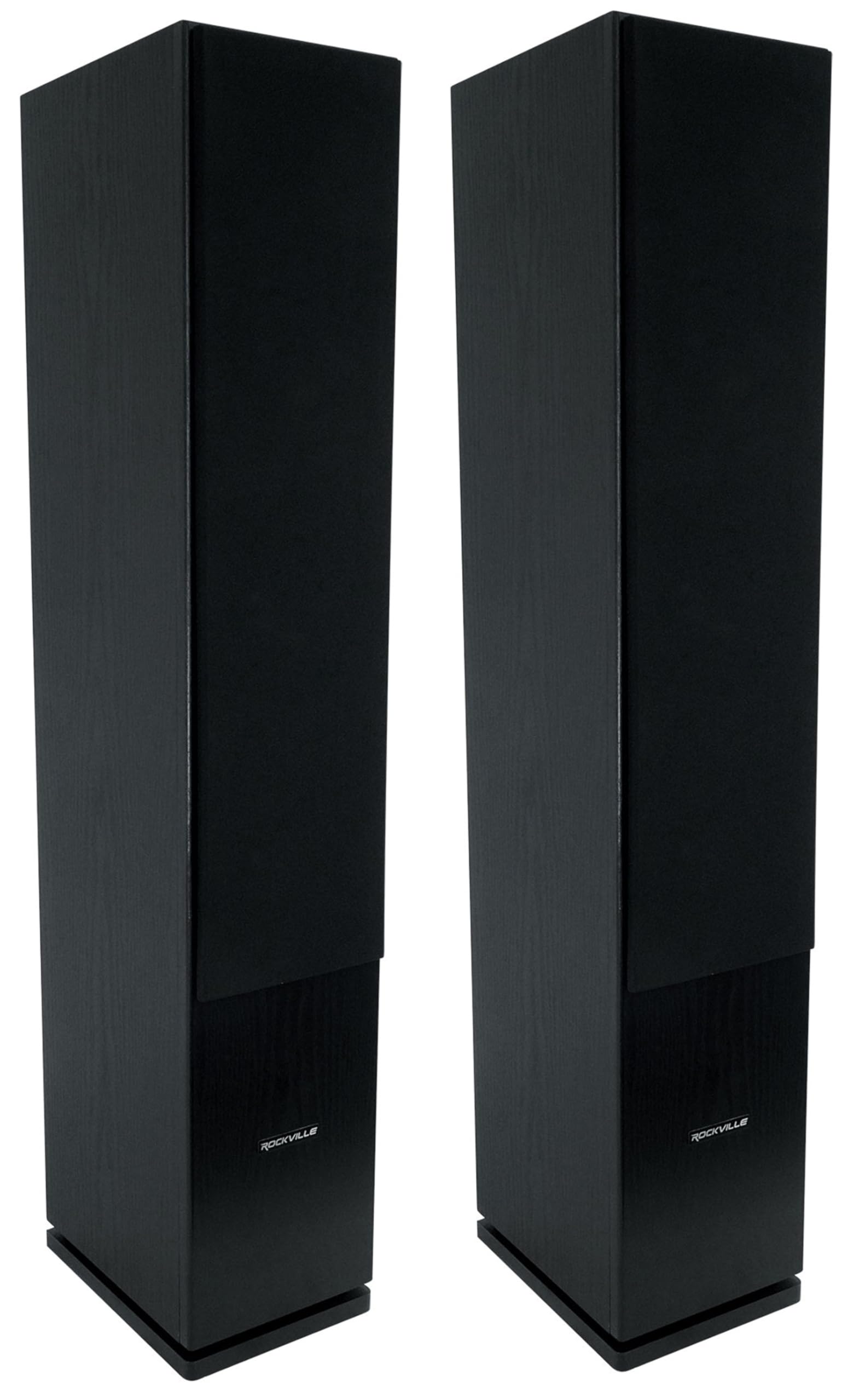
Rockville RockTower 68B Pair

Rockville RockTower 68B Pair

Powerful Budget

Our Score 9.0/10
Check Price

Worth Noting

  • Treble detail is limited
Sold As
Pair
Impedance
8 ohms
Dolby Atmos
No
Tweeter Type
Dome

The Rockville RockTower 68B pair offers a 3-way configuration with dual 6.5-inch woofers at a price that undercuts most floorstanders. It produces strong, distortion-free output at low volumes — suited for casual movie nights and background music. The treble lacks refinement, making it a poor match for audiophiles or critical listening sessions. Build quality is solid for the cost, but the high-frequency detail is a tradeoff you accept at this budget tier.

Bottom line: Best for buyers on a tight budget who prioritize bass and value over high-frequency clarity, and who listen casually or watch movies.

10

Fluance Ai81 Pair

Fluance Ai81 Pair

Powered Setup

Our Score 8.8/10
Check Price

Worth Noting

  • For listeners seeking deep bass and high-fidelity detail, the sound may feel underpowered.
Sold As
Pair
Impedance
Dolby Atmos
No
Tweeter Type
Dome

The Fluance Ai81 Elite pair eliminates the need for a separate amplifier or receiver, offering a straightforward all-in-one solution for users who want floorstanding speakers without extra gear. The built-in Bluetooth, RCA, and optical inputs make it easy to connect a TV, turntable, or phone. Sound quality is average — bass lacks impact for bass-heavy music, and clarity doesn't match passive speakers at a similar price when paired with a good amp. This tradeoff makes sense for desktop or small-room setups where simplicity is the priority, rather than critical listening.

Bottom line: A good fit for users who prioritize a tidy, amplifier-free setup over sonic precision.

11

Klipsch R-625FA Single

Klipsch R-625FA Single

Atmos Builder

Our Score 9.2/10
Check Price

Worth Noting

  • Single speaker sold individually
  • Screws can be fragile and may strip during assembly.
Sold As
Each
Impedance
8 ohms
Dolby Atmos
Yes
Tweeter Type
Horn

Home theater builders expanding piece by piece will appreciate the R-625FA's built-in Atmos elevation driver paired with a 1-inch tweeter and dual 6.5-inch woofers, delivering clear highs and immersive overhead effects without a separate module. The sound quality matches Klipsch's lively signature — detailed and dynamic for both movies and music. However, this speaker is sold individually, not as a pair, making it best as part of a full Klipsch system where you buy multiple units. Some units may arrive with cosmetic damage or have fragile screws, so careful inspection on arrival is advisable.

Tip: Hand-tighten screws to avoid stripping.

Bottom line: Best for those building a full Klipsch Atmos system one speaker at a time, provided they inspect each unit upon arrival.

12

Definitive BP-9040

Definitive BP-9040

Built-in Sub

Our Score 9.2/10
Check Price

Worth Noting

  • In high-volume home theater use, the powered subwoofer's durability over years is not yet established.
  • The integrated sub limits future upgrade options if you want a more powerful external subwoofer.
Sold As
Each
Impedance
8 ohms
Dolby Atmos
No
Tweeter Type

The BP-9040's integrated powered sub simplifies setup and saves space, delivering bass depth typical of a dedicated sub. Its bipolar design creates a wide, immersive soundstage, and optional Atmos height modules add overhead effects. However, long-term durability under sustained high-volume use has limited verification — this design trade-off suits buyers who prioritize convenience over a decades-long track record. For those willing to accept some uncertainty in exchange for an all-in-one solution, it is a compelling alternative to traditional towers plus a separate sub.

Bottom line: A good fit for buyers who want a single-pair solution for music and movies without dedicating space to a separate subwoofer, and who accept a shorter performance history for the convenience.

13

KEF Q550 Each

KEF Q550 Each

Compact Imaging

Our Score 8.4/10
Check Price

Worth Noting

  • Sold singly; the pair price is high relative to the driver size.
  • Bass extension is limited; a subwoofer is needed for low-end weight.
Sold As
Each
Impedance
8 ohms
Dolby Atmos
No
Tweeter Type
Coaxial

The KEF Q550 floorstander uses a Uni-Q coaxial driver to create a focused, coherent soundstage that pulls detail from recordings—especially in smaller rooms where dispersion matters. Its 5.25-inch drivers keep the cabinet slim and visually unobtrusive. The catch is the price: sold individually, a pair costs around what larger competitors ask, yet the bass output stays light. Deep low-end extension is limited, so a subwoofer becomes necessary for any weight or impact. This makes the Q550 a specific fit—ideal if you value KEF's midrange purity and have a sub ready, but less appealing if you want full-range punch from the towers alone.

Bottom line: Best for KEF fans who want compact floorstanders with precise imaging and plan to pair them with a subwoofer, rather than seeking full-range bass from the towers alone.

14

Yamaha NS-F150 Each

Yamaha NS-F150 Each

Entry Level

Our Score 9.2/10
Check Price

Worth Noting

  • Per-speaker pricing: a pair costs twice the advertised price
  • Bass extension is modest; deeper low end may require a separate subwoofer
Sold As
Each
Impedance
6 ohms
Dolby Atmos
No
Tweeter Type

The Yamaha NS-F150 delivers clean, open mids and treble that bring vocals and instruments to the front. The piano-black mirror finish gives it an upscale look uncommon at this price point.

Each speaker is sold individually, so a stereo pair comes to double the sticker price. That puts it up against complete pairs from competitors that offer fuller bass and higher overall output, making the NS-F150 a better fit for incremental system building than a one-shot purchase.

Bottom line: Best suited for budget buyers building a Yamaha-based system over time, especially when paired with a subwoofer for bass.

How to Choose

Woofer Size and Configuration

Larger woofers (8-inch) move more air and produce deeper bass, but they require larger cabinets. A dual 6.5-inch design can still deliver solid low-end in a medium room, while a triple 5.25-inch array trades bass extension for faster response.

Pair the woofer size with your room dimensions: smaller rooms benefit from agile 5.25-inch drivers, while large rooms need the displacement of 8-inch cones.

Tweeter Type: Horn vs. Dome

Horn-loaded tweeters, common in Klipsch designs, increase efficiency and directionality — they project sound with higher sensitivity and lower distortion at high volumes. Dome tweeters offer a wider, softer dispersion that blends more smoothly with midrange drivers.

For home theater, horns provide clear dialogue; for critical music listening, domes often sound more natural.

Built-in Dolby Atmos

Up-firing Atmos drivers bounce sound off the ceiling to create height effects without cutting holes. Their effectiveness depends on ceiling height (8-10 feet ideal) and material (flat, non-absorbent).

In rooms with vaulted or textured ceilings, dedicated ceiling speakers deliver more precise overhead imaging. Consider whether your room geometry supports up-firing reflections before paying for the feature.

Impedance and Amplifier Matching

Most floorstanders are 8 ohms, which works with nearly any receiver. Six-ohm speakers draw more current and may overload budget AVRs at high volumes, causing distortion or shutdown.

Check your amplifier's rated power at the speaker's impedance — a 6-ohm speaker needs an amp that can deliver stable current into lower loads.

Per-Speaker Pricing Trap

Many manufacturers sell towers individually, making a $350 speaker a $700 pair. Always verify the listing before checkout. This is especially common with budget and entry-level models from Yamaha, ELAC, and KEF.

If your budget is fixed, filter for 'pair' listings to avoid sticker shock.

Frequently Asked Questions