Office Electronics

7 Best Financial Calculator of 2026: Match Your Workflow and Budget

Which financial calculator balances exam approval, button reliability, and cost? This guide cuts through the trade-offs for students, CFA candidates, and real estate agents.

For decades, two calculator families have dominated finance and exam halls. Recent production changes have introduced frustrating key response issues and build variation that make old recommendations unreliable. But newer models from both families have left some buyers disappointed with stiff buttons, plastic cases, and short battery life.

The choice often comes down to input method, exam approval, and build durability. Algebraic entry is simpler for beginners, while RPN offers faster calculation once learned. Some models include specialized functions for real estate or investment analysis. Most finance students and professionals do not need advanced metrics like modified duration. Understanding these trade-offs ensures you do not pay extra for features you will never use or sacrifice reliability for a lower price. Getting the right calculator saves frustration and money.

A calculator that fails to register a keypress during a timed exam or loses battery in the middle of a deal is worse than no calculator at all. This guide helps you identify the right tool for your specific job by highlighting the differences that matter, so you can choose with confidence.

1

TI BA II Plus

Top Pick
TI BA II Plus

Finance students

Our Score 9.2/10
Check Price

Worth Noting

  • Buttons can require firm presses and may produce audible clicks in quiet settings, which can slow rapid data entry during exams.
Input Method
Algebraic
TVM Functions
TVM, amortization, NPV, IRR
Cash Flow Analysis
NPV, IRR, cash flow

The BA II Plus delivers the time-value-of-money, amortization, and cash flow analysis functions that form the backbone of finance coursework and professional exams. It is approved for CFA, FRM, and CMA exams — a credential few budget-priced calculators carry. The calculator handles up to 4-digit cash flow frequencies, covering the vast majority of scenarios a student or practitioner will encounter.

The build feels solid for its price, with a no-frills design that withstands daily transport in a backpack. The buttons require firmer presses than some alternatives, and in quiet exam halls the mechanical noise can be noticeable. This is a tradeoff of its cost-conscious construction, not a defect — most users adapt quickly, though rapid data entry may feel less fluid than with premium models.

This calculator is the standard recommendation in finance departments and exam-prep materials. Its ubiquity means plentiful tutorials, cheat sheets, and peer support are available — a practical advantage during study and timed exams. For those who need consistent, exam-approved functionality at a low entry price, the BA II Plus is the clear default.

It suits finance and accounting students, CFA/FRM/CMA candidates, and professionals who need straightforward TVM, NPV, IRR, and amortization calculations. It is not designed for advanced metrics like modified duration or discounted payback — those belong on the Professional version. It also lacks RPN input, so HP loyalists should look elsewhere. The button feel may be a sticking point for those who must enter data quickly under time pressure, but it remains the most cost-effective way to access the functions that actually appear on exams and in course work.

Tip: Press buttons firmly and test your unit beforehand during mock exams to build muscle memory for the required pressure.

Bottom line: For finance students and exam candidates, the BA II Plus covers every essential function at a budget-friendly price — no other calculator in this class offers the same combination of affordability and exam approval.

2

TI BA II Plus Pro

TI BA II Plus Pro

CFA Level II/III

Our Score 9.0/10
Check Price

Worth Noting

  • Stiff buttons require firm presses that can slow data entry in fast-paced exam settings
  • Screen can show imprints from light bumps, noticeable if transported without a case
Input Method
Algebraic
TVM Functions
TVM, amortization, NPV, IRR
Cash Flow Analysis
NPV, IRR, mod duration

The BA II Plus Professional expands the standard financial calculator’s functions with modified duration, discounted payback, and cash flow handling for up to 32 entries — metrics that become essential in CFA Level II/III and complex corporate finance work. Its metal enclosure gives it a weighted, solid feel that suits desk use, and the prompted display with variable labels reduces input errors on nested cash flow problems.

This calculator is built for finance professionals and advanced exam takers who routinely calculate IRR/NPV with irregular cash flow patterns or need modified duration for bond portfolio analysis. The tradeoff is interface tactility: buttons are stiff and require deliberate presses, which in timed exam conditions can slow rapid data entry, and the screen may show imprints from pressure if carried without a protective case. These quirks are manageable for focused calculation sessions but less ideal for quick back-to-back entries.

Tip: Keep the calculator in a padded sleeve or case when carrying to protect the screen from pressure imprints.

Bottom line: If your work or exams require modified duration, discounted payback, or cash flow sets beyond 16 entries, the BA II Plus Professional delivers those metrics in a sturdy package. For standard TVM and IRR, the standard BA II Plus offers the same core reliability at a lower price.

3

HP 12C

HP 12C

RPN enthusiasts

Our Score 9.0/10
Check Price

Worth Noting

Input Method
RPN only
TVM Functions
TVM, amortization, bond, depreciation
Cash Flow Analysis
NPV, IRR, bond

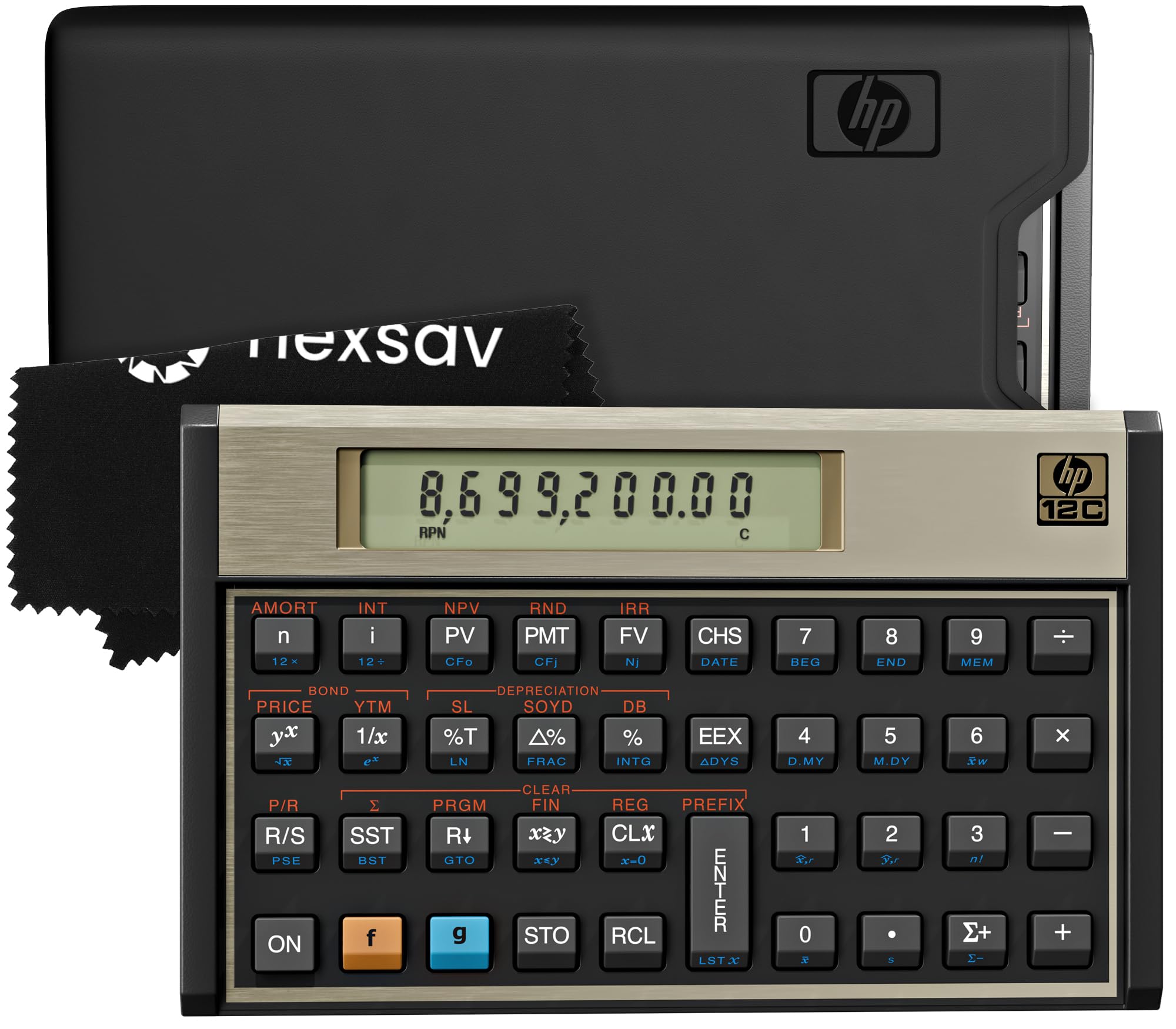
The HP 12C's RPN input speeds up calculations for those who master it. While the TI BA II Plus dominates exam rooms with algebraic logic, the HP 12C offers keystroke efficiency over menu navigation. Its TVM, amortization, NPV, and IRR functions cover professional needs, and it is exam-approved for CFP, CFA, and FRM.

This calculator suits financial professionals who already use RPN and value muscle memory. The plastic case feels lighter than vintage 12Cs, and some units may have sticky keys — a tradeoff for those expecting heirloom build. Beginners should look to the TI BA II Plus.

The HP 12C's electronics have a strong track record of consistent performance over years of use. Its long presence in finance and real estate confirms its fit for RPN power users.

Bottom line: For the RPN devotee, the HP 12C delivers unmatched calculation speed and workflow continuity — a classic tool with modern build compromises.

4

CI Qualifier 3415

CI Qualifier 3415

Real estate agents

Our Score 9.4/10
Check Price

Worth Noting

  • The display can separate from the body under heavy handling in some units.
Input Method
Algebraic
TVM Functions
TVM, PITI, ARMs, combos
Cash Flow Analysis

The Qualifier Plus IIIx puts buyer qualification front and center with dedicated income and debt keys — no need to wade through time-value-of-money menus for a simple qualifying ratio. This contrasts with the 3430, which adds investment functions like IRR and NPV for property analysis but loses some of the qualification-specific simplicity.

For agents qualifying multiple buyers daily, the direct key access cuts calculation time noticeably. The calculator handles standard real estate scenarios — PITI, ARMs, FHA/VA — without memorized sequences, and its learning curve is minimal. A small number of units have had the display separate from the body under repeated pressure; it is worth checking the seam on arrival and handling the unit with care.

This calculator is built for real estate professionals who need quick, repeatable buyer qualification — not for corporate finance DCF analysis or CFA exam preparation. Those tasks call for a general-purpose financial calculator like the TI BA II Plus or HP 12C. If your work involves investment property evaluation with IRR/NPV, the 3430 is the better fit.

Tip: Check the display seam on arrival and avoid carrying it loose in a bag with heavy items.

Bottom line: For agents who need a no-nonsense qualification tool, this calculator delivers where generic models fall short — just keep an eye on the display seam.

5

HP 10bII+

HP 10bII+

Budget finance students

Our Score 9.4/10
Check Price

Worth Noting

  • Battery life may be shorter than expected in some units, requiring replacement within weeks.
  • Some units may become unresponsive during use, which can disrupt exams or timed work.
Input Method
Algebraic
TVM Functions
TVM, amortization, NPV, IRR
Cash Flow Analysis
NPV, IRR

The HP 10bII+ covers core financial functions like TVM, NPV, and amortization through an intuitive algebraic layout — no RPN learning curve. Its dedicated keys for common operations make it straightforward for beginners, and the price is notably lower than comparable models from Texas Instruments.

Where it falls short is in advanced cash flow analysis; it lacks metrics like modified duration and discounted payback that professionals in finance or real estate may need. Battery life can be short in some units, and occasional power loss has been noted during extended use — isolated reports, but worth factoring in for exam settings. For introductory courses or CFP study on a tight budget, these tradeoffs are manageable, but professionals requiring deeper functionality should look to the BA II Plus.

Bottom line: Best suited for students in introductory finance classes or cost-conscious CFP candidates who prioritize affordability over advanced cash flow metrics.

6

CI Qualifier 3430

CI Qualifier 3430

Real estate investors

Our Score 9.2/10
Check Price

Worth Noting

  • Included manual provides limited guidance, pushing users to external resources for setup and advanced functions.
  • Higher price than dedicated qualifying-only models like the Qualifier 3415 for those who don't need investment analysis.
Input Method
Algebraic
TVM Functions
TVM, PITI, ARMs, combos
Cash Flow Analysis
IRR, NPV, cash flow

This calculator bridges two workflows: instant buyer pre-qualifying (PITI, debt ratios) and investment property evaluation with IRR, NPV, and cash flow. Dedicated keys and clear labeling make it efficient for agents who switch between both tasks. The tradeoff is a manual that offers minimal guidance; users will rely on online resources to unlock the full feature set. It also costs more than simpler qualifying-only models like the Qualifier 3415, so it makes sense only for those who actually need the investment metrics.

Tip: Supplement the manual with official Calculated Industries video tutorials or user forums to quickly master the investment functions.

Bottom line: A fit for real estate agents and brokers who regularly evaluate investment properties and want one device for both qualifying and IRR/NPV analysis, provided they're comfortable learning from online resources instead of the manual.

7

Casio FC-200V2

Casio FC-200V2

Casio users

Our Score 9.2/10
Check Price

Worth Noting

  • User feedback is scarce, making real-world performance and durability difficult to assess.
  • Lacks the extensive community support and tutorial resources available for TI and HP models.
Input Method
Algebraic
TVM Functions
Interest, amortization, date calc
Cash Flow Analysis
Cash flow, date calc

The Casio FC-200V2 covers essential time-value-of-money calculations, cash flow analysis, amortization, and date functions on a four-line LCD, with an included impact protection cover. Its compact size and algebraic input suit users already familiar with Casio scientific calculators. However, user feedback is limited, so long-term durability under regular use is not well documented. This makes it a risk for buyers who rely on peer recommendations, though it may satisfy those evaluating based on specs alone.

Bottom line: Best suited for users who already own Casio calculators and prefer the brand’s key layout, and who are comfortable purchasing based on feature specifications rather than extensive user verification.

How to Choose

TVM Functions

Time-value-of-money calculations are the core of any financial calculator. Most models cover annuities, mortgages, and leases, but the depth varies. Some calculators limit the number of cash flow entries or lack amortization schedules, which becomes a problem when handling complex loan structures. For basic coursework, any model with TVM will suffice, but real estate and investment professionals need amortization and bond functions to avoid manual recalculations.

The real trade-off is between simplicity and breadth. Calculators with dedicated real estate keys handle PITI and combo loans instantly but skip corporate finance metrics. Models aimed at finance students pack standard TVM but rarely include bond depreciation. Choosing the right set means knowing whether you will ever need to price a bond or model a graduated lease.

Cash Flow Analysis

Net present value (NPV) and internal rate of return (IRR) are standard for evaluating investments and projects. Most financial calculators offer these, but the number of cash flow entries and the ability to handle uneven frequencies vary widely. The TI BA II Plus supports up to 4-digit frequencies, while the Professional version handles 32 distinct cash flows with modified duration. If you routinely analyze complex real estate deals or corporate projects, a higher cash flow capacity saves time. For occasional use, even a basic model with 10 to 20 cash flows is sufficient.

Exam Approvals

The CFA and CFP exams strictly regulate which calculators are allowed. Only the Texas Instruments BA II Plus family and the HP 12C series are authorized. Using a different calculator, no matter how capable, can disqualify you. Real estate and custom calculators from Calculated Industries are not permitted. Always verify the latest exam policy before purchasing if certification is your goal. For non-exam use, this restriction does not apply.

Input Method

The choice between Reverse Polish Notation (RPN) and algebraic input affects keystroke efficiency and learning curve. RPN eliminates parentheses and equal signs, allowing faster calculations once mastered, but requires a mental shift. Algebraic entry is more intuitive for users familiar with standard calculators. The HP 12C is RPN-only, while the TI BA II Plus uses algebraic. Some newer HP models offer both. If you are a student or occasional user, stick with algebraic. If you calculate all day and value speed, invest time in RPN.

Build Quality and Buttons

Button responsiveness is the most common complaint across all brands. TI models often require firm presses, especially when new, while some HP 12C units have sticky keys or lighter plastic cases that feel less durable than vintage versions. The TI BA II Plus Professional has a metal enclosure that feels more solid but a fragile screen. Battery life varies: the HP 10bII+ is known for rapid battery drain, while the TI models typically last longer. These build differences matter most if the calculator sees heavy daily use or must survive being tossed in a bag.

Frequently Asked Questions