Smart Home & Security

13 Best Door and Window Sensors of 2026: Skip the Adhesive Headaches and Surprise Fees

Which door and window sensors actually stick and alert without unexpected hub fees? A guide to picking the right type for your home.

Standalone magnetic alarms promise quick, cheap security, but the adhesive strip is often the weak link. Many buyers discover their sensor on the floor weeks later, or are startled by a 120 dB blast that can't be turned down.

Smart sensors solve the remote-alert problem but introduce a different frustration: hidden hub requirements and subscription costs that double the initial price. The choice isn't between loud and quiet — it's between a simple deterrent and a system that fits your actual living situation.

This guide separates the two categories by the decision that matters most: whether you need local noise or remote notification, and whether your door frames can handle adhesive without reinforcement.

1

Philips 4-Pack Alarm

Top Pick
Philips 4-Pack Alarm

Simple security

Our Score 9.0/10
Check Price

Worth Noting

  • No remote alerts
  • Lacks smart home integration; no app control or automation possible.
Type
Standalone magnetic
Adhesive
Peel-and-stick
Loudness
120 dB
Ecosystem
None

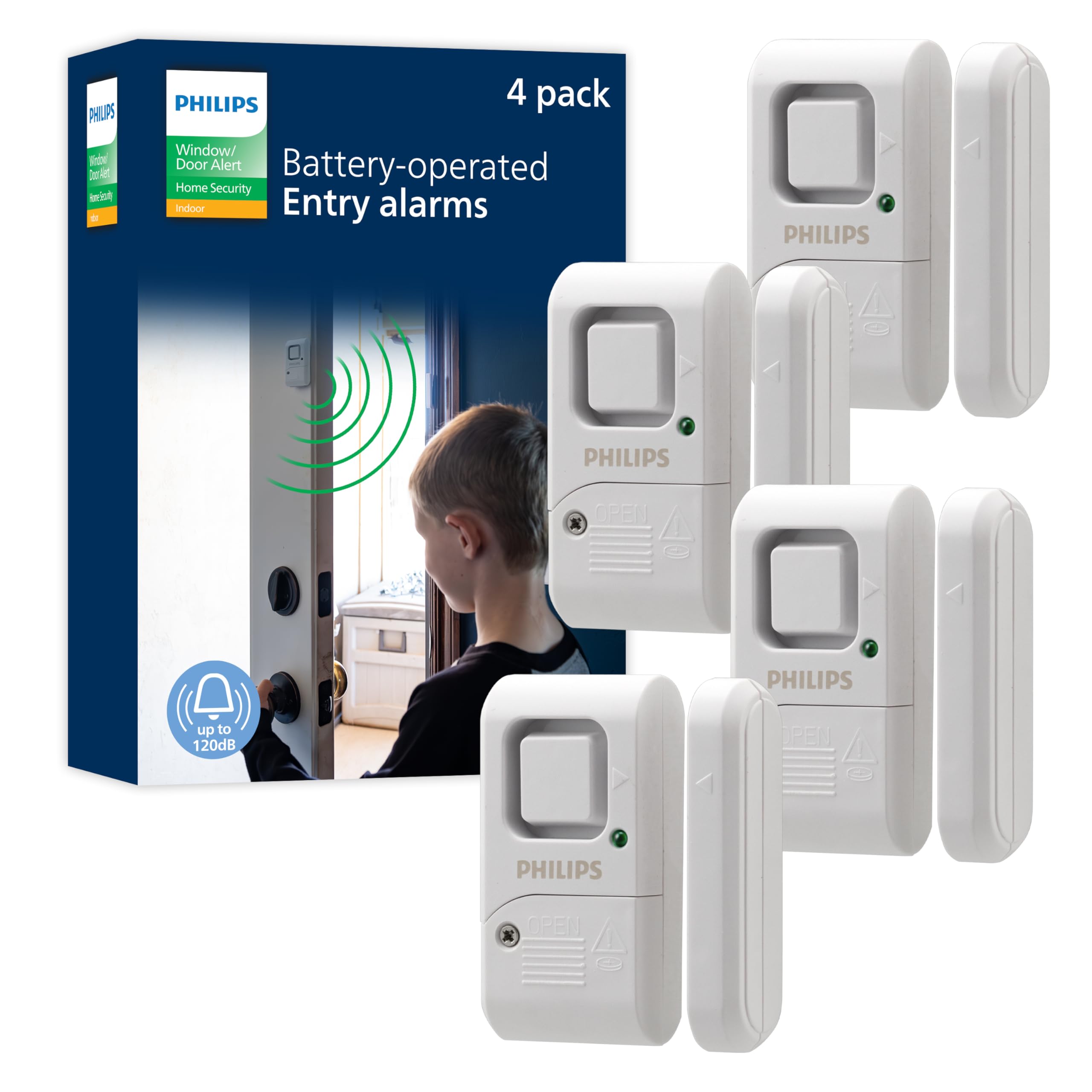
The Philips 4-pack delivers a loud 120 dB alarm that wakes sleepers and deters intruders. Peel-and-stick installation takes seconds with no tools or wiring required, making it one of the most approachable security upgrades you can buy.

On smooth, clean surfaces the adhesive holds well under normal conditions. On textured or uneven frames, grip can loosen over time – a known tradeoff in budget standalone alarms that is easily managed with a few screws or stronger mounting tape.

Ideal for renters, RV owners, or anyone needing quick, no-drill security on smooth surfaces. For uneven frames, plan to reinforce with screws or 3M VHB tape to prevent spontaneous detachment. No smart features or remote alerts – the alarm sounds only at the sensor itself.

Tip: On rough or painted surfaces, use the included screws or upgrade to 3M VHB tape for a more permanent hold.

Bottom line: A straightforward, affordable perimeter alarm that does one thing well – no subscriptions, no connectivity, just a loud siren on entry.

2

Ring 6-Pack Sensor

Ring 6-Pack Sensor

Ring system expansion

Our Score 9.4/10
Check Price

Worth Noting

  • Pairing can occasionally require a reset when adding multiple sensors at once.
  • Battery life may drain faster than the three-year estimate in some units.
  • For buyers without a Ring base station, these sensors offer no standalone functionality
Type
Smart (hub+plan)
Adhesive
Peel-and-stick
Loudness
Ecosystem
Ring

Designed exclusively for the Ring Alarm ecosystem, these contact sensors pair in seconds via QR code and mount flush against door and window frames. The compact second-generation design is noticeably slimmer than the original, fitting tight spaces without protruding.

Detection reliability is high in most setups, with the Z-Wave connection maintaining a consistent link to the base station. Battery life is rated up to three years, though some units may show low battery warning sooner – a CR2032 swap is straightforward. Occasional pairing hiccups can occur when adding sensors, but a quick reset usually resolves them.

This 6-pack is the natural choice for Ring Alarm owners expanding coverage across multiple entry points. It requires the Ring Alarm Base Station (sold separately) and a Protect subscription for mobile alerts, so buyers new to Ring should factor in that upfront and recurring cost. Homeowners comfortable with ecosystem lock-in and ongoing fees will find the convenience and reliability worth the commitment.

Tip: If a sensor shows low battery shortly after installation, try a fresh CR2032 – some units may ship with pre-installed batteries that are partially drained.

Bottom line: For existing Ring homeowners, this 6-pack is the logical, cost-effective expansion; for anyone else, the upfront base station cost and ongoing subscription make it a non-starter unless they already plan to adopt the Ring ecosystem.

3

YoLink 3-Pack

YoLink 3-Pack

Large properties

Our Score 9.0/10
Check Price

Worth Noting

  • Requires YoLink hub (sold separately) to access app notifications and automations.
  • Alexa integration can have occasional glitches that require skill re-enabling.
Type
Smart (hub req)
Adhesive
Peel-and-stick
Loudness
Ecosystem
YoLink

Up to a quarter-mile open-air range sets these sensors apart from typical Wi-Fi or Z-Wave units, which often lose connection beyond 100 feet indoors. The LoRa radio protocol penetrates thick walls and reaches detached garages, basements, and outbuildings. Notifications arrive quickly through the YoLink app, and there are no subscription fees — just a one-time hub purchase.

This three-pack is built for large properties, remote cabins, or any setting where standard smart sensors fall short. Home Assistant and Alexa users can integrate without monthly fees, but the YoLink hub (sold separately) is required for app access and automations. Occasional Alexa skill glitches have been noted, so testing with your setup beforehand is a good idea.

Setup is straightforward: scan the QR code on each sensor with the YoLink app for instant pairing. The included AA battery is rated for up to five years of use, and the adhesive backing holds well on clean surfaces. For users who need long-range coverage and don't mind adding a dedicated hub, this pack delivers consistent performance.

Tip: Keep the YoLink skill updated in Alexa to reduce occasional disconnects.

Bottom line: For large properties needing long-range coverage without monthly fees, the YoLink 3-pack is a strong choice — just budget for the separate hub.

4

SimpliSafe 4-Pack

SimpliSafe 4-Pack

SimpliSafe owners

Our Score 9.6/10
Check Price

Worth Noting

  • Only works with SimpliSafe base station; remote alerts require a monitoring plan.
  • Some units may ship with a sensor that does not pair or trigger out of box.
Type
Smart (hub+plan)
Adhesive
Peel-and-stick / screw
Loudness
Ecosystem
SimpliSafe

SimpliSafe's Entry Sensor pack pairs with any Gen 3 base station in seconds, giving existing owners a direct path to expand coverage. The peel-and-stick mounting and pre-installed battery make setup a two-minute task, and the sensors feel solid in hand with no rattle or loose plastic. Within the SimpliSafe system, they trigger the base siren and push mobile alerts when a monitoring plan is active.

This pack is built for current SimpliSafe users who want to add door or window protection without learning a new app or dealing with cross-platform quirks. It requires the base station to function at all, and mobile alerts depend on a paid monitoring plan — not a surprise for anyone already in the ecosystem, but a firm boundary for newcomers. Some sensors may arrive with pairing issues or fail to trigger straight out of the box, so testing each unit during install is wise.

Optional professional monitoring adds a layer of response dispatch, but the sensors themselves work as standalone local alarms through the base station even without a plan. The 4-pack brings per-sensor costs down compared to buying singles, and the high rating reflects consistent performance across thousands of installations.

Tip: To receive mobile alerts when sensors trigger, sign up for a SimpliSafe monitoring plan; without it, only the base station alarm sounds.

Bottom line: For SimpliSafe owners, this pack is the natural expansion choice — no competing sensor matches its ecosystem integration. For those without a base station, look elsewhere.

5

Tapo T31 Kit

Tapo T31 Kit

Multi-platform smart

Our Score 8.8/10
Check Price

Worth Noting

  • Hub can disconnect from Wi-Fi and requires a manual power cycle to reconnect
  • Adhesive pads may not hold well on uneven or porous surfaces long-term
Type
Smart (hub incl.)
Adhesive
Peel-and-stick
Loudness
90 dB adj.
Ecosystem
Matter

This kit bundles a Smart Hub with three contact sensors, making it a self-contained entry point into Matter-compatible smart homes. The hardware pairs quickly via the Tapo app and works with Alexa, Google Home, Apple HomeKit, and SmartThings out of the box – no monthly fees for local alarms or push notifications.

Detection is consistent across the three sensors, with a 90 dB adjustable alarm and up to two years of battery life per sensor. The main tradeoff involves the hub: it can drop its Wi-Fi connection, requiring a manual power cycle to restore. That behavior is sporadic but worth noting if you need always-on monitoring. The included adhesive pads hold on smooth surfaces but may need reinforcement for textured walls or high-humidity areas.

This kit suits tech enthusiasts exploring multi-ecosystem automation without recurring costs. For homes where the hub can be placed close to the router and occasional connectivity interruptions are acceptable, it offers strong value. Those needing absolute hub stability or more than three sensors from the start should look at purpose-built alarm systems or buy additional sensors separately.

Tip: If the hub disconnects, power-cycling the hub (unplug and plug back in) typically restores connection; placing it within a few feet of the router may reduce the frequency.

Bottom line: A cost-effective introduction to Matter-based sensors for those who can accommodate occasional hub resets and don't mind adding stronger mounting tape for certain surfaces.

6

UltraPro 6-Pack

UltraPro 6-Pack

Budget coverage

Our Score 9.0/10
Check Price

Worth Noting

  • Adhesive may lose grip on uneven or textured surfaces over time.
  • Alarm volume cannot be adjusted
Type
Standalone magnetic
Adhesive
Peel-and-stick
Loudness
120 dB
Ecosystem
None

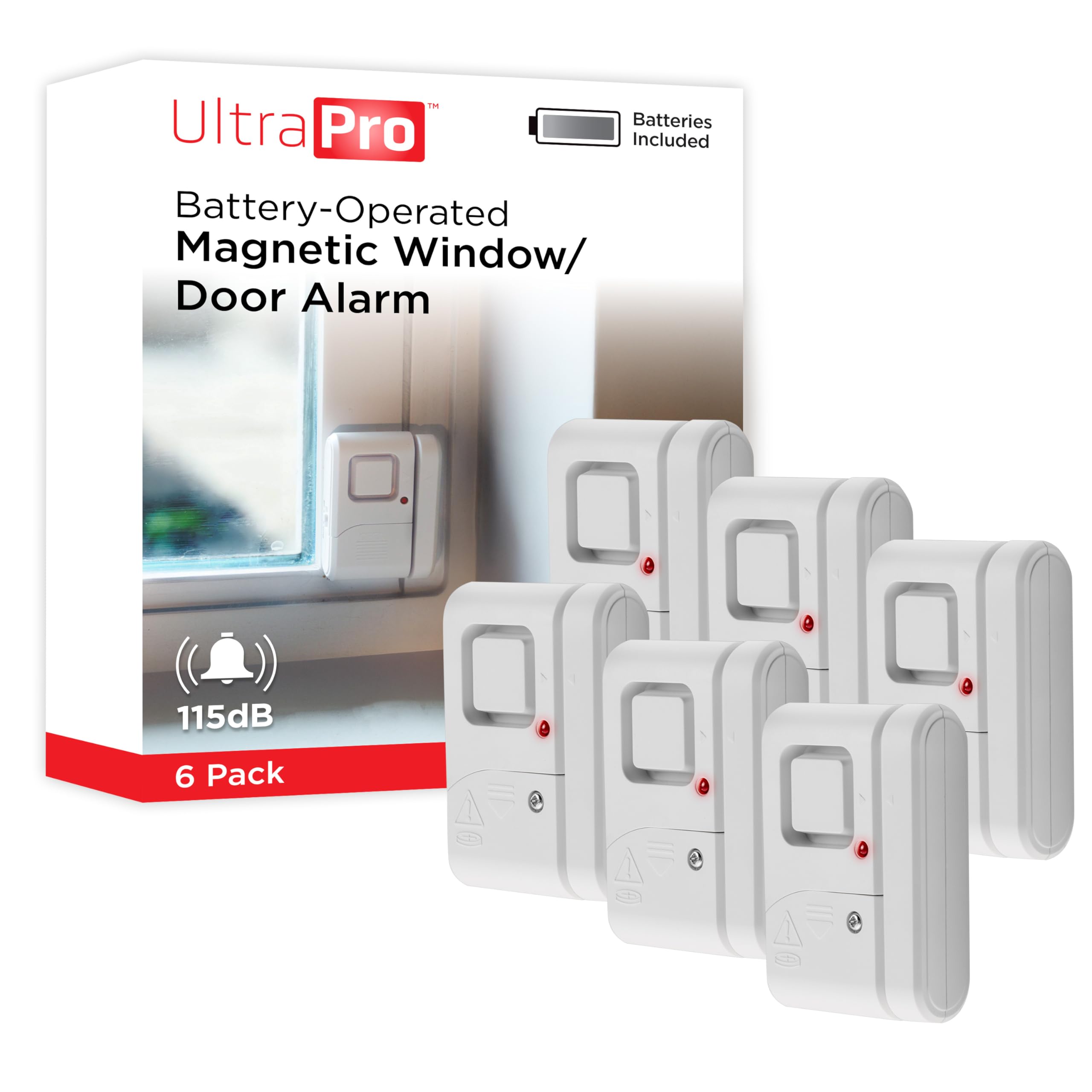
The UltraPro 6-pack delivers the loudest alarm in its price bracket — 120 dB from six sensors at the lowest cost per unit. While the top pick offers better adhesive reliability and a less jarring volume, the UltraPro is the go-to for buyers who want every entry point covered with maximum sound output.

This pack suits garages, workshops, or temporary setups where the alarm's intensity isn't a nuisance and adhesive can be reinforced with screws or stronger tape. The loud, fixed volume and occasional adhesive separation on uneven surfaces are real boundaries — buyers should plan for extra mounting tape or alternative fastening.

Each sensor triggers reliably on separation, with the peel-and-stick install taking only minutes. The main practical constraint is the alarm's volume: it works as a strong deterrent but can be startling in an enclosed hallway.

Tip: Use screws or stronger double-sided tape for long-term installation on painted or rough surfaces.

Bottom line: The six-pack gives you the most sensors per dollar at a volume that deters, but only if you can tolerate the fixed loudness and reinforce the adhesive.

7

UltraPro 2-Pack

UltraPro 2-Pack

Ultra-budget

Our Score 9.0/10
Check Price

Worth Noting

  • Adhesive may lose grip on uneven or dusty surfaces
  • Siren volume is fixed at 120 dB, which can be uncomfortably loud for some
Type
Standalone magnetic
Adhesive
Peel-and-stick
Loudness
120 dB
Ecosystem
None

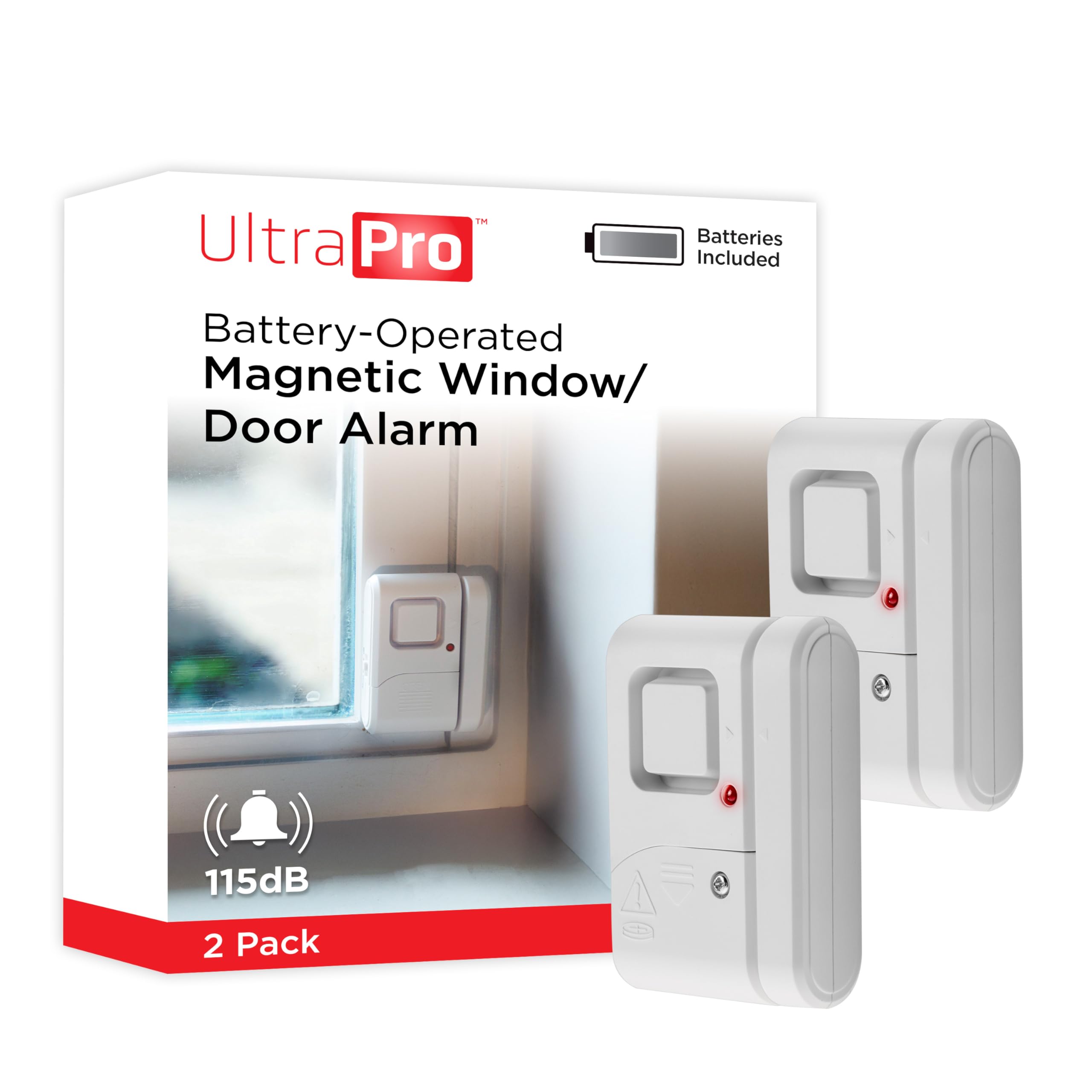
The UltraPro 2-Pack delivers two 120 dB alarms at a price that undercuts most single-sensor options. Installation is genuinely tool-free: peel off the backing and stick. The alarm triggers reliably when the magnetic contact is broken. However, the adhesive may loosen on rough or painted surfaces, and the siren's fixed volume can be jarring in quiet rooms. This makes the UltraPro best suited for temporary setups — a dorm room, a travel doorstop, or a rental where permanent mounting isn't an option. For long-term use, consider reinforcing with screws or heavy-duty tape.

Bottom line: Best for temporary use where price and loudness are prioritized over long-term adhesion reliability.

8

Sanjie 5-Pack

Sanjie 5-Pack

Volume control

Our Score 8.8/10
Check Price

Worth Noting

  • Individual units may trigger false alarms or not sound when triggered
  • Adhesive may not hold securely on rough or textured surfaces
Type
Standalone magnetic
Adhesive
Peel-and-stick
Loudness
125 dB adj.
Ecosystem
None

Sanjie's 5-pack delivers adjustable volume levels — chime, 100 dB low alarm, and 125 dB high alarm — a rare feature at this price point. Installation is adhesive and tool-free. The maximum loudness covers typical home layouts. However, individual units may occasionally not sound when expected or trigger false alerts, and the adhesive grip can be inconsistent on uneven or rough surfaces. These unit-to-unit variations keep it from matching the consistency of top standalone options like the UltraPro 6-pack.

Tip: For better adhesion on rough surfaces, use screws or replace with stronger double-sided tape.

Bottom line: A viable option for noise-sensitive buyers who need multiple adjustable alarms and are willing to accept occasional unit inconsistencies.

9

TECKNET 6-Pack

TECKNET 6-Pack

Child safety

Our Score 9.2/10
Check Price

Worth Noting

  • Adhesive can weaken over time, leading the sensor to fall off in some cases.
  • Maximum volume may be too low for large homes or noisy environments.
Type
Standalone magnetic
Adhesive
Peel-and-stick
Loudness
Adj. levels
Ecosystem
None

The TECKNET 6-pack adds adjustable volume control to a basic magnetic alarm, offering a chime setting for daytime use and two louder tones for alerts. This makes it a better fit for noise-sensitive environments like homes with young children or pool gates, where a blaring siren would be disruptive. However, the maximum volume may not carry across larger homes or compete with ambient noise, and the adhesive backing can lose grip over time on some surfaces, causing the sensor to detach. Compared to alternatives like the 5-pack with similar volume options, the TECKNET’s higher piece count suits broader coverage, but the loudness ceiling and adhesive variation keep it from replacing a dedicated security system.

Bottom line: Best for parents monitoring pool gates or child doors where moderate volume is acceptable and the adhesive can be reinforced with screws or stronger tape.

10

Aqara 3-Pack Sensor

Aqara 3-Pack Sensor

Aqara expansion

Our Score 8.8/10
Check Price

Worth Noting

  • May disconnect or show as offline during use.
  • Only works with Aqara hubs; third-party Zigbee compatibility is inconsistent.
Type
Smart (hub req)
Adhesive
Peel-and-stick
Loudness
Ecosystem
Aqara / HomeKit

The Aqara sensor’s slim profile fits flush on narrow window and door frames, and its Zigbee connection delivers near-instant alerts to HomeKit, Alexa, and IFTTT. Battery life is rated at two years, and the three-pack offers good value for expanding an existing Aqara setup.

The trade-off is that these sensors require an Aqara hub—they are not universal Zigbee devices. Additionally, some units may lose connection or show as offline temporarily, which is worth checking if you need always-on monitoring. This suits Aqara or HomeKit users who already own the hub and can accept occasional hiccups.

Bottom line: Best for existing Aqara or HomeKit users who value compact hardware and fast alerts, but not for those seeking hub-free or always-on reliability.

11

eufy Entry Sensor

eufy Entry Sensor

eufy system

Our Score 9.2/10
Check Price

Worth Noting

  • Battery life may fall short of claims in homes with frequent door openings
  • Adhesive grip may weaken on textured or uneven surfaces
Type
Smart (hub req)
Adhesive
Peel-and-stick
Loudness
Ecosystem
eufy

Within the eufy Security ecosystem, this sensor pairs directly with the HomeBase for instant setup and responsive alerts. Its claimed 800-day battery life stands out among smart contact sensors, and local storage means no monthly fees for recorded events. However, this sensor only works with a eufy HomeBase — it has no Alexa or HomeKit automation, and the single-unit price is high compared to multi-packs from other brands. That makes it a practical choice only for those already invested in the eufy system.

Bottom line: A good pick for existing eufy users who need one replacement sensor and value long battery life, but skip it if you plan to expand to multiple sensors or want cross-platform integration.

12

Hue Contact Sensor 2-Pack

Hue Contact Sensor 2-Pack

Hue automation

Our Score 9.2/10
Check Price

Worth Noting

  • Per-sensor cost is higher than many standalone and smart alternatives
  • Notifications and alarm features are limited without the Hue Secure subscription, reducing its value for security use
Type
Smart (hub req)
Adhesive
Peel-and-stick
Loudness
Ecosystem
Hue

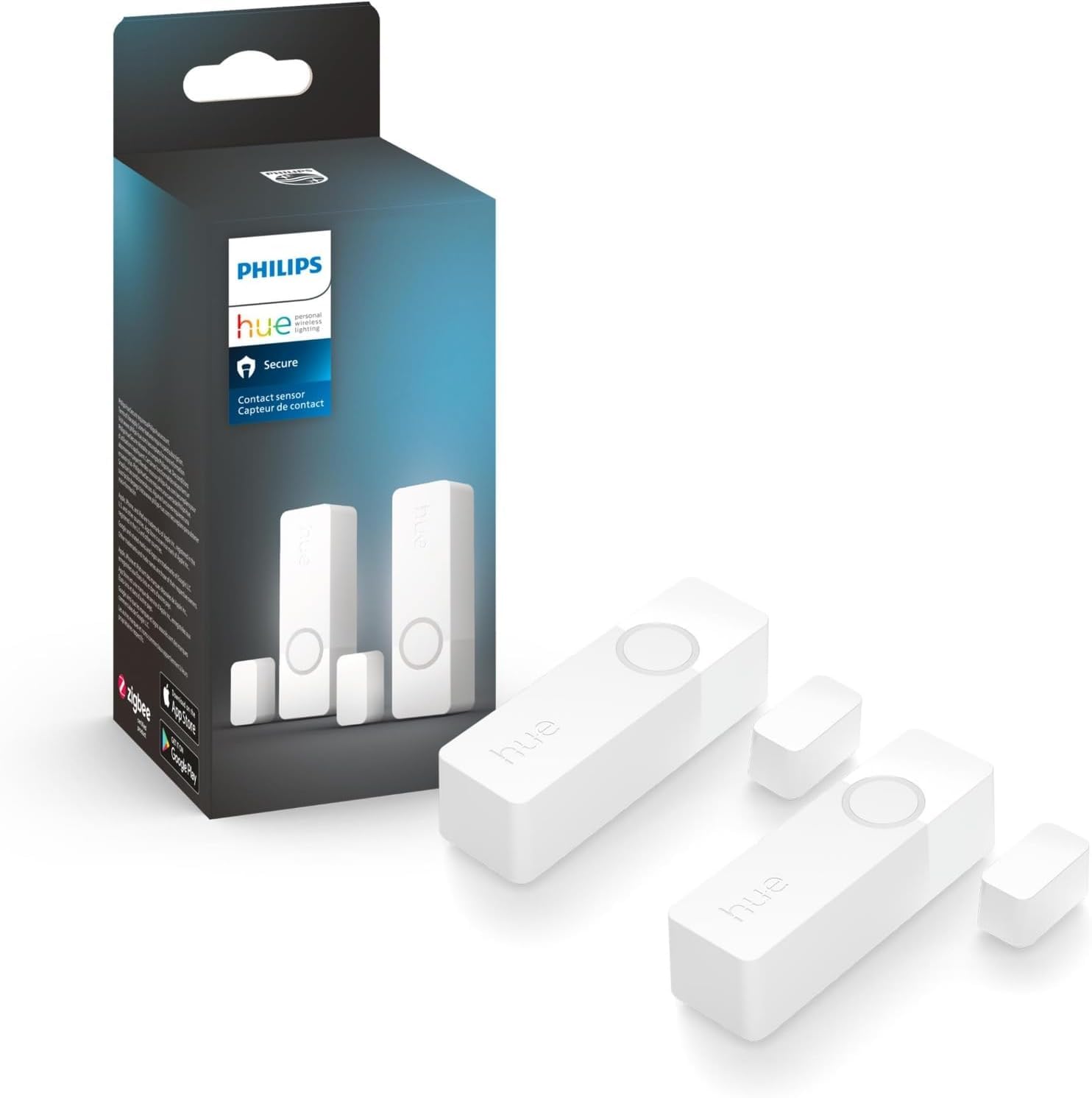
The Philips Hue Secure Contact Sensor pairs instantly with Hue lights for automated scenes — open a door and a hallway light turns on, close it and the lamp dims. Build quality is polished, and peel-and-stick installation takes seconds. However, this is a two-sensor pack at a premium price, and core features like mobile alerts and alarm chimes require the Hue Secure subscription. Without it, the sensor is limited to local light automation only. For anyone not deeply invested in Hue, the per-sensor cost and subscription dependency make this a narrow fit.

Bottom line: Best for existing Hue users who want light-based automation and don't need mobile alerts without a subscription — skip it if you're outside the Hue ecosystem or want a general-purpose sensor.

13

SimpliSafe Single

SimpliSafe Single

Single expansion

Our Score 9.6/10
Check Price

Worth Noting

  • Requires SimpliSafe base station
  • Battery compartment can be difficult to open for replacement in some cases.
Type
Smart (hub req)
Adhesive
Peel-and-stick / screw
Loudness
Ecosystem
SimpliSafe

This single SimpliSafe Entry Sensor offers the same consistent detection and peel-and-stick installation as the 4-pack, making it a convenient option when you need to cover one additional door or window or replace a failed unit. It pairs instantly with any SimpliSafe Gen 3 base station. However, the per-sensor cost is higher than buying the pack, so this only makes sense if you truly need just one. The battery compartment can be tight to open for replacement, and the sensor has no standalone functionality — it requires the SimpliSafe system.

Bottom line: The right pick when you need exactly one sensor for your SimpliSafe system, but the 4-pack is more cost-effective if you need more than one.

How to Choose

Standalone vs. Smart

Standalone magnetic alarms are self-contained: they detect separation and sound a local siren. No hub, no app, no monthly fee. Their limitation is that you won't get a phone alert — you must be within earshot.

Smart sensors require a proprietary hub (or existing alarm base station) to relay notifications. They offer remote alerts and automation, but the hub purchase and optional subscription add $50–100 to the upfront cost. Choose standalone if you only need a local deterrent; choose smart if you need to know when you are away.

Loudness and Volume Control

Most standalone alarms advertise 120 dB, which is loud enough to deter an intruder but can be painfully shrill indoors, especially in small apartments or near bedrooms. Some models offer a chime mode or lower volume setting, which is more practical for daily use.

Smart sensors typically trigger a siren on the hub rather than on the sensor itself, so the loudness depends on the hub's speaker. If you live in a multi-unit building or have sensitive ears, a volume-adjustable standalone or a smart sensor with chime mode is a better fit.

Adhesive and Mounting

Adhesive strips are the most common mounting method, but they are not universal. Painted, textured, or uneven surfaces reduce adhesion strength, and many sensors fall off within weeks. For long-term installations, consider sensors that allow screw mounting or plan to use heavy-duty 3M tape.

If you are a renter or cannot drill holes, peel-and-stick is still the best option — just prep the surface with alcohol and press firmly for 30 seconds. Some users report success with a dab of super glue on the adhesive for extra grip.

Battery Life

Battery life varies from 1 to 5 years depending on the sensor type and how often it triggers. Standalone magnetic alarms typically use small LR44 cells that last about a year; smart sensors on Zigbee or LoRa can run 2–5 years on a single CR2032 or AA battery.

The trade-off is that longer battery life often comes with a larger sensor body. If you need a slim profile for narrow door frames, expect more frequent battery changes. Always check if the battery is replaceable — some sensors are sealed and must be replaced entirely.

Ecosystem Compatibility

Smart sensors are tied to a specific brand's hub: Ring, SimpliSafe, Aqara, YoLink, or Matter-compatible platforms. If you already own a hub, adding sensors from the same ecosystem is seamless. If you are starting from scratch, a Matter-certified kit like the Tapo T31 gives you flexibility to change platforms later.

Beware of sensors that require a subscription for basic features like mobile alerts or chime sounds. The ecobee sensor, for example, is nearly useless without its monthly Smart Security plan. Always read the fine print before committing to an ecosystem.

Frequently Asked Questions