Tools & DIY

11 Best Clamp Meter of 2026: Match Your Tasks with DC Capability

Which clamp meter measures DC current accurately? Find the best for automotive, HVAC, or home use without overpaying for features you don't need.

Many clamp meters on the market only measure AC current. That's fine if you're checking household outlets, but it becomes a problem if you work on cars, solar panels, or HVAC systems with DC circuits. Buyers often discover this limitation only after purchase.

Even meters with DC capability vary in reading stability, display readability in sunlight, and long-term reliability. A low price can hide accuracy drift or a screen that washes out outdoors.

This guide focuses on finding the right tool for your actual electrical work — whether you need microamps for flame rods, milliamps for parasitic draws, or a rugged daily driver for AC distribution panels. The choice comes down to matching specs to your specific tasks, not chasing the most features.

1

Fluke 301D

Top Pick
Fluke 301D

Tight panel work

Our Score 9.4/10
Check Price

Worth Noting

  • Very compact body may feel cramped for users with large hands during prolonged work
True RMS
Yes
AC/DC Current
600A AC/DC
Safety Rating
CAT III 300V
Display Readability
LCD

The Fluke 301D slips into a shirt pocket and its 10mm jaw slides between tightly packed wires, making it the most portable AC/DC clamp meter at this price. It measures up to 600A AC and DC with True RMS, so waveform distortion won't throw off readings. Capacitance and continuity checks round out the core functions for electrical and HVAC work.

In cramped breaker panels and behind appliances, the slim jaw reaches conductors that would be inaccessible to bulkier meters. The display is easy to read even in direct sunlight, a practical advantage for outdoor or bright workshop use. The rotary switch and button layout are simple enough to operate one-handed, though the small body may feel cramped for technicians with larger hands during extended use.

This meter suits electricians who regularly work in tight spaces, HVAC techs who need DC current for troubleshooting motors and controls, and anyone who wants to lighten their toolbag without losing measurement capability. The compact size is a deliberate tradeoff: if you prefer a full-size meter with a large display or have very large hands, the 301D will feel small. For everyone else, it's a precise and portable solution.

Tip: Try the meter in hand before buying if you have larger hands - the compact size is a deliberate tradeoff for portability.

Bottom line: If you need a clamp meter that fits in a pocket and handles AC/DC current up to 600A without sacrificing accuracy, the Fluke 301D delivers where larger meters can't go.

2

Fluke 902 FC

Fluke 902 FC

HVAC diagnostics

Our Score 9.4/10
Check Price

Worth Noting

  • Premium pricing adds cost for general-purpose needs, though it fits HVAC budgets
  • Probe lead sheaths may come loose after extended use
True RMS
Yes
AC/DC Current
600A AC/DC, µA DC
Safety Rating
CAT III 600V
Display Readability
LCD

The Fluke 902 FC is purpose-built for HVAC service technicians, with a 200 µA DC range that reliably catches microamp signals from flame rods – a measurement most clamp meters skip entirely. Wireless data logging through Fluke Connect allows remote monitoring of system trends, which is helpful when you need to track performance over time without being tethered to the panel. That makes it a more specialized tool than the slimmer AC/DC meters in this guide.

This meter is ideal for HVAC techs who regularly diagnose burner control circuits, temperature sensors, and refrigeration systems. The premium price reflects niche features that add no value for general electrical or automotive work, so hobbyists and electricians should look elsewhere. Some owners note that the probe lead sheaths can loosen over time – an occasional inconvenience worth checking during routine tool maintenance.

Tip: Check probe lead sheaths periodically to ensure they remain snug, particularly after frequent plugging and unplugging.

Bottom line: If your work revolves around HVAC systems – especially flame rod diagnostics and wireless data logging – the Fluke 902 FC delivers exactly what you need. For general electrical or automotive tasks, the top pick is a more practical choice.

3

UNI-T UT210e

UNI-T UT210e

Parasitic draw test

Our Score 9.2/10
Check Price

Worth Noting

  • Maximum current limited to 100A
True RMS
Yes
AC/DC Current
100A AC/DC
Safety Rating
CAT III 300V
Display Readability
LCD

The UNI-T UT210e cuts through the category’s usual omission of DC current with true milliamps resolution. Unlike most budget clamp meters that skip DC altogether, this compact unit reads current as low as 1mA – a critical capability for tracking down battery drains in vehicles that other meters simply miss. At this price point, that level of low-current precision is hard to match.

Its pocket-friendly size and jaw fit into cramped engine bays and tight fuse boxes, which is exactly where automotive enthusiasts and electronics hobbyists work. The 100A AC/DC limit is a real boundary though – anyone needing to measure high-amperage commercial loads should look to the top pick Fluke 301D. For car diagnostics or bench-level electronics, the UT210e’s range is more than adequate.

True RMS and VFC mode add utility for non-linear signals, while the 2000-count display keeps readings clear in most lighting. The build feels budget-appropriate – plastic body with decent grip – but the value tradeoff is clear: you get capabilities usually found in meters costing twice as much, as long as you stay within its 100A ceiling.

Bottom line: If your work involves automotive parasitic draws or low-current electronics, this budget-friendly meter delivers precision that many pricier options lack – just keep it away from industrial high-amperage circuits.

4

Fluke 323

Fluke 323

AC panel work

Our Score 9.4/10
Check Price

Worth Noting

  • Cannot measure DC current
  • Included soft case is bulky and doesn't fit leads well
True RMS
Yes
AC/DC Current
400A AC only
Safety Rating
CAT IV 300V
Display Readability
LCD

The Fluke 323 delivers CAT IV 600V safety and True RMS accuracy on AC circuits, backed by field-tested consistency. Unlike the slimmer compact meters that offer both AC and DC current, the 323 focuses on AC-only distribution work where safety and ruggedness take priority over feature breadth.

This meter suits professional electricians and facility maintenance teams who work primarily on commercial AC panels. It does not measure DC current, so automotive diagnostics and solar installations are outside its scope. For those who need DC, a compact AC/DC clamp meter in this lineup fills that gap.

The simple dial and large digits make it straightforward to select functions and read values, even in dimly lit panels. Some users note that the included soft case lacks dedicated lead storage, but the meter itself remains a familiar tool on commercial sites.

Tip: The soft case is spacious but has no dedicated lead slots – rolling the leads or using a separate pouch helps keep things tidy.

Bottom line: For commercial electricians who work exclusively on AC distribution, the Fluke 323 provides consistent accuracy and high safety ratings that justify its premium price. If DC measurement is needed, the slimmer AC/DC options in this lineup are a better fit.

5

FNIRSI DMC-100

FNIRSI DMC-100

Budget feature seekers

Our Score 9.2/10
Check Price

Worth Noting

  • Accuracy can drift on some measurements, limiting its use for critical diagnostics.
  • Display text is small, which may be hard to read for those with vision difficulties.
True RMS
Yes
AC/DC Current
600A AC/DC
Safety Rating
CAT III 600V
Display Readability
TFT

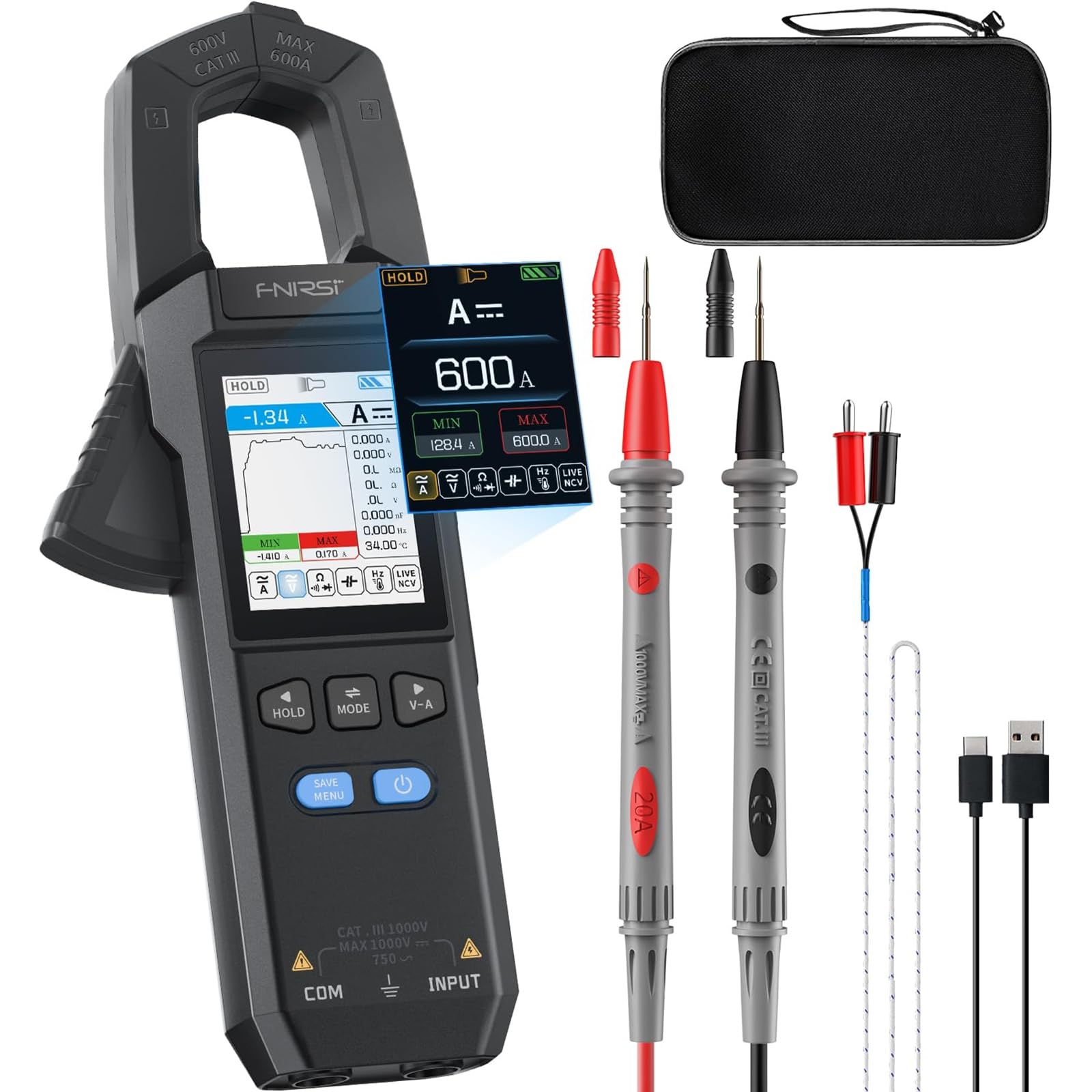
The FNIRSI DMC-100 stands apart from other budget clamp meters by including a bright 2-inch TFT display that remains readable in dim environments and a USB-C rechargeable battery that eliminates the need for replacement coin cells. Curve recording and data storage let you track current trends over time, and dual UI themes add a touch of customization rarely seen at this price point. It handles up to 600A AC/DC and covers voltage, resistance, and capacitance — a broad feature set for occasional troubleshooting.

This meter is best suited for hobbyists and DIYers who want advanced functionality without spending over $100. The accuracy consistency can vary between units — some measurements may drift, so it is not a reliable tool for professional diagnostics where repeatable precision matters. The compact screen is another consideration: text appears small, which may be a strain for those who need reading glasses. For occasional automotive or home electrical work, these trade-offs are manageable.

Compared to the slimmer AC/DC clamp meter in this roundup, the DMC-100 offers more screen real estate and a rechargeable battery, but it does not match the compact size or the tighter accuracy of that alternative. If fit and consistent readings are your priority, that model is the better choice. The DMC-100 earns its place as a feature-rich secondary meter for light-duty use.

Tip: Adjust the screen brightness in settings; the default may be too bright for low-light use.

Bottom line: If you want a feature-rich clamp meter for occasional home or automotive use and can accept some accuracy variance, the DMC-100 delivers impressive value — but for consistent precision, consider the slimmer AC/DC meter in this group.

6

Klein CL120

Klein CL120

Basic AC tasks

Our Score 9.4/10
Check Price

Worth Noting

  • Cannot measure DC current
  • Auto-ranging lacks True RMS, so readings on non-sinusoidal waveforms may be less accurate.
True RMS
No
AC/DC Current
400A AC only
Safety Rating
CAT III/IV capped
Display Readability
Backlit LCD

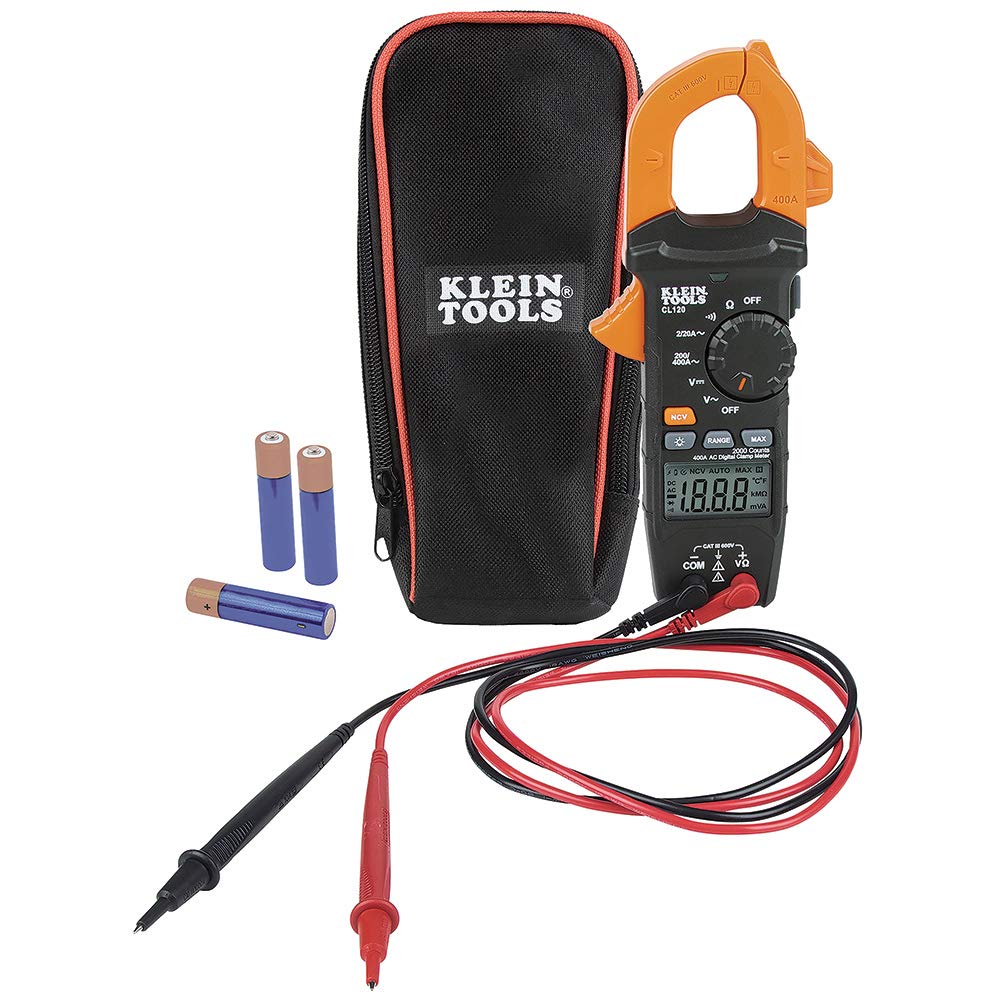
The Klein CL120 stands out for its straightforward operation and clear display – the most beginner-friendly entry-level meter in this roundup. However, it lacks both DC current measurement and True RMS, which means it cannot handle automotive, solar, or non-linear loads. For homeowners diagnosing AC appliance circuits or checking outlet voltage, those omissions rarely matter. The compact size and solid build add to the appeal for occasional use.

Bottom line: This meter fits best for homeowners who need a simple, affordable AC-only clamp meter for basic household circuits and have no need for DC current or True RMS.

7

Klein CL390

Klein CL390

HVAC and DIY

Our Score 9.4/10
Check Price

Worth Noting

  • Display unreadable in direct sunlight due to reverse-contrast screen.
  • Some units may stop functioning after several months of use.
True RMS
Yes
AC/DC Current
400A AC/DC, µA DC
Safety Rating
CAT III/IV 600V
Display Readability
Hi-Viz LCD

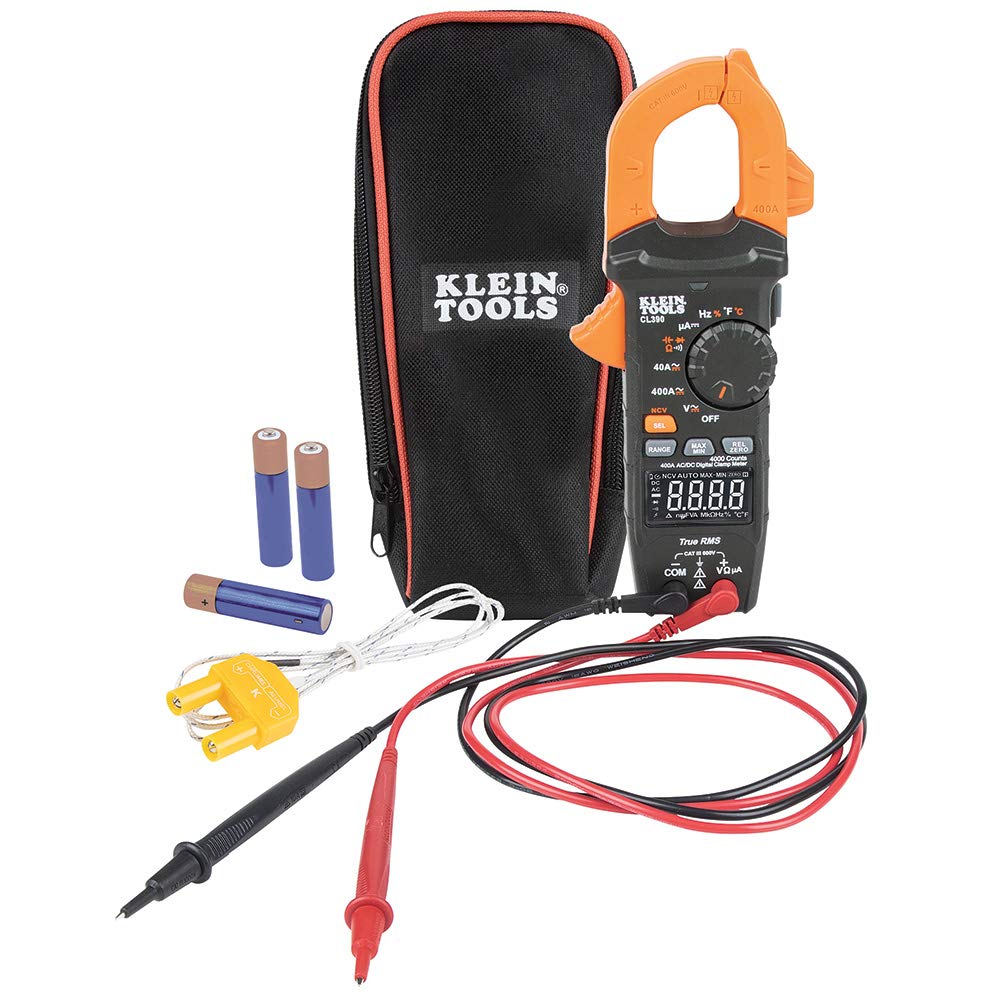
The Klein CL390 offers DC microamps, temperature, True RMS, and duty cycle at a competitive price — a rare combination for under $100. However, the reverse-contrast display washes out in direct sunlight, restricting use to indoor or shaded areas. Some units have been known to stop functioning after months, raising concerns about long-term durability. These limitations keep it from our top pick, but for HVAC techs who work mostly indoors and need these specific features, it remains a compelling option.

Bottom line: Best suited for indoor HVAC work and DIY tasks where sunlight and long-term durability are not primary concerns.

8

Fluke 302+

Fluke 302+

Commercial AC work

Our Score 9.4/10
Check Price

Worth Noting

  • In automotive or solar work, the lack of DC current measurement is a hard stop
  • Fewer measurement functions than the Fluke 323, which may matter for diagnostics requiring frequency or temperature.
True RMS
Yes
AC/DC Current
400A AC only
Safety Rating
CAT IV 300V
Display Readability
LCD

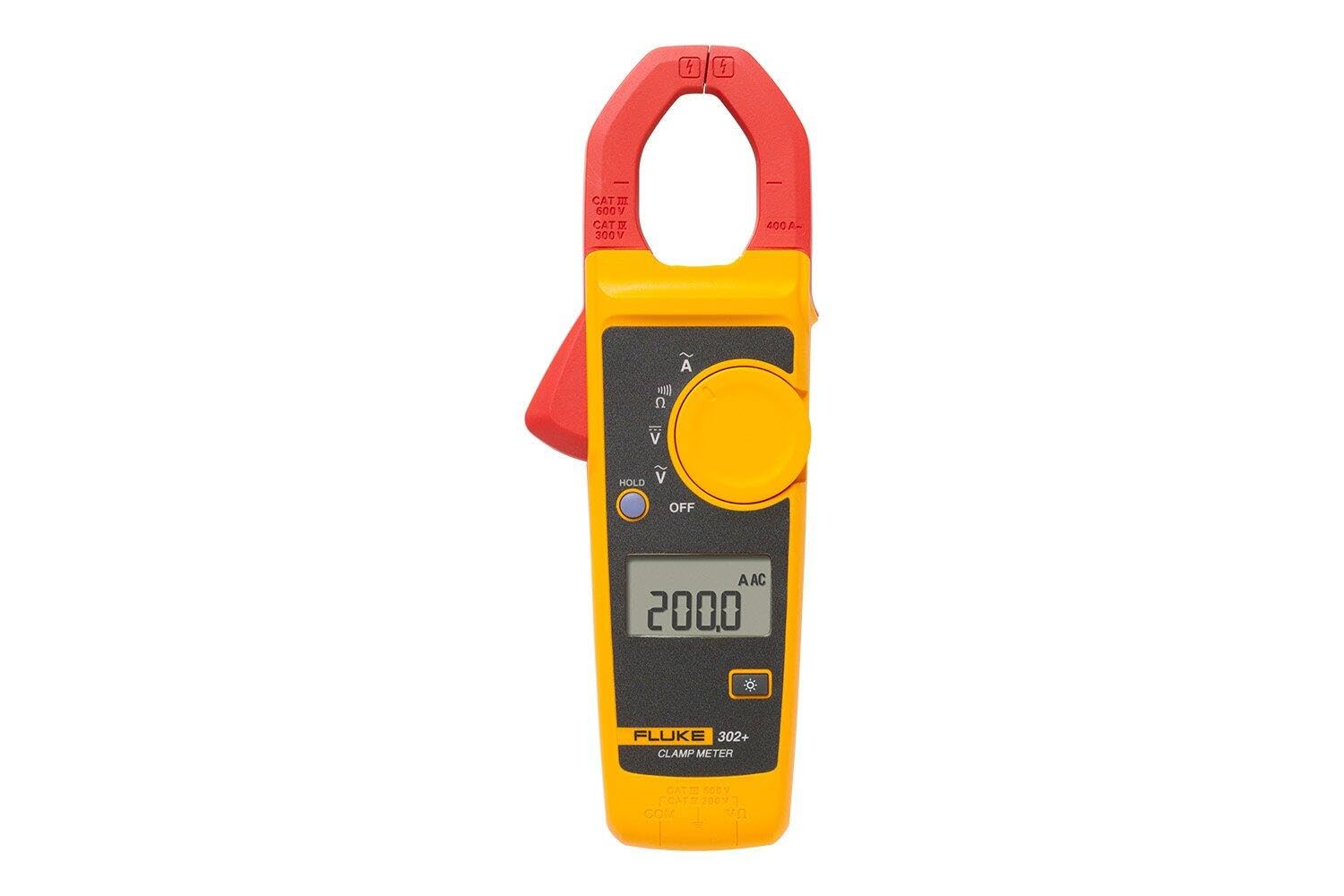
The Fluke 302+ delivers the build quality and accuracy expected from the brand at a lower price than the similar Fluke 323, and adds capacitance measurement. For commercial electricians working exclusively with AC circuits – up to 400A and 600V with True RMS – it handles the basics without fuss. The tradeoff is that DC current is not measured, which excludes automotive, solar, and HVAC flame-rod diagnostics entirely. It also lacks some functions (frequency, temperature) that the 323 includes, so buyers who need those capabilities should step up. This meter suits industrial maintenance where only AC loads are encountered and where Fluke's durability is valued over extra features.

Bottom line: Best for commercial electricians and industrial maintenance who work exclusively with AC circuits and want Fluke reliability at a lower cost, but need to accept the absence of DC current and reduced feature set.

9

Ideal 61-737

Ideal 61-737

Budget TRMS

Our Score 9.4/10
Check Price

Worth Noting

  • No DC current measurement
  • NCVT sensor requires precise wire positioning for consistent detection
True RMS
Yes
AC/DC Current
400A AC only
Safety Rating
CAT III 600V
Display Readability
Backlit LCD

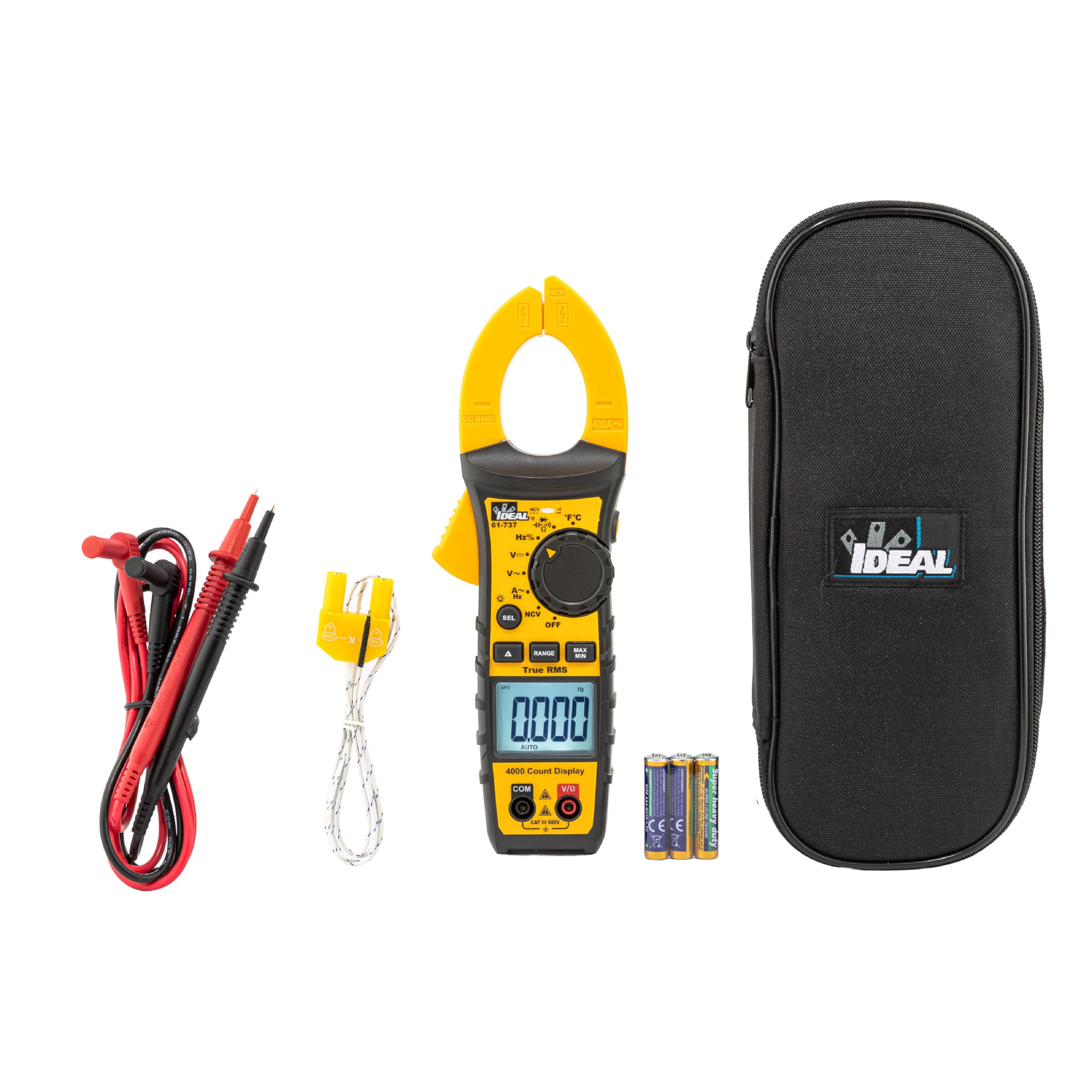
The Ideal 61-737 delivers True RMS accuracy at a budget-friendly price, with a temperature probe and well-built feel. However, it measures AC current only – no DC current – so it is limited to residential AC circuits and cannot be used for automotive, solar, or other DC work. The NCVT sensor can be finicky about wire placement, but for light commercial or home electrical tasks where AC is all you need, this meter covers the basics without unnecessary cost.

Tip: When using the non-contact voltage detector, position the wire near the tip's center for consistent detection.

Bottom line: For AC-only electrical work at a budget price, the Ideal 61-737 offers True RMS accuracy – just plan for the NCVT's need for precise positioning.

10

Klein CL220

Klein CL220

Home AC use

Our Score 9.4/10
Check Price

Worth Noting

  • Cannot measure DC current, limiting it to AC-only tasks
  • LCD display may develop issues after 1-2 years on some units
True RMS
Yes
AC/DC Current
400A AC only
Safety Rating
CAT III 600V
Display Readability
Backlit LCD

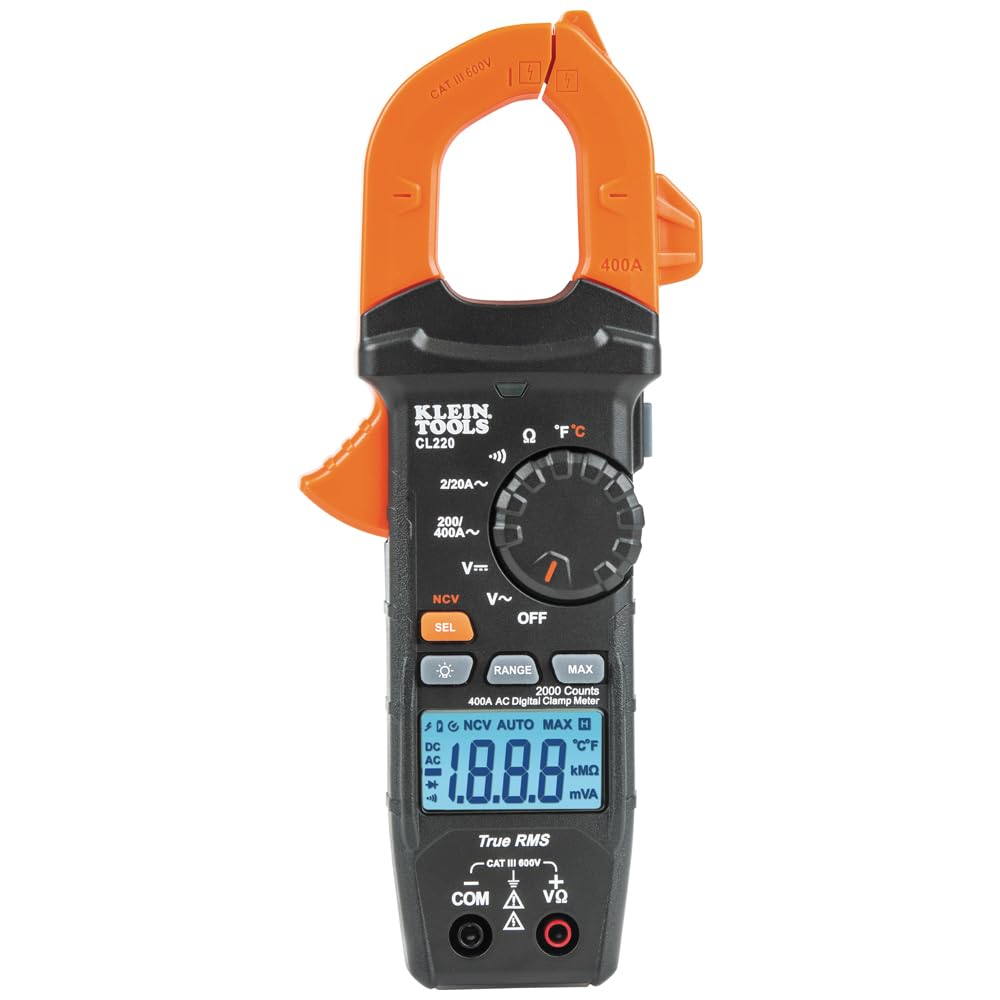
The Klein CL220 is a step up from basic AC-only clamp meters, offering True RMS accuracy and a built-in temperature probe – useful for home electrical work and entry-level HVAC checks. Its auto-ranging works reliably, and the backlit display is easy to read in most conditions. The limitation is that it measures only AC current, so automotive or DC solar applications are off the table. Some units have also shown LCD degradation after a year or two, which adds uncertainty for long-term ownership. For the price, it is a capable tool for those who understand its AC-only scope.

Bottom line: Best suited for home DIYers and entry-level HVAC helpers who only need AC current and temperature measurement, and who can accept the possibility of display wear over time.

11

KAIWEETS D-Shape

KAIWEETS D-Shape

Budget buyers

Our Score 9.0/10
Check Price

Worth Noting

  • Accuracy and long-term durability are not independently verified
  • Maximum AC/DC current rating is not clearly stated, requiring users to infer from typical values.
True RMS
Yes
AC/DC Current
600A AC/DC (likely)
Safety Rating
CAT III 600V
Display Readability
Backlit LCD

The KAIWEETS D-Shape packs a 1.1-inch D-shaped jaw, True RMS, temperature probing, a flashlight, and backlight into a budget-friendly price. Compared to basic AC-only meters like the entry-level Klein, this adds DC current measurement and extra utility for home DIY or light automotive work. However, detailed performance documentation is sparse — accuracy consistency and long-term durability under frequent use are not independently confirmed. This makes it a practical choice for occasional tasks where features outweigh the need for a verified track record.

Bottom line: Best for home users and hobbyists who want many features for occasional measurements and are willing to accept some uncertainty in long-term consistency.

How to Choose

AC and DC Current Measurement Capability

A meter that reads only AC current works for household outlets, motors, and HVAC contactors. DC capability is required for automotive batteries, solar panels, and variable-frequency drives. Many budget models omit DC current entirely.

If you work on cars, boats, or off-grid systems, confirm the meter measures DC amps. The difference is in the clamp's Hall sensor; AC-only clamps rely on a current transformer that cannot sense constant DC flow.

True RMS

True RMS (Root Mean Square) accurately measures non-sinusoidal waveforms produced by LED drivers, VFDs, and switched-mode power supplies. Without it, the meter assumes a pure sine wave and can underreport current by 20-40% on distorted loads.

For modern electronics and industrial gear, True RMS is non-negotiable. Basic averaging meters are fine for resistive loads like incandescent bulbs or heaters, but not for anything with electronics.

Safety Rating

Safety ratings (CAT I through CAT IV) define the meter's ability to withstand transient voltage spikes on different parts of the power grid. CAT III 600V is the minimum for residential and commercial distribution panels. CAT IV 300V/600V is needed for utility-level work.

A high rating indicates better insulation and surge protection. A cheap meter with a low rating may fail catastrophically on live circuits. Always match the rating to the environment you work in.

Display Readability in Bright Light

A backlit LCD works fine indoors, but direct sunlight can wash out the screen entirely. Reverse-contrast LCDs (white text on black) are worse in sunlight because they rely on a reflective layer. TFT screens with high brightness are better outdoors.

If you work on rooftops or outdoor panels, prioritize a meter with a high-contrast display or adjustable brightness. Otherwise, you will find yourself shading the screen constantly.

Build Quality and Reliability Over Time

The internal components — protection circuitry, switch contacts, and lead connectors — determine how long the meter lasts. Budget meters often use cheaper relays and have looser tolerances, leading to accuracy drift or failure after a year of frequent use.

Fluke meters are known for surviving drops and daily abuse, while some Klein and FNIRSI models show higher failure rates in user reports. If you need a daily driver for professional work, invest in a brand with proven longevity.

Frequently Asked Questions