Tools & DIY

8 Best Benchtop Power Supply of 2026: Output Switches and Precision Control

Choose the best benchtop power supply for electronics work: budget, precision, output switch, and USB features explained.

A benchtop power supply seems simple: voltage, current, display. But once you use one regularly, small design choices matter. The absence of an output enable switch means unplugging leads every time you adjust, and a cheap potentiometer knob makes dialing in 5.00V a frustrating exercise of overshooting.

The good news: the sub-$60 market now offers supplies with encoder knobs for precise adjustment and USB-C fast charging. But the trade-off often comes down to whether you get a dedicated output switch or memory presets. Most buyers find the switch more valuable for everyday safety, while memory presets save time for repeatable tasks.

This guide cuts through the specs to highlight which features actually matter for your workbench. Whether you power microcontrollers, repair phones, or test automotive circuits, the right supply balances accuracy, noise level, and convenience features without breaking the bank.

1

Jesverty SPS-3010V

Top Pick
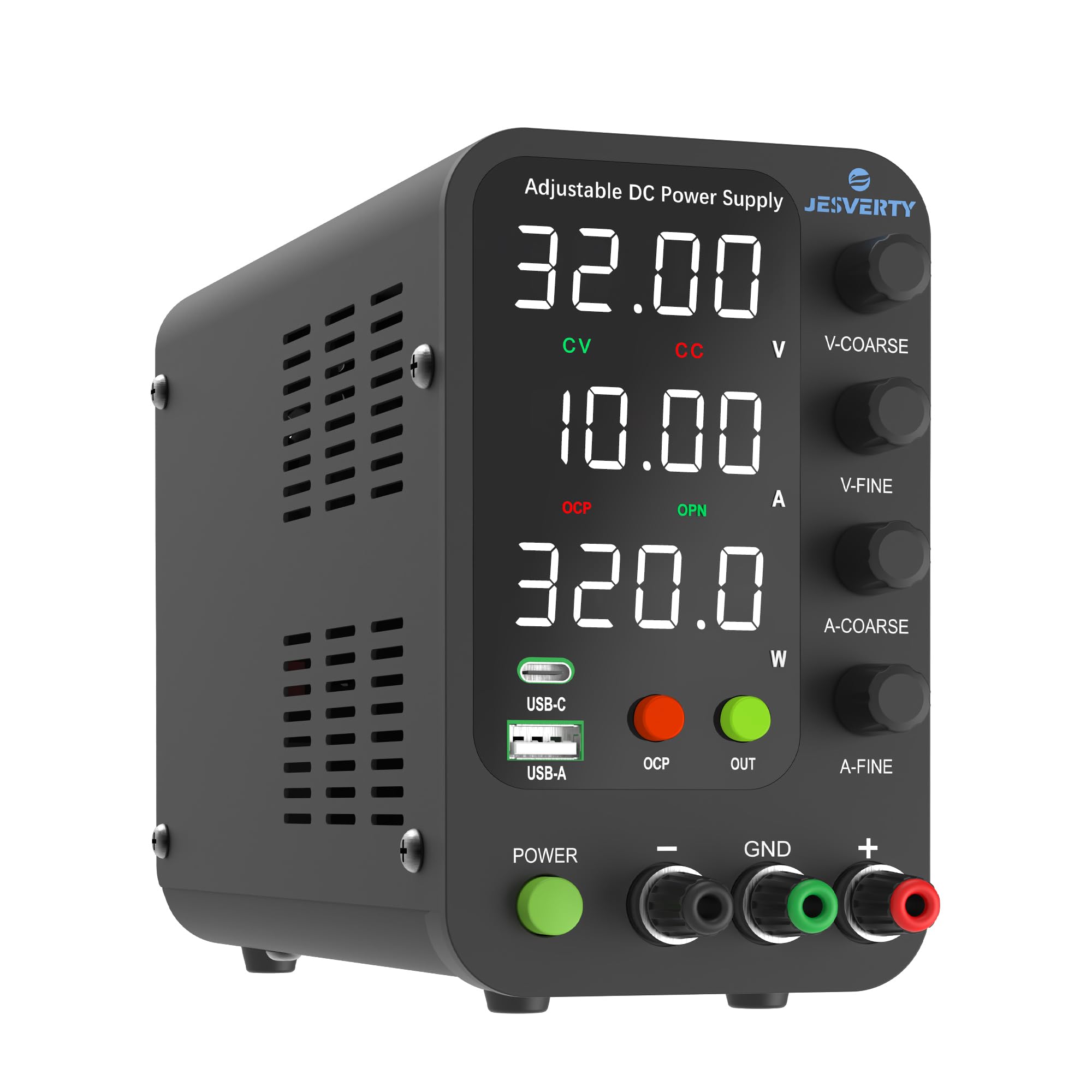
Jesverty SPS-3010V

Hobbyists & beginners

Our Score 9.2/10
Check Price

Worth Noting

  • Fan noise may be audible in quiet workspaces
  • Included test leads are short and of low quality; replacements are recommended.
USB Ports
USB-A & USB-C
Power Type
Switching
Output Switch
Yes
Adjustment Type
Encoder coarse/fine

The SPS-3010V brings together two features most budget supplies omit: a dedicated output enable switch and encoder-based knobs for coarse and fine adjustment. Voltage and current settings are accurate within typical hobbyist needs, confirmed by users with multimeters. The encoder knobs allow precise, repeatable steps without overshooting target values.

The internal fan operates during load and produces enough noise to be present in a quiet room — less bothersome in a workshop setting. Likewise, the included test leads are short and feel flimsy; swapping them for better leads is a minor expense that improves usability.

This model suits electronics hobbyists who work on breadboard circuits, device repair, or general lab tasks. The output switch adds a layer of safety when connecting sensitive components, and the USB-C port delivers 20W fast charging for phones or tablets right on the bench. It is not the right choice for professionals who need ultra-low ripple noise, programmable sequences, or more than 10A of current.

For those weighing options, the primary alternative is the similarly priced supply that lacks the output switch — a tradeoff that matters for anyone powering experimental circuits.

Tip: If fan noise is a concern, place the supply in a cabinet or use it in a workshop; the noise is most noticeable under load.

Bottom line: For hobbyists who value a safety output switch over programmability, this supply delivers precision and modern features at a budget price.

2

WANPTEK DPS3010U

WANPTEK DPS3010U

Hobbyists USB-C

Our Score 9.2/10
Check Price

Worth Noting

  • No output enable/disable switch forces disconnection of the load to adjust voltage or current safely.
  • Voltage output may drop under heavy load, with some units unable to reach 30V near full 10A current.
USB Ports
USB-A & USB-C 3.6A
Power Type
Switching
Output Switch
No
Adjustment Type
Encoder coarse/fine

The WANPTEK DPS3010U stands out as the only sub-$50 supply in this roundup that pairs encoder coarse/fine knobs with memory presets and a 3.6A USB-C port for fast device charging. Where the top pick (Jesverty SPS-3010V) includes a physical output enable switch, the WANPTEK omits it, meaning you must disconnect the load or set current to zero before adjusting voltage or current. The auto-sensing input voltage (100-240V) makes it travel-friendly without a manual selector.

This supply suits hobbyists who value USB-C convenience and encoder precision over the safety convenience of an output switch. The clear display and intuitive controls simplify daily use, and the memory function recalls your last settings each power-on. However, the missing output switch is a real tradeoff: you cannot adjust voltage with a load connected without risking unexpected output. Additionally, some units may not deliver the full 30V when drawing near 10A, so heavy-duty projects that need consistent max voltage may find it limiting.

Tip: To adjust voltage safely without an output switch, turn the current limit to zero before connecting the load, set your voltage, then increase current back to your target.

Bottom line: For hobbyists who prioritize USB-C charging and encoder controls and don't mind working without an output switch, this is the most feature-rich budget option; those who need a physical output switch should go with the top pick.

3

NICE-POWER SPS-C3010

NICE-POWER SPS-C3010

Budget beginners

Our Score 9.2/10
Check Price

Worth Noting

  • Fine tuning is less precise with potentiometer knobs
  • Voltage calibration may vary slightly between units
USB Ports
5V/2A USB-A
Power Type
Switching
Output Switch
Yes
Adjustment Type
Potentiometer coarse/fine

At the lowest price point among adjustable 30V 10A supplies with an output enable switch, the NICE-POWER SPS-C3010 removes the need to unplug leads when changing loads. A bright 4-digit LED shows voltage and current clearly, and the built-in USB port powers small projects without an extra adapter.

The coarse and fine potentiometer knobs require a steady hand to dial in exact voltages — overshooting is easy when making small adjustments. Some units also show a minor voltage offset (a few percent from the set value), which matters for precise circuits but is acceptable for battery charging or LED testing where approximate values work.

This supply suits budget-conscious beginners who need a safe, functional bench tool for basic electronics tasks. If you rarely need fine voltage control and can accept a quick multimeter check for calibration, the SPS-C3010 delivers the essentials at the lowest cost. The 110V-only input is a limitation for international use, and the fan noise is typical for switching supplies in this class.

Tip: Use a multimeter to verify output voltage and adjust calibration if needed — minor offsets may exist.

Bottom line: For anyone who needs a functional 30V 10A supply on a tight budget and can work around coarse adjustments, this is the most cost-effective option with an output switch.

4

HYELEC HY50-06A

HYELEC HY50-06A

Automotive & LED

Our Score 9.4/10
Check Price

Worth Noting

  • Voltage accuracy may drift over time, which can affect precision electronics work.
  • At 50V the 150W limit restricts current to 3A, limiting use for high-current loads.
USB Ports
5V/2A USB-A
Power Type
Switching
Output Switch
Yes
Adjustment Type
Encoder coarse/fine

The HYELEC HY50-06A delivers a 0-50V output range uncommon in switching supplies at this price point, along with three memory presets and a dedicated output switch. The 150W power limit means available current drops as voltage rises — at 50V you cannot exceed 3A, but for typical 12V/24V automotive work the full 6A is available. The output switch works as a soft on/off, keeping voltage stable during connect.

This supply fits electronics hobbyists working with automotive 12V/24V systems, LED strips requiring higher voltage, or anyone who values memory presets for repeated test setups. Some units may experience voltage calibration drift over time, which is worth checking for precision work. The 6A current limit also rules out high-current battery charging or motor testing.

Output stability is good for a switching supply — voltage holds within 0.1V under moderate load based on user feedback. The coarse/fine encoder knobs allow precise adjustment, and the built-in 5V/2A USB-A port adds convenience for powering small circuits. The 4-digit LED display reads out voltage and current simultaneously, clear enough for bench work.

Tip: Periodically verify voltage with a multimeter to catch any drift early.

Bottom line: Best for buyers who specifically need 50V output and memory presets at a reasonable price, provided the 6A current limit and potential calibration drift are acceptable.

5

KORAD KA3005P

KORAD KA3005P

Engineers, lab work

Our Score 9.2/10
Check Price

Worth Noting

  • Fan noise may be noticeable during operation, especially under higher loads
  • Heavy at 9 pounds and bulkier than portable alternatives
USB Ports
Power Type
Linear
Output Switch
Yes
Adjustment Type
Encoder coarse/fine

The KORAD KA3005P stands apart from simpler benchtop supplies by offering USB and RS232 control, letting you script voltage and current changes for automated testing sequences. Four memory presets save frequently used settings, so you can recall a 5V/1A bias or a 12V/2A rail without re-dialing the encoder knobs. This makes it well suited for production verification or repeated experiments where consistency matters more than portability.

The linear regulation keeps output ripple low — a real advantage when powering audio circuits or RF stages that would pick up switching noise. But the tradeoff is weight: at 9 pounds, this supply stays planted on a bench, not in a go-bag. The internal fan is audible in quiet rooms, especially when the supply is drawing close to its 5A limit. Under light loads it runs at a lower speed, but you’ll notice it in a home lab if silence is a priority.

This supply is built for engineers who need remote programmability and clean DC — think automated test stands, audio design, or sensitive measurement work. The 5A ceiling and physical footprint rule out high-current battery charging or portable use. If your tasks stay under that current threshold and you value repeatable settings, the KA3005P delivers without the unpredictable voltage spikes seen on some cheaper programmable units.

Tip: The fan runs continuously but gets louder under sustained 4-5A draw; placing the supply away from quiet work areas or using earplugs helps.

Bottom line: For engineers who need remote programming and clean DC from a linear supply, the KA3005P is a capable tool — just accept the fan noise and bench-hogging weight as the cost of that capability.

6

SKY TOPPOWER PS3010H

SKY TOPPOWER PS3010H

Electroplating users

Our Score 9.0/10
Check Price

Worth Noting

  • No USB charging port limits modern convenience for powering small devices.
  • Some units may require replacement sooner than expected after limited usage
USB Ports
Power Type
Switching
Output Switch
No
Adjustment Type
Potentiometer coarse/fine

The SKY TOPPOWER PS3010H provides a ground terminal and anti-reverse protection, making it a functional choice for electroplating and electrolysis tasks. Voltage output stays steady during basic bench use, and the price is cost-effective for a 30V 10A supply. However, this unit omits a USB charging port and an output switch, limiting its daily-driver appeal. Long-term durability under heavy use is a known vulnerability — a small number of units have been reported to stop functioning after moderate hours. For general electronics repair or lab work, other options at similar prices include USB and an output switch, but this model fills a specific niche for hobbyists who need the ground terminal.

Bottom line: Best suited for buyers focused on electroplating or electrolysis who need the ground terminal and are willing to forgo USB and an output switch.

7

NICE-POWER SPS-E3010

NICE-POWER SPS-E3010

Low-power projects

Our Score 9.0/10
Check Price

Worth Noting

  • Cannot deliver 30V and 10A simultaneously; maximum output is 150W total.
  • Fan noise can be noticeable in quiet environments during operation.
USB Ports
Power Type
Switching
Output Switch
No
Adjustment Type
Encoder digit select

This NICE-POWER supply takes up less bench space than any other 30V model, and the encoder adjustment allows precise voltage and current setting for light electronics work. However, the 150W power limit means you cannot get 30V and 10A at the same time — expect 15V at 10A or 30V at 5A. The cooling fan can be audible in a quiet room, which may be a consideration for sensitive audio or long-duration testing. It suits hobbyists who need a compact, affordable PSU for low-current projects under 5A, electroplating, or battery charging, but not for anyone requiring the full 30V 10A output or a silent workspace.

Bottom line: If you are working on compact benchtop and need a budget supply for low-current electronics, battery charging, or electroplating under 5A, this NICE-POWER unit saves space without overspending. Skip it if your projects require the full 30V at 10A or a silent workspace.

8

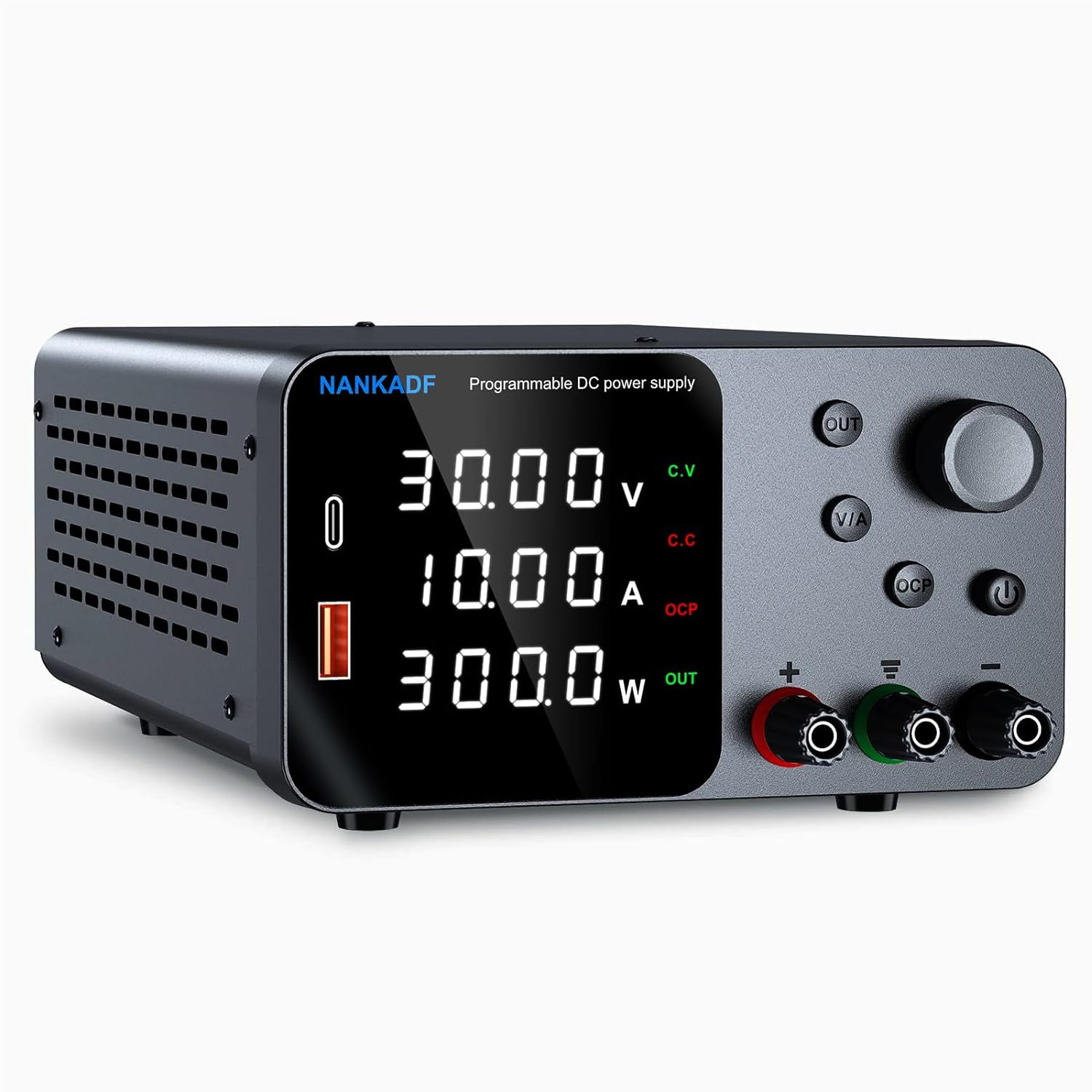
NANKADF 30V 10A

NANKADF 30V 10A

Budget USB-C

Our Score 9.2/10
Check Price

Worth Noting

  • Voltage output may be limited to 24V on some units; possible unit-to-unit variation.
  • Unit may arrive configured for 220V input, requiring adjustment for 110V systems.
USB Ports
USB-A & USB-C 5V/3.6A
Power Type
Switching
Output Switch
Yes
Adjustment Type
Encoder digit select

Encoder knobs allow digit-by-digit voltage and current setting, and the dual USB ports deliver 5V/3.6A fast charging for phones and small devices. However, some units cannot reach the full 30V output, maxing out around 24V, and a few arrive configured for 220V input, requiring a quick switch for North American 110V outlets. These quality-control variations make it a gamble for consistent lab work, so buyers should verify settings on arrival.

Bottom line: Best for budget-conscious hobbyists who need USB-C charging and are comfortable checking input voltage and output calibration on arrival.

How to Choose

Voltage and Current: Matching Your Needs

Most benchtop supplies offer 30V and 10A, which covers a wide range of electronics work. However, power is limited by wattage: a 150W supply cannot deliver 30V and 10A simultaneously; it forces a trade-off (e.g., 15V at 10A or 30V at 5A).

If you work on automotive electronics or LED strips, a 50V supply like the HYELEC gives headroom for 12V and 24V systems. For microcontroller and phone repair, 30V 5A is usually sufficient. Match the voltage range to your typical load, not the maximum advertised numbers.

Switching vs. Linear: Noise vs. Weight

Switching supplies are lightweight, cheap, and efficient, but they produce electrical noise (ripple) that can interfere with sensitive analog circuits like audio preamps or RF stages. Linear supplies use a heavy transformer to filter noise, delivering clean DC but weighing 8-10 pounds and costing more.

For digital logic, Arduino, and battery charging, a switching supply is perfectly adequate. Only invest in a linear supply if you measure microvolt-level signals or work with high-gain audio. The extra weight and fan noise are the price of purity.

Adjustment Method: Encoder vs. Potentiometer

Encoder knobs register each click, letting you set voltage digit-by-digit without overshooting. Potentiometers are continuous analog controls; dialing in exactly 5.00V requires patience and a steady hand, and they drift with temperature and age.

If you frequently change settings or need repeatable values (e.g., 3.3V for logic, 12V for fans), an encoder-based supply saves frustration. For occasional use with rough settings, potentiometers work and keep costs low.

Output Switch: Safety Feature You Shouldn't Skip

An output enable/disable button lets you set voltage and current before connecting the load, preventing short circuits and sparks. Without it, you must physically disconnect the load cables every time you adjust, risking accidental shorts or damaging your circuit.

This small feature adds significant convenience and safety. Many budget supplies omit it; our top pick includes one. If you prioritize safety, make this non-negotiable.

USB Charging: Convenience or Distraction?

USB-A and USB-C ports on a power supply are handy for charging phones or powering small devices, but they draw from the same internal transformer. A 20W USB-C port can slow the main output under load, and some supplies share the current limit.

Treat USB as a bonus, not a reason to buy. If you need a dedicated phone charger, a separate wall adapter is more efficient. For a clean bench, a supply without USB is lighter and simpler.

Frequently Asked Questions