Car & GPS

9 Best VHF Marine Radio of 2026: Match Your Boat and Safety Needs

Which fixed-mount or handheld VHF marine radio actually stays loud and reliable after months of spray — and which avoid battery and speaker letdowns.

Many boaters discover their VHF radio’s speaker goes weak or the battery won’t hold a charge just when they need it most — often because salt air and infrequent upkeep take a toll even on waterproof gear. A radio that works perfectly at the dock can become frustratingly quiet at cruising speed or fail to send a DSC distress call when the GPS fix drops.

This guide cuts through that uncertainty by matching specific radios to how you actually use your boat. Whether you need a permanently mounted 25-watt powerhouse with integrated GPS or a grab-and-go floating handheld that survives a dunking, each pick is grounded in long-term field performance and the components that hold up — or don’t.

The lineup spans recreational day sailing to offshore passages, with clear trades-offs around charging, installation, and audio clarity. You’ll walk away knowing exactly which radio fits your helm, your habits, and your budget — without hype or guesswork.

1

Uniden UM385

Top Pick
Uniden UM385

Everyday boating

Our Score 9.2/10
Check Price

Worth Noting

  • Occasional functionality gremlins such as scan mode not engaging or fuses blowing without apparent cause.
DSC & GPS
Class D DSC
Power Output
25W
Waterproof Rating
IPX4

The Uniden UM385 delivers 25W transmission, Class D DSC with a dedicated distress button, and NOAA Weather Alert with S.A.M.E. region-specific warnings. Mounting hardware is clearly labeled, and the unit powers up without complicated menus, making it a practical choice for weekend installers. The overall build quality supports consistent day-to-day use on small to mid-sized boats.

Over months of use, the internal speaker has been noted to lose volume in some cases, particularly where salt air is present. An external speaker port allows a simple upgrade that solves this entirely. A small number of units may exhibit intermittent scan behavior or blown fuses, but these are isolated instances rather than a pattern.

This radio suits recreational boaters who want dependable emergency communication without the complexity of networked systems. It works well on boats where adding an external speaker is a reasonable step. For those who prioritize portability or need a grab-and-go backup, a floating handheld offers different strengths — the Uniden is best as a permanent fixture.

Tip: Installing an external speaker ensures clear audio even after the internal unit ages, especially in saltwater environments.

Bottom line: Recreational boaters who can add an external speaker get the best value in fixed-mount VHF communication with this Uniden.

2

Standard Horizon HX210

Standard Horizon HX210

Recreational handheld

Our Score 9.0/10
Check Price

Worth Noting

  • Microphone or speaker output can exhibit static or low volume in some cases.
  • Battery capacity may diminish over time, reducing runtime on extended trips.
DSC & GPS
Power Output
6W
Waterproof Rating
IPX7

The HX210 delivers 6W floating portability and the rare inclusion of an AC/DC charging cradle - a charging convenience most handheld VHF radios skip, even at higher prices. While the top pick, the Uniden UM385 fixed-mount, anchors your boat with 25W DSC power and permanent installation, this handheld frees you from the helm: it floats, submerses to IPX7, and snaps into the included cradle for charging at home or on the boat via AC or 12V.

Reception holds up well for a handheld, and the FM broadcast band adds a touch of off-duty utility. Operation stays uncluttered - presets and soft keys are intuitive enough that you won't need the manual after the first outing. The 3-year waterproof warranty backs up its saltwater exposure claims, giving confidence in its weather resistance.

For the recreational boater who wants a grab-and-go safety radio with the charging convenience of a dock-or-home cradle, the HX210 fits. Battery capacity can taper over time, so day trips and short passages are its natural domain. Multi-day outings without a chance to recharge call for a spare battery on board.

Bottom line: The HX210 is a thoughtful companion to a fixed-mount radio for boaters who value grab-and-go portability and the convenience of a dock-or-home charging cradle; just keep a spare battery on board for longer trips.

3

Uniden Atlantis 275

Uniden Atlantis 275

Floating emergency

Our Score 9.2/10
Check Price

Worth Noting

  • Battery endurance can be inconsistent; some units drain faster than expected during a day on the water
DSC & GPS
Power Output
6W
Waterproof Rating
IPX8

While a top-tier fixed-mount VHF delivers 25 watts and full DSC integration, the Atlantis 275 brings grab-and-go portability without sacrificing core communication quality. Its 6-watt selectable output drives clear, intelligible audio across a bay, and the IPX8-rated, buoyant body won't sink if knocked overboard. The receiver picks up distant transmissions cleanly, and the build inspires confidence when salt spray and bumps are daily realities.

The oversized dual-color backlit LCD is a rarity among handhelds — it stays legible in direct sun. If you capsize in low light, the water-activated strobe automatically blinks, making retrieval far easier; a built-in flashlight adds hands-free visibility. NOAA weather alerts scan in the background, so you hear warnings without needing to monitor manually.

Kayakers, paddleboarders, and day sailors who want a floating, easy-to-read radio with weather alerts will find the Atlantis 275 a practical choice. The belt clip isn't built for heavy daily use — a lanyard or pocket carry is more dependable. Large backlit buttons and a clear display work well with wet gloves, and battery life suits a day of coastal exploring; a spare NiMH pack extends confidence for longer trips.

Tip: Carry a spare NiMH battery pack for full-day adventures; use the strobe only in real emergencies to keep the radio running.

Bottom line: For coastal cruisers, kayakers, and paddleboarders who prioritize a floating, easy-to-read handheld with a water-activated strobe and NOAA alerts, the Atlantis 275 is a capable safety tool. Carry it in a pocket or on a lanyard, and pack a spare battery for all-day peace of mind.

4

Icom IC-M73

Icom IC-M73

Professional duty

Our Score 9.2/10
Check Price

Worth Noting

  • Premium price puts it well above entry-level floating handhelds.
  • Lacks integrated GPS and AIS, limiting tracking and position-sharing capabilities for users who need them.
DSC & GPS
Power Output
6W
Waterproof Rating
IPX8

Where the feature-rich AIS handhelds layer on vessel tracking and GPS mapping, the IC-M73 strips VHF down to pure, no-excuses communication. Six watts of transmit power and a clear speaker cut through engine noise and wave slap, while the simplest button layout keeps operation instant under stress.

The 18-hour battery rating translates to all-day coverage without scrambling for a charger, and the IPX8 submersible construction survives an accidental dunk without a hiccup. The compact hourglass body tucks into a PFD pocket or a console slot, always ready.

Professional captains, rescue teams, and serious offshore sailors will appreciate the commercial-grade durability that ignores rust, drops, and constant spray. Kayakers and paddlers who treat their gear hard also get a radio that outlasts the adventure. The premium price will feel steep for a casual boater who only needs hailing power in fair weather — a basic floating handheld does the same job for far less.

Bottom line: For offshore professionals who treat a radio as a lifeline, the IC-M73 offers no-excuses communication that makes every dollar count.

5

Cobra MR F77W GPS

Cobra MR F77W GPS

GPS fixed-mount

Our Score 9.0/10
Check Price

Worth Noting

  • The LCD screen can develop garbled characters or blank out after exposure to salt air and moisture.
DSC & GPS
GPS & DSC
Power Output
25W
Waterproof Rating
IPX8

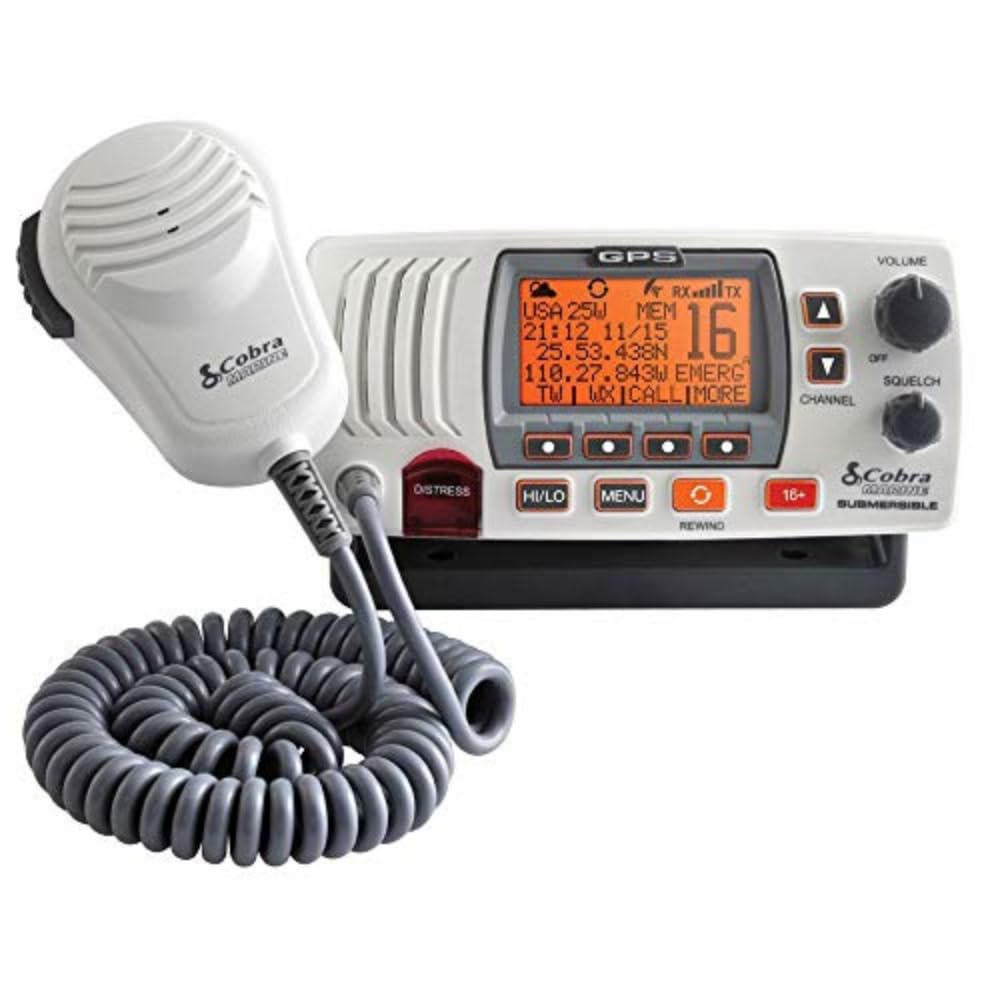
The Cobra MR F77W GPS integrates its own position receiver, so DSC distress calls automatically include your coordinates without running a NMEA cable from a separate chartplotter. The top pick requires that extra link, but this radio consolidates everything into the head unit — a cleaner install for tight helm stations.

Audio cuts through wind and engine noise at cruising speed, and the Rewind-Say-Again function lets you replay the last transmission with a single button press — helpful when you miss a weather alert or hailing call while tending lines. The chassis fits many existing mounting cutouts, making upgrades fast.

Small-console boaters and those retrofitting older vessels will appreciate the streamlined DSC setup. The tradeoff is the LCD screen: it can develop garbled segments or blank out after salt exposure, so an early shakedown and routine visual checks are smart.

Bottom line: For boaters who value a self-contained DSC system without the spaghetti of NMEA cables, this Cobra fits the bill — just be prepared to keep a close eye on the display.

6

Retevis RM01

Retevis RM01

Budget starter

Our Score 8.0/10
Check Price

Worth Noting

  • Charging cable uses a proprietary headphone-style USB connector
  • NiMH batteries may lose charge capacity with infrequent use, causing unpredictable runtime.
DSC & GPS
Power Output
3W
Waterproof Rating
IP67

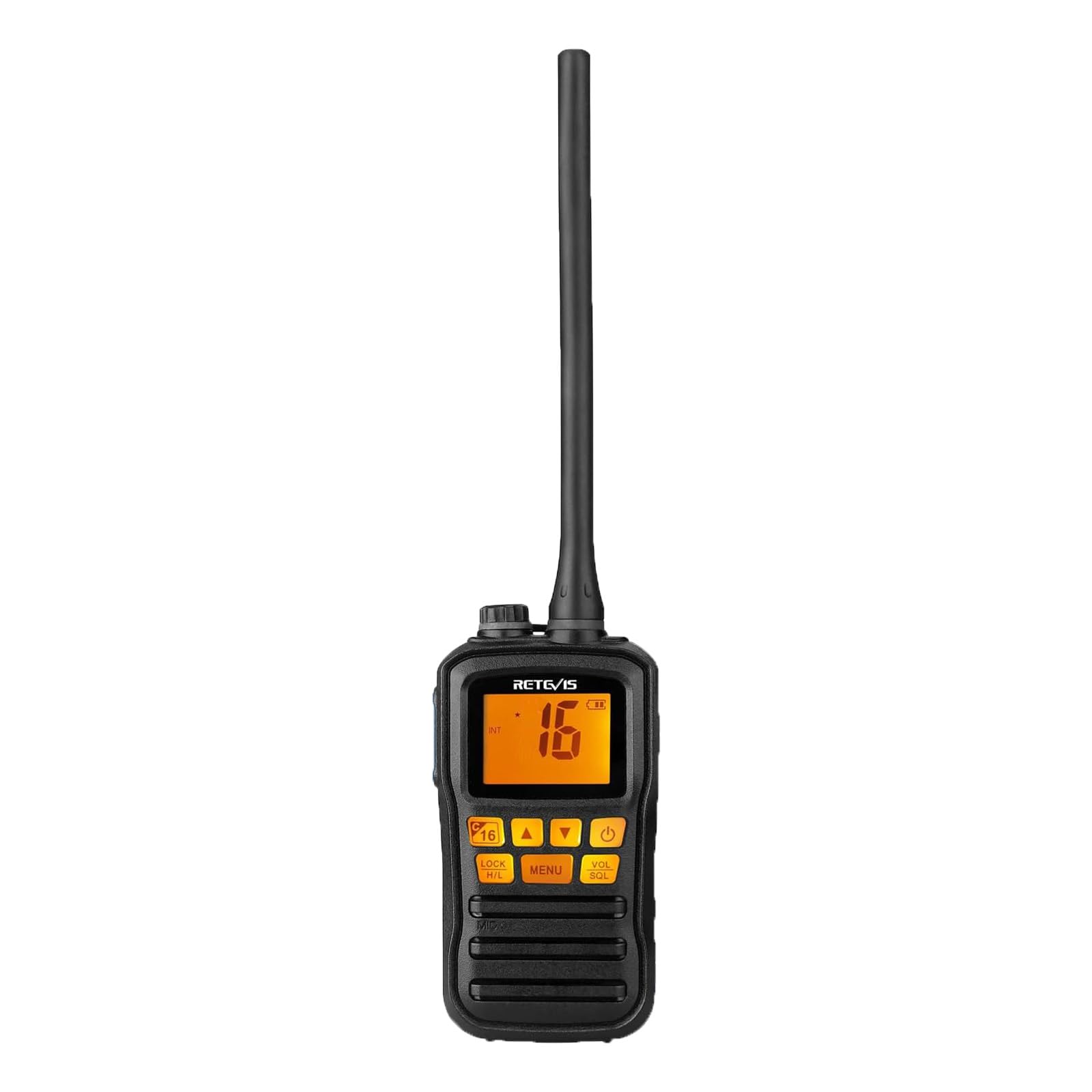
The Retevis RM01 is the most affordable floating handheld in its class, offering 3 watts, all U.S. and international channels, and NOAA weather alerts in a compact package that's floatable and submersible to IP67 standards. Unlike fixed-mount radios with 25W transmission and DSC distress capability, this 3W handheld is for line-of-sight communication up to a few miles — not offshore safety.

Reception is adequate for lake sailors and paddlecraft within a few miles of shore; hearing marina traffic and weather updates is straightforward. The device requires no programming — just twist the knob and press the talk button.

This radio suits a very specific role: a learner radio for youth sailing programs or kayak beginners, or a backup sealed in a ditch bag for emergencies where nothing else is available. The proprietary USB charging cable uses a headphone-jack plug, not USB-C, so if the cable is lost, finding a replacement is a headache. The AAA NiMH cells can lose charge capacity after sitting unused, so testing and charging before every outing is essential. For anyone relying on VHF as a primary lifeline — say, solo offshore passages — the battery and charging quirks make this a poor choice.

Tip: Keep the charging cable attached to a dedicated USB power source and label it; the connector is not standard and easily misplaced.

Bottom line: It's a sensible backup radio for a ditch bag or a training tool for young sailors, provided you keep the proprietary cable safe and test battery health before each trip.

7

Icom M94D

Icom M94D

Offshore AIS

Our Score 8.8/10
Check Price

Worth Noting

  • The button-heavy menu can be cumbersome, and occasional screen error messages have been noted.
DSC & GPS
DSC, GPS, AIS
Power Output
6W
Waterproof Rating
IPX7

The Icom M94D combines an AIS receiver, GPS, and a 1500mW speaker in a floating handheld, giving offshore sailors a portable view of nearby vessel traffic. Its audio clarity stands out in high-noise conditions, and the water-activated strobe is a smart emergency feature. The AIS display works well for tracking targets without needing a full chartplotter.

The built-in GPS needs an unobstructed sky view — it can lose fix inside a cabin or under a hard top. This radio suits open-cockpit mariners and commercial operators who value AIS above all else, but it may frustrate those who frequently use it below decks or on a tight budget.

Bottom line: Offshore sailors who operate in open cockpits and want AIS situational awareness without a fixed-mount will find the M94D a capable, if premium-priced, companion.

8

Retevis RM20

Retevis RM20

Budget GPS fixed

Our Score 8.2/10
Check Price

Worth Noting

  • Squelch and microphone controls can stick or behave intermittently.
  • Internal speaker may be very quiet upon arrival or stop producing audio over time.
DSC & GPS
GPS DSC
Power Output
25W
Waterproof Rating
IP67

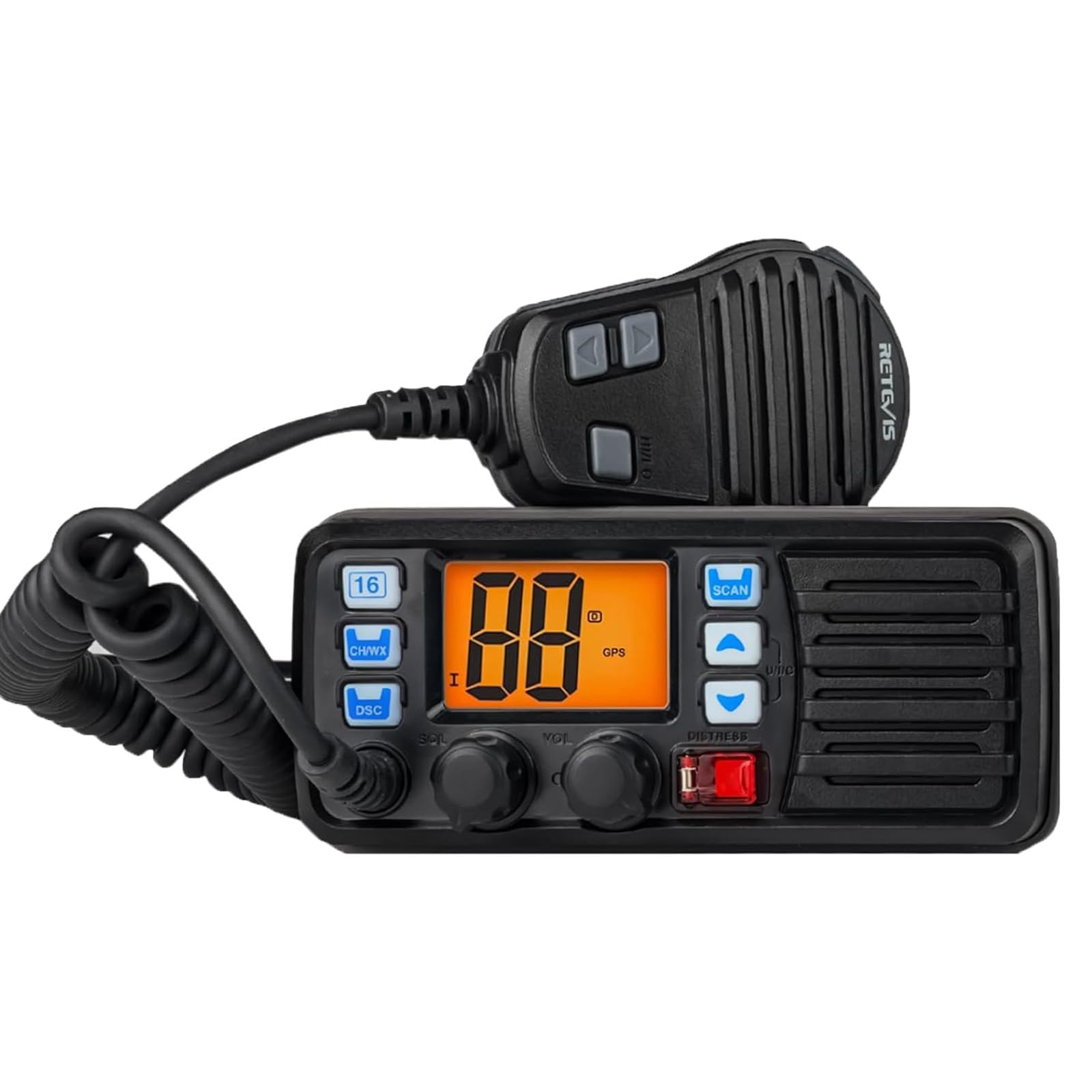
The Retevis RM20 delivers 25-watt transmission with integrated GPS for DSC position at a cost that undercuts anything else on the market. The IP67 chassis shrugs off splashes and brief submersion, and the external speaker jack lets you bypass the internal audio entirely. However, the internal speaker output can be faint from the start or may stop working after months, and squelch and microphone controls can become sticky over time. This radio is a fit for budget-conscious boaters who plan to add an external speaker and view it as a secondary communications link rather than a sole safety lifeline.

Bottom line: The cheapest DSC-capable fixed-mount with GPS, but only if you add an external speaker and accept that this unit serves best as a backup communications link — not a primary safety device.

9

Icom IC-M330

Icom IC-M330

Compact helm

Our Score 9.0/10
Check Price

Worth Noting

  • No built-in GPS
DSC & GPS
Class D DSC
Power Output
25W
Waterproof Rating
IPX7

The Icom IC-M330 packs a full Class D DSC VHF radio into a palm-sized chassis that disappears into the tightest helm layouts. Audio stays loud and clear even at full volume, cutting through engine and wind noise without distortion, and the IPX7 waterproofing shrugs off heavy spray or brief submersion.

DSC distress functionality relies on position data, which the IC-M330 cannot generate on its own. You must supply GPS coordinates from an external antenna via the NMEA 0183 input. Boaters with a chartplotter or GPS receiver already feeding a NMEA network will find this a seamless integration. Radios with built-in GPS eliminate that extra step entirely, but if your helm already has position data available, the IC-M330 delivers ICOM audio quality in a space-saving footprint that few other fixed-mount radios match.

Bottom line: The right fixed-mount VHF for small-console boats already equipped with a GPS source on the NMEA network — not the choice for an all-in-one DSC solution with no extra wiring.

How to Choose

Power Output and Antenna Reach

A handheld’s 1–6 watts are sufficient for line-of-sight communication within a few miles, but effective range drops quickly with a short antenna near the water’s surface. Fixed-mount radios output 25 watts and connect to a masthead or 8-foot antenna, often doubling the horizon distance.

The hidden trade-off: a 6-watt handheld paired with a poorly placed duck antenna may perform worse than a 1-watt handheld connected to an elevated external antenna. Kayakers and dinghy sailors value portability over raw power, while offshore cruisers need the reach only a fixed installation can provide.

Waterproof Ratings and Salt Reality

IPX4 resists splashes, while IPX7/IPX8 can survive immersion — but neither stops salt buildup from eating solder joints and speaker cones over months. Even an IPX8 unit can develop muffled audio or a dead display if not rinsed with fresh water and protected with dielectric grease.

For open boats, misty coastal runs, or accidental drops, an IPX7 or IPX8 rating is essential. Kayakers should prioritize floating designs; fixed-mount users get longer life by mounting the radio in a protected console and adding an external speaker.

DSC and Built-in GPS

Digital Selective Calling (DSC) automatically sends a mayday with position — but only if the radio knows your coordinates. Models with integrated GPS eliminate extra wiring, yet the internal antenna can struggle under hardtops. Separate external GPS units deliver a more consistent fix but add cabling complexity.

A key pitfall: if a built-in GPS fails, you lose position reporting entirely unless a secondary source is connected via NMEA. For minimalist helm layouts, integrated GPS is clean; for mission-critical offshore use, an external feed is more dependable.

Battery Chemistry and Charging Methods

Lithium-ion packs pack more energy per ounce and hold a charge longer, but NiMH cells can be swapped out with alkaline AA batteries in an emergency. How you replenish matters just as much: many handhelds include only a 12V car adapter, chaining you to the boat’s battery.

USB-C radios let you top up from a power bank or laptop, while proprietary chargers create a single point of failure. If you store the radio at home between trips, a model with AC charging or USB-C prevents arriving with a dead battery.

Audio Punch in Noisy Cockpits

Speaker clarity at speed depends on output power and cone design. A 1,500mW speaker cuts through engine drone better than a 500mW unit, and an external speaker jack transforms a fixed-mount radio’s audibility.

Even a loud radio can become tinny when the speaker grille is wet or clogged with salt. If you routinely run at high RPM, prioritize models rated for high audio output and test with an external speaker on hand.

Frequently Asked Questions