Car & GPS

7 Best Fish Finder of 2026: Match Your Fishing Style and Budget

Find a fish finder that fits your boat, kayak, or shore fishing without overpaying for features you rarely use. We help you navigate real trade-offs.

Many anglers gravitate toward fish finders packed with side imaging and live sonar, only to discover those features go unused on their local lake. A sunlight-readable screen and reliable CHIRP sonar matter far more for most fishing scenarios than the latest premium imaging technology.

Budget models often lack preloaded lake maps, and Bluetooth castable units frequently drop connectivity when you need it most. This guide cuts through the hype to match you with a fish finder that actually fits your boat, kayak, or shore fishing style without breaking your budget.

1

Garmin Striker 4

Top Pick
Garmin Striker 4

Kayak, beginners

Our Score 9.2/10
Check Price

Worth Noting

  • Condensation can build up inside if the unit is exposed to rain or splash without protection, potentially damaging electronics.
Mounting
Fixed mount
Sonar Type
CHIRP dual-beam
Transducer
Included
Screen Size
3.5 inches

The Garmin Striker 4 brings CHIRP sonar and GPS waypoint storage together in a package that costs less than many standalone depth finders. The 3.5-inch display is small but readable, and the CHIRP transducer delivers crisp fish arches and bottom contours. Depth capability reaches 1,600 feet in fresh water and 750 feet in salt, covering most recreational fishing scenarios without fuss.

On the water, the Striker 4 is easy to use and set up. The menu is intuitive, and the transducer mounts quickly on kayaks, small boats, or through ice holes. Battery life supports full-day outings, and the compact footprint makes it a natural fit for ice fishing where space is tight. Portability is a clear strength — it moves between boats or gear bags without hassle.

This fish finder suits beginners, kayak anglers, and anyone on a tight budget who wants a device that just works. The tradeoff comes with moisture management: the IPX7 rating handles splashes but not prolonged rain or submersion. Condensation can form inside if the unit is left exposed to wet conditions, so users should plan to store it in a dry bag or cover when not in use.

If you're tempted by the upgraded Striker Vivid 4cv with ClearVü scanning, know that the base Striker 4 gives up detailed structure imagery but keeps the core sonar and GPS functions at a noticeably lower cost. For anglers who don't need photographic views of brush piles, the Striker 4 is the more practical pick.

Tip: Store the Striker 4 in a dry place and cover it when not in use to prevent moisture from seeping into the case.

Bottom line: For anyone who wants a functional, affordable fish finder without unnecessary extras, the Striker 4 delivers where it counts — just remember to keep it dry.
2

Humminbird Helix 7 G4

Humminbird Helix 7 G4

Bass boaters

Our Score 9.0/10
Check Price

Worth Noting

  • Side imaging range tops out at 125 feet, limiting effectiveness in deeper lakes or coastal waters.
  • In choppy water or at higher trolling speeds, depth tracking may cut out
Mounting
Fixed mount
Sonar Type
MEGA Side/Down, CHIRP
Transducer
Included
Screen Size
7 inches

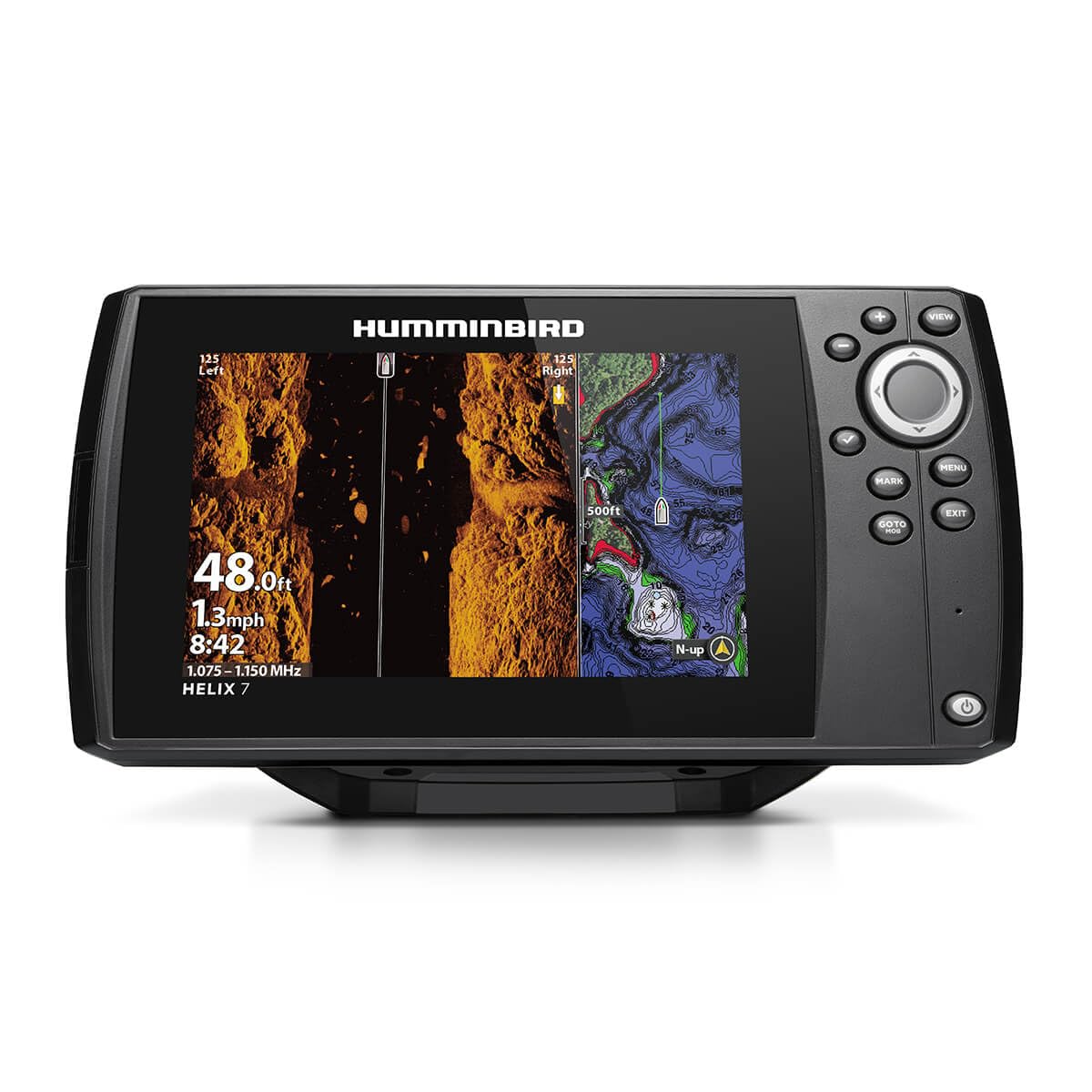
The Humminbird Helix 7 G4 pairs MEGA Side Imaging with a crisp 7-inch HD display, giving anglers a sharp look at structure and fish up to 125 feet on each side. The screen stays readable in direct sunlight, and the included GPS with Basemap and AutoChart Live adds mapping capability without extra cost. For the price, this unit offers imaging quality that rivals more expensive models.

This fish finder is best suited for bass boaters and recreational anglers who want detailed side imaging without paying flagship prices. It works well in calm lakes and rivers at moderate boat speeds. However, depth tracking can become inconsistent in rough water or at higher trolling speeds, and the 125-foot side imaging range means it won't serve deep-water or offshore fishing. If you fish in choppy conditions or need greater depth, consider a unit designed for those environments.

Tip: Reduce boat speed when crossing deeper channels or in rough water to maintain depth tracking.

Bottom line: For anglers who want clear side imaging and a large screen without spending flagship money, and who fish at moderate speeds in shallower water, this Helix 7 is a strong option.

3

Humminbird Helix 5 Portable

Humminbird Helix 5 Portable

Ice, kayak

Our Score 0.0/10
Check Price

Worth Noting

  • Screen cover is not included, leaving the display exposed during transport.
  • Menu system has a noticeable learning curve compared to Lowrance or Garmin units.
Mounting
Portable kit
Sonar Type
Dual Spectrum CHIRP
Transducer
Included
Screen Size
5 inches

The Humminbird Helix 5 Portable arrives as a complete set: the 5-inch Helix unit, a 7Ah sealed lead-acid battery, charger, suction cup transducer mount, and a padded shuttle bag. This eliminates the need to source a separate battery and carrying case, making it a turnkey solution for anglers who want to hit the water without extra shopping.

The sonar performance is solid for its class. Dual Spectrum CHIRP provides clear returns of fish and structure, and the built-in basemap with AutoChart Live allows you to create custom depth contours on the water. The 5-inch display is adequate for daylight viewing, though not as vibrant as larger Helix models.

This kit is best suited for ice fishermen who need a portable rig, or for kayak anglers who value a setup that doesn't require permanent mounting. The interface has a steeper learning curve than Lowrance or Garmin units, so first-time users should budget time for menu familiarization. Note that a screen cover is not included, which is a minor oversight for a portable unit that will be transported frequently.

Tip: Spend time with the manual to learn menu navigation — the initial setup takes patience.

Bottom line: For anglers who want a portable fish finder that works out of the box without buying extra accessories, this Helix kit delivers — as long as you're willing to learn its menu logic.

4

Lowrance Eagle Eye 9

Lowrance Eagle Eye 9

Shallow water

Our Score 9.2/10
Check Price

Worth Noting

  • Getting the most from live sonar requires adjusting sensitivity and range settings
  • Live sonar detail drops beyond roughly 40 feet depth
Mounting
Fixed mount
Sonar Type
Live, CHIRP, DownScan
Transducer
Included
Screen Size
9 inches

The Eagle Eye 9 delivers live forward and down sonar views plus CHIRP and DownScan with FishReveal for under $1,000, making it the most accessible way to watch your lure interact with fish in real time. This combination of traditional sonar and live imaging suits anglers who want to try the technology without stepping into premium pricing.

This unit is built for shallow-water anglers who want to watch their lure in real time without spending over $2,000. The preloaded C-MAP charts can be off in some areas, so mapping accuracy isn't guaranteed out of the box. For those willing to use Genesis Live or cross-check with other sources, the tradeoff is manageable.

Setup is straightforward, with the included live transducer packing neatly onto a trolling motor or transom. Image quality from the CHIRP and DownScan is clear, and FishReveal helps identify targets. The 9-inch IPS display provides good sunlight readability for a unit at this price.

Tip: Adjust live sonar sensitivity and range manually — the default settings often need tuning to reveal fine structure and fish.

Bottom line: If you fish shallow water and want to experiment with live sonar without exceeding a grand, the Eagle Eye 9 is the right gateway — just keep expectations in check for depth and preloaded charts.

5

Garmin Striker Vivid 4cv

Garmin Striker Vivid 4cv

Kayak, small boat

Our Score 9.4/10
Check Price

Worth Noting

  • Transducer may be non-functional on arrival or can cease operating after extended use
Mounting
Fixed mount
Sonar Type
CHIRP, ClearVü
Transducer
Included
Screen Size
4 inches

The Garmin Striker Vivid 4cv’s ClearVü scanning sonar renders underwater structure and fish with near-photographic clarity, a noticeable step up from standard CHIRP. The vivid color palettes make it easy to distinguish bottom composition and cover, and the menu layout is straightforward even for first-time users.

This unit suits kayak and small-boat anglers who value portability and imaging over screen real estate — the 4-inch display keeps the package light (11.2 oz) but may feel cramped if you are accustomed to larger screens. A minority of units have experienced transducer issues, so testing the transducer early is wise. Anglers needing side imaging or advanced LakeMaster mapping should consider other options.

Tip: Bench-test the transducer in a bucket before mounting; any defects are easiest to resolve during the return window.

Bottom line: A solid mid-range pick for kayak and small-boat anglers who want sharper sonar imaging — just verify transducer function early.

6

Lowrance Elite FS 10

Lowrance Elite FS 10

Serious anglers

Our Score 0.0/10
Check Price

Worth Noting

  • Power button may become unresponsive after extended use; unexpected shutdowns can occur
  • Transducer sonar performance degrades at speeds above 15 mph
Mounting
Fixed mount
Sonar Type
Active Imaging 3-in-1
Transducer
Not included
Screen Size
10 inches

The Elite FS delivers crisp imaging and intuitive touchscreen control, with Active Imaging 3-in-1 sonar that reveals fish and structure in high detail. Setup is straightforward, and fish tracking performance draws strong praise. However, some units have shown power button issues and unexpected shutdowns after extended use, and the transducer sonar quality drops off above 15 mph – limitations that matter for anglers who cover water quickly or plan long-term ownership. For those who fish slow and value screen clarity, this remains a viable option.

Bottom line: For anglers who fish at slow speeds and want a large touchscreen for detailed structure scanning, the Elite FS delivers – but those needing trouble-free long-term performance should consider alternatives.

7

Venterior Portable FF

Venterior Portable FF

Shore, beginners

Our Score 8.6/10
Check Price

Worth Noting

  • Depth readings can be inconsistent in shallow water under 5 feet
  • Fish hugging the bottom may not show up on the display
Mounting
Castable wireless
Sonar Type
Wireless sonar
Transducer
Built-in
Screen Size
2.6 inches

This portable fish finder works by tossing the sensor into the water and reading depth, water temperature, and basic fish location on a 2.6-inch color LCD held in hand. No installation, no transducer mount - ideal for shore fishing or quick kayak trips where setting up gear feels like a chore. The battery recharges, the sonar beam covers a wide 105-degree cone, and the whole kit fits in a small bag.

Where it falls short is depth consistency and bottom detection. Readings can be unreliable in shallow water under 5 feet, and some users note it may not pick up fish hugging the bottom. Serious anglers needing precise depth charts or clear fish arches will find its capabilities too limited for professional use. This is a casual tool for seeing if there's water and fish nearby - not a replacement for a mounted sonar unit.

Bottom line: Best for casual anglers who want a no-fuss look at what's below the surface while shore fishing or paddling, but skip it if precise depth or reliable bottom fish detection matters.

How to Choose

Screen Size

Larger screens (5 inches and up) make it easier to read detail at a glance, especially in bright conditions, but they draw more power and require more mounting space. A 7-inch screen is ideal for bass boaters who need to see structure and fish arches clearly, while a 3.5-inch screen works well for kayak anglers who value portability over screen real estate.

Sonar Type

Traditional CHIRP sonar sends a continuous range of frequencies, giving you crisp fish arches and bottom detail down to 1,600 feet. Down Imaging and Side Imaging create photo-like views of structure, but they operate at shallower depths (typically under 200 feet) and cost more. Live sonar shows your lure in real time but requires a premium investment and works best in water under 40 feet. For most recreational anglers, a quality CHIRP unit with Down Imaging strikes the best balance.

GPS Capability

Budget fish finders typically offer waypoint-only GPS – you can mark spots but won't see lake contours. Mid-range units include basemaps with thousands of preloaded lakes, while premium models let you build custom maps in real time using tools like Quickdraw Contours or AutoChart Live. If you fish unfamiliar waters, a preloaded map is worth the extra cost; if you stick to the same few spots, waypoints are sufficient.

Transducer

Most fish finders include a transducer in the box, but some premium control-head-only units require a separate purchase – adding several hundred dollars to the total. The transducer determines sonar performance, so check that the included model matches your needs (e.g., CHIRP vs. imaging). A poorly mounted transducer can lose signal at speed, so pay attention to mounting options (transom, trolling motor, or portable suction cup).

Mounting and Portability

Fixed mounts (transom or through-hull) offer the most stable readings but are permanent installations. Portable kits include a battery, bag, and suction-cup mount, making them easy to move between boats or use for ice fishing. Castable wireless units require no installation at all but have limited range and accuracy. Kayak anglers often prefer portable kits because they can be removed after each trip to prevent theft and weather damage.

Frequently Asked Questions