Smart Home & Security

12 Best Driveway Alarms of 2026: Real-World Range and Reliable Power

Find a driveway alarm that detects cars without false alarms – whether you need budget PIR, solar, or vehicle-only probe.

Driveway alarms promise peace of mind, but the reality is often missed deliveries, false alerts from passing deer, or a sensor that stops working after one rainy season. Range claims rarely match what you get through trees and walls, and solar sensors need direct sun to stay charged.

The real choice isn't just between motion sensor types – it's about power source and mounting height that match your driveway's length and shade. A sensor mounted at 2–3 feet catches vehicles best; at 3–4 feet it's better for people and large animals. Ignoring that can triple false alerts.

The best system for you delivers consistent detection without constant battery swaps or app frustrations. That means picking a unit whose real-world range and power source match your property, not the marketing numbers.

1

HTZSAFE 1/2 Mile Alarm

Top Pick
HTZSAFE 1/2 Mile Alarm

Budget long driveways

Our Score 8.8/10
Check Price

Worth Noting

  • In humid or wet climates, moisture can enter the sensor housing if the seam is not sealed
  • In homes with background noise, the receiver chime may be hard to hear at maximum volume
Power
3x AA batteries
Range
1/2 mile claimed
Detection
PIR
Expandability
Up to 32 sensors

The HTZSAFE driveway alarm delivers strong wireless signal across half a mile, using FSK+FHSS technology to cut through walls and trees without interference from garage doors or Wi-Fi networks. Its PIR sensor detects motion up to 50 feet away, with two sensitivity levels that let you dial in the detection zone for your specific driveway layout. Users confirm consistent performance at the claimed range even in partially wooded or multi-building setups.

Installation takes minutes: the sensor and receiver come pre-paired, and the ball mount lets you aim the sensor precisely toward your driveway. Users describe setup as taking under ten minutes with basic tools. The included hardware allows mounting on a post, tree, or wall, and the plug-in receiver sounds a chime indoors when motion is detected. Adjusting the sensor angle and sensitivity typically eliminates most unwanted triggers from animals or moving branches.

This kit suits budget-conscious homeowners with long driveways who want a simple alert system without Wi-Fi or smartphone apps. The sensor runs on three AA batteries, so no wiring or solar panels are needed. Note that moisture can enter the sensor housing over time in humid climates — a dab of silicone sealant around the seam prevents this. Also, the receiver volume may be too quiet for homes where TVs or music play, so it works best in quieter households or when placed in a central area. This is not for buyers who require app notifications or guaranteed waterproof operation without extra sealing.

At its price point, the HTZSAFE offers expandability to up to 32 sensors and unlimited receivers, making it a cost-effective way to cover multiple entry points. Adding extra sensors is straightforward via a button-pairing process. While premium alternatives cost two to three times more, this system provides comparable detection range and performance. Additional features include adjustable chime volume and multiple melody options to distinguish between zones.

Bottom line: For homeowners with a long driveway who want an affordable, expandable system and are willing to apply a simple weatherproofing step, this is the most practical choice at its price.

2

Dakota Alert DCPA-4k

Dakota Alert DCPA-4k

Rural vehicle detection

Our Score 9.4/10
Check Price

Worth Noting

  • Installation requires trenching and burying the probe
  • Higher initial cost than PIR-based alarms
Power
3x CR-123 batteries
Range
1 mile claimed
Detection
Buried electromagnetic probe
Expandability
Up to 16 sensors

The DCPA-4k Plus uses a buried electromagnetic probe to sense only metal vehicles, ignoring deer, people, and wind entirely. This makes it the only driveway alarm on our list that delivers virtually zero false alarms from wildlife or weather — a significant advantage for rural properties with constant animal traffic.

This system is built for homeowners with long, unpaved driveways who need permanent vehicle-only detection and are willing to trench and bury the sensor. The premium pricing and installation effort make little sense for short driveways or renters — a simpler PIR alarm would suffice there. The receiver offers relay outputs for integration with smart home systems or additional alerts.

Signal performance holds up through dense brush and over long distances, and the receiver can pair with up to 16 sensors for covering multiple entry points. The probe runs on three CR123 batteries that last about a year, keeping maintenance minimal after the initial setup.

Tip: Use a trencher or hire a landscaper to bury the probe – the effort pays off in years of maintenance-free operation.

Bottom line: The Dakota Alert DCPA-4k Plus is the right choice if zero false alarms and vehicle-only detection are non-negotiable, despite the higher cost and installation effort.

3

Betterlink Solar 2-Sensor

Betterlink Solar 2-Sensor

Solar two-zone coverage

Our Score 9.0/10
Check Price

Worth Noting

  • In quiet households, the alarm tone can be jarring even on the lowest volume setting
  • Under certain conditions, small animals or wind can trigger the sensor, though less frequent than many alternatives
Power
Solar + USB-C
Range
1/2 mile claimed
Detection
PIR
Expandability
Up to 16 sensors

The Betterlink stands apart from battery-driven options like the top pick by integrating solar panels on each sensor with a USB-C port as backup — meaning you can place sensors in shaded spots without worrying about dead batteries. The PIR detection reliably catches cars and larger animals when aimed properly, and the receiver shows which zone triggered the alert. Two sensors in the box give you immediate coverage for a long driveway or separate entry points.

The alarm sound is fixed across both zones and can be loud even on the lowest setting — fine for a workshop or detached garage but jarring in a quiet living room. Occasional false alarms from deer, rabbits, or wind-driven debris happen, though less often than with cheaper PIR models. That tradeoff is a boundary for buyers who need a silent alert or live in areas with constant small animal traffic.

Tip: Place the receiver in a room where a loud chime won't disturb sleep — the volume cannot be adjusted separately per zone.

Bottom line: For homeowners who want a solar-powered two-zone system and don't mind a loud alarm, the Betterlink delivers reliable detection and IP65 protection at a mid-range price.

4

1byone 2-Sensor Kit

1byone 2-Sensor Kit

Budget basic alert

Our Score 8.4/10
Check Price

Worth Noting

  • False alarms can occur from wind, leaves, and small animals
  • Effective detection range can be as low as 10–20 feet rather than the advertised 24 feet.
  • Some units may stop working after weeks or months of outdoor use.
Power
AAA batteries
Range
1000 ft claimed
Detection
PIR
Expandability
Up to 5 sensors

The 1byone driveway alarm delivers the lowest entry price for a two-sensor system, making it an attractive option for budget shoppers. The kit includes two PIR sensors and a receiver with 36 chime tunes and three volume levels – plug it in, mount the sensors, and you have basic motion alerts for two zones.

Detection performance has limitations. The PIR sensors can be triggered by wind, leaves, and small animals, which may generate several false alerts per day. The advertised range of 1000 feet is optimistic; real-world detection often drops to 10–20 feet, and vehicles passing quickly or at an angle may go unnoticed. Some units have been noted to stop working after a few months of outdoor exposure, so this is best suited for short-term or low-duty use.

Given these tradeoffs, this kit fits best in low-stakes settings: a garden gate, a short side path, or a small parking area where occasional false alarms are acceptable. For longer driveways where missing a vehicle matters, the top pick provides more consistent detection and fewer false triggers.

Tip: Mount sensors at least 6 feet high and point away from swaying trees to reduce false triggers.

Bottom line: If your budget is tight and you need basic motion alerts for a short area where false alarms are tolerable, this kit delivers value – but for dependable driveway monitoring, plan to spend more.

5

eMACROS Pro 3 WiFi

eMACROS Pro 3 WiFi

Smart notifications

Our Score 8.4/10
Check Price

Worth Noting

  • False alarms can occur despite adjustable sensitivity, especially from moving branches or animals.
  • Battery may not stay charged in shaded sensor locations, requiring periodic manual recharge.
Power
Solar, plug-in receiver
Range
1/2 mile claimed
Detection
PIR
Expandability

The eMACROS Pro 3 WiFi differentiates itself by pairing smartphone push notifications via the My Hosmart app with a plug-in chime receiver simultaneously. The solar-powered sensor and adjustable PIR detection allow quick installation, and the half-mile range covers typical driveway lengths. App alerts arrive promptly when motion is detected, and settings include notification schedules and custom sounds not found on basic chime-only systems.

This system suits homeowners with sunny sensor locations who value remote alerts and don't mind checking the sensor's status. The sensor can stop transmitting after several months in cold or wet climates, and solar charging may not keep the battery topped up in shaded areas – a durability tradeoff that makes it less dependable than battery-powered alternatives. The plug-in receiver relies on household power without backup, so brief outages silence alerts. Those willing to monitor performance will appreciate the smart features, but buyers needing consistent uptime are better served by the top pick's proven design.

Tip: Place the sensor in full sun and check battery status periodically to avoid downtime.

Bottom line: The eMACROS Pro 3 WiFi delivers the convenience of app notifications for those who can accept its durability limits and have a sunny, mild-climate driveway.

6

TECKNET Solar Alarm

TECKNET Solar Alarm

Budget customization

Our Score 9.2/10
Check Price

Worth Noting

  • In areas with small animal activity, motion detection may trigger false alerts or miss vehicles.
  • Some units may lose function within a few months; customer support handles replacements.
Power
Solar + rechargeable
Range
2600 ft claimed
Detection
PIR
Expandability
4 zones

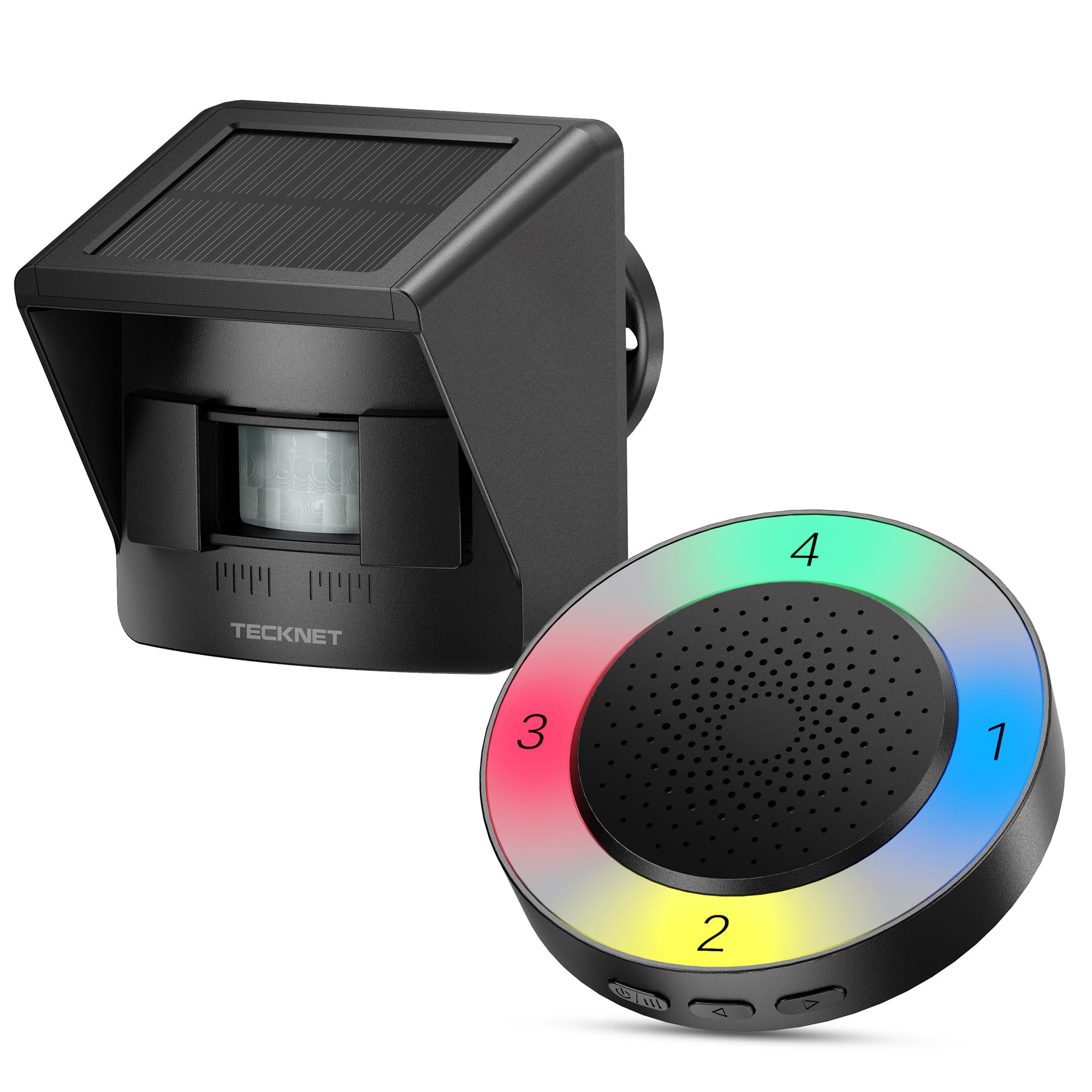
This budget-priced alarm delivers a level of customization uncommon at this price point, with 36 ringtones, five volume levels, and four zone indicators that let you assign different sounds to different areas. The solar panel keeps the sensor charged in sunny locations, and the claimed 2600ft range works well through walls for most driveways. However, motion detection can be inconsistent in some conditions—occasionally missing vehicles or triggering on small animals. Some units may experience loss of function within a few months, though customer support is responsive about replacements. This is best suited for buyers who prioritize variety in ringtones and zone differentiation over guaranteed long-term durability, and who have a sun-exposed installation spot.

Bottom line: Best for budget-conscious shoppers who want extensive ringtone and zone customization and have a sunny driveway, and who accept occasional detection quirks and the possibility of early replacement.

7

Wuloo Solar 2-Sensor

Wuloo Solar 2-Sensor

Solar two-sensor

Our Score 8.6/10
Check Price

Worth Noting

  • In shaded sensor locations, battery drain may outpace solar charging, shortening runtime.
  • Sensitivity adjustment can still trigger false alarms from birds or blowing leaves.
Power
Solar + rechargeable
Range
1800 ft claimed
Detection
PIR
Expandability
Up to 8 sensors

The Wuloo kit includes two motion sensors and a receiver with a built-in clock and alarm, providing two-zone coverage straight out of the box. Its solar panels and rechargeable batteries reduce the need for battery swaps in sunny spots, but in shaded positions or cloudy conditions the charging may not keep up, leading to faster battery drain. The sensitivity adjustment helps, but small animals or moving leaves can still set it off. The top pick in this category handles these issues more consistently, making the Wuloo best suited for homeowners with a sunny driveway who want a complete dual-sensor setup without needing extra purchases.

Bottom line: A good option for sunny driveways where two-zone coverage is wanted at a mid-range price, as long as you can accept occasional false alarms and the need for direct sunlight on the sensors.

8

Wuloo 2-Sensor 1800ft

Wuloo 2-Sensor 1800ft

Shaded locations

Our Score 8.8/10
Check Price

Worth Noting

  • Sensor battery capacity can decrease over time, shortening runtime between charges
  • Receiver continues draining its internal battery even when switched off, requiring unplugging to preserve charge
Power
Rechargeable battery
Range
1800 ft claimed
Detection
PIR
Expandability
Up to 8 sensors

This Wuloo kit offers a practical solution for shaded driveways where solar-powered alternatives would struggle. It covers up to 1800 feet with adjustable PIR detection, and the sensors recharge via USB-C—cutting down on battery waste. The receiver doubles as a clock and alarm, adding convenience. The tradeoff comes in battery management: the sensor's internal cell may lose capacity over weeks of use, and the receiver continues drawing power even when switched off, meaning unplugging it is the only way to stop drain. Detection sensitivity, while adjustable, can still trigger from birds or wind-blown branches in breezy conditions.

Bottom line: Best suited for shaded locations where solar is not viable and where occasional false alarms are acceptable—ideal for monitoring a short driveway with periodic recharging.

9

Mighty Mule FM231

Mighty Mule FM231

Short driveway probe

Our Score 8.2/10
Check Price

Worth Noting

  • Actual detection range may be as low as 200 feet, not the advertised 400.
  • In some cases, the transmitter stops working after a year or two of use.
Power
2x AA batteries
Range
400 ft claimed
Detection
Buried electromagnetic probe
Expandability
Multiple receivers

The Mighty Mule FM231 uses a buried electromagnetic probe to detect only metal vehicles, so you get few false alarms from animals, wind, or passing traffic — a real advantage over PIR sensors. Installation is simple: dig a shallow trench for the probe, connect the wires, and pair with the plug-in receiver. But the claimed 400-foot range often falls short in practice, with many users finding 200 feet more realistic. Durability is another watchpoint: some units stop working after a year or two. That makes this a strong fit for short driveways (under 200 feet) where vehicle-specific alerts matter more than longevity, but for longer runs or multi-year reliability, the premium buried probe option (Dakota Alert’s DCPA-4k) is a safer investment.

Bottom line: Works well for short driveways where you want vehicle-only alerts and easy installation, but plan on replacing it sooner than you would a more robust system.

10

Hosmart 1/2 Mile

Hosmart 1/2 Mile

Mid-range expandable

Our Score 8.6/10
Check Price

Worth Noting

  • Battery life may be shorter than expected, and the sensor can drain power even when turned off.
  • False alarms can occur, particularly at higher sensitivity settings.
Power
4x AA batteries
Range
1/2 mile claimed
Detection
PIR
Expandability
Up to 4 sensors

The Hosmart alarm delivers consistent long-range detection through trees and rain, making it a viable option for driveways up to half a mile. Setup is straightforward and the receiver offers 38 ringtones. However, battery life may be around six months, and the sensor can consume power even when switched off. False alarms can occur, especially with higher sensitivity, and some units may stop working after several months. These tradeoffs keep it a step behind the HTZSAFE, which offers more predictable battery life and fewer false triggers.

Tip: Remove batteries if the sensor will be unused for extended periods to prevent drain when off.

Bottom line: Suitable for budget-conscious buyers who need long range and many tone options, and are willing to accept potential battery and false alarm quirks.

11

Dakota Alert DCMA-4k

Dakota Alert DCMA-4k

Lower-cost Dakota

Our Score 8.2/10
Check Price

Worth Noting

  • Receiver volume may be too low for busy households
  • Motion detection can miss vehicles or pedestrians, requiring careful placement to improve consistency
Power
1x 9V battery
Range
1 mile claimed
Detection
PIR
Expandability
Up to 16 sensors

The Dakota Alert DCMA-4k Plus delivers the brand's signature 1-mile range and straightforward setup at a lower price point. The motion detector works through heavy woods in many conditions, and the receiver offers multiple chime options. However, some units have been noted to miss cars or people, and detection can become inconsistent after a few months. The receiver volume may also be insufficient in noisy environments. For buyers needing guaranteed long-term reliability, the buried-probe DCPA-4k model is a more consistent alternative.

Bottom line: The DCMA-4k works best for buyers familiar with Dakota Alert who need a basic, lower-cost option for moderate-range driveway monitoring and are willing to accept the occasional missed alert.

12

Chtoocy Radar+IR

Chtoocy Radar+IR

Dual detection early

Our Score 8.2/10
Check Price

Worth Noting

  • False alarms may still happen despite dual confirmation, especially in areas with leaf movement or small animal activity.
Power
Solar + rechargeable
Range
1/2 mile claimed
Detection
Radar+IR dual
Expandability
Up to 4 sensors

The Chtoocy uses both radar and infrared detection to confirm motion before signaling——a system that can cut down on false alerts compared to single-sensor alarms. Solar charging and a claimed half-mile range meet what you'd expect from a mid-priced driveway sensor. The unit is weatherproof from -4°F to 140°F and can pair with up to four additional sensors for expanded coverage. However, long-term durability under outdoor exposure is unverified, and occasional false alarms still occur in some setups, particularly with small animals or blowing debris. For buyers willing to take a chance on a newer design, the dual-detection approach is a reasonable experiment.

Bottom line: This alarm is worth considering if you're an early adopter interested in dual-sensor false alarm reduction and you can accept unknown long-term durability. For a more predictable choice, look at models with a longer track record.

How to Choose

Wireless Range

Manufacturers state range in open-field conditions with clear line of sight. In a typical suburban setting with trees and walls, expect 1/4 to 1/3 mile from a 1/2-mile-rated unit. For a half-mile driveway, look for a 1-mile-rated system or a battery-powered sensor with strong signal processing like FSK+FHSS.

Detection Technology

Passive infrared (PIR) sensors detect heat from people, animals, and vehicles. They are cheap and versatile but trigger on deer, leaves, and temperature shifts. Buried electromagnetic probes detect only metal vehicles, eliminating nearly all false alarms. Dual radar+IR sensors try to combine both but are newer and less proven.

Power Source

Solar sensors eliminate battery swaps but require direct sun for at least 4-5 hours a day. In shaded or northern climates, the battery drains and the sensor dies. Battery-only models (AA or CR-123) are more reliable year-round but need periodic replacement. USB-C backup, as found on some solar units, provides a safety net.

False Alarm Reduction

Adjustable sensitivity is standard on most PIR alarms, but it only reduces false triggers from large animals, not wind or leaves. Mounting height matters: 2-3 feet for vehicles, 3-4 feet for people. Pet immunity is rarely specified; if you have small animals, a buried probe is the only guaranteed solution.

Expandability

Most systems allow multiple sensors paired to one receiver. This is critical for long driveways with multiple access points or for covering a side gate. Check the maximum number of sensors and whether each sensor can be assigned a distinct chime or zone. Systems that support 16 or 32 sensors offer flexibility for large properties.

Frequently Asked Questions