Audio & Headphones

3 Best DAC for Home Audio of 2026: Which Deliver Reliable High-Res Sound

Find a reliable DAC that converts digital audio from TV, PC, or streamer to analog without premature failure.

The typical $15 optical converter looks like a no-brainer for adding digital audio to an old stereo receiver. But thousands of buyers discover within months that the unit stops working or introduces noise. That initial savings often turns into a second purchase and lost listening time.

Spending more on a well-built DAC eliminates that risk. The extra money buys a better DAC chip, robust inputs like HDMI ARC, and outputs such as balanced XLR that simplify system integration. It also buys components that keep working years later.

The trade-off in this category comes down to connectivity priorities. A home theater setup benefits from HDMI ARC and a preamp, while a desktop system may value a powerful headphone output. The right choice depends on whether your primary source is a TV or a computer.

1

Fosi Audio ZD3 DAC Preamp

Top Pick
Fosi Audio ZD3 DAC Preamp

Home theater integration

Our Score 9.2/10
Check Price

Worth Noting

  • OLED display is small and dim, hard to read from across a room.
Inputs
HDMI ARC, USB, Optical, Coax, BT
Preamp
Yes
Outputs
Balanced XLR, RCA
DAC Chip
ES9039Q2M

The Fosi Audio ZD3 brings home-theater-focused connectivity to a compact DAC preamp, pairing an ES9039Q2M chip with HDMI ARC, USB, optical, coaxial, and Bluetooth inputs. Balanced XLR and RCA outputs feed straight into an amplifier or powered speakers, turning a TV or streamer into a high-resolution source (PCM 32-bit/768kHz, DSD512). The remote control handles volume and input switching, and a preamp bypass lets it integrate into systems with separate volume control.

Sound quality leans warm with dynamic bass, delivering clarity that suits both music and dialogue-heavy content. Users consistently note the detail retrieval across all inputs — optical from a game console, USB from a computer, or ARC from a TV all produce consistent, noise-free output. The Bluetooth receiver offers convenient streaming, though audiophiles will likely stick to wired connections for the highest resolution.

This DAC is built for someone with a home theater or stereo system that needs TV audio via HDMI ARC, plus balanced XLR outputs to match a balanced amplifier. It also works well for desktop setups that share a display with a game console or streamer, as long as you don't need headphone output — there is none. The OLED display shows input and volume, but sitting more than a few feet away makes it tough to read, which reduces the remote's usefulness in larger rooms. For close-range placement or as a set-and-forget component, this is not an issue.

Tip: Place the ZD3 within arm's reach or rely on the remote's input memory — the display is best read up close.

Bottom line: The ZD3 delivers HDMI ARC and balanced outputs where most rivals offer only one — a focused buy for TV-centric audio systems that value clean signal path and remote control.

2

Fosi Audio ZH3 DAC/Amp

Fosi Audio ZH3 DAC/Amp

Desktop headphones + speakers

Our Score 9.2/10
Check Price

Worth Noting

  • Menu navigation without the remote is cumbersome
  • XLR and RCA output levels differ, requiring careful gain matching to connected amps
Inputs
USB, Optical, Coax, RCA, 12V
Preamp
Yes
Outputs
XLR, RCA, 4.4mm, 6.35mm
DAC Chip
AKM4493SEQ

The ZH3 drives demanding headphones like the Sennheiser HD 650 with noticeable headroom, thanks to its balanced 4.4mm output delivering over 2.5 watts per channel. This is a desktop-centric DAC/amp that also functions as a preamp with both XLR and RCA outputs, though the two outputs differ in level by about 6 dB — careful matching to your amplifier is recommended.

Sound quality is detailed with strong stereo imaging across a range of genres, and the built-in bass/treble EQ gives you direct control without leaving your listening position. The front-panel knob is responsive for volume adjustment, but navigating the menu system requires the included remote — there is no back button on the device itself, so changing filters or EQ presets is less convenient without the remote in hand.

This unit is best suited for desktop audiophiles, gamers, and music producers who want a single hub for both powered speakers and high-impedance headphones. If your system revolves around a TV or home theater receiver with HDMI ARC, the Fosi ZD3 (our top pick) is a better fit. The ZH3 lacks HDMI input and its output-level mismatch requires some care when pairing with downstream gear — these are manageable tradeoffs for headphone-focused setups.

Tip: When connecting to an amplifier, note that the XLR output is about 6 dB hotter than the RCA — adjust gain accordingly to avoid distortion.

Bottom line: If your desktop setup prioritizes high-impedance headphones and you want EQ control without software, the ZH3 delivers — just plan to keep the remote nearby.

3

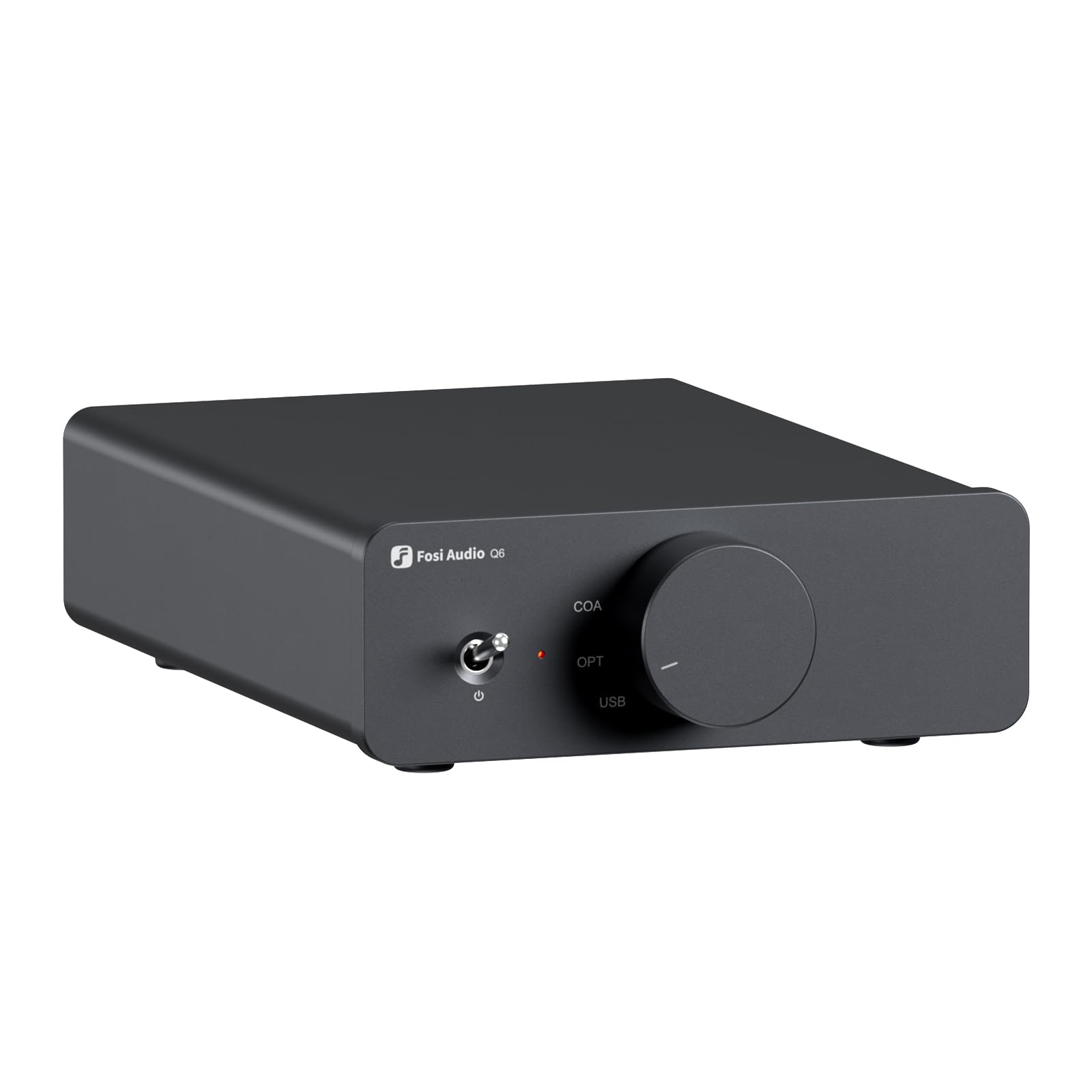
Fosi Audio Q6 Mini DAC

Fosi Audio Q6 Mini DAC

Budget high-res 2.1 system

Our Score 9.4/10
Check Price

Worth Noting

  • No volume control or preamp; requires the amplifier or source device to handle volume adjustments.
  • Lacks 12V trigger and remote control, making integration with rack systems less convenient.
Inputs
USB-C, Optical, Coaxial
Preamp
No
Outputs
RCA, Subwoofer out
DAC Chip
AKM AK4493S

The Fosi Audio Q6 stands out among budget DACs for its dedicated subwoofer output, a feature typically reserved for more expensive units. Combined with the AKM AK4493S chip, it produces clean, detailed audio that easily matches DACs costing twice as much. Where the ultra-budget alternative (B0C1Y7C9HH) offers MQA support but risks early failure, the Q6 focuses on reliable core performance with a straightforward USB-C, optical, and coaxial input set.

Setup is genuinely plug-and-play: connect a source, power it via USB-C, and route the RCA outputs to an amplifier or powered speakers. The aluminum case keeps interference low and heat dissipation quiet. For desktop listeners building a 2.1 system, the subwoofer out integrates cleanly without extra adapters or splitters.

This DAC suits buyers who already have an amplifier with volume control or powered speakers with their own knob. It requires an upstream or downstream device to adjust listening levels; no preamp function or remote is included. Users with rack-mounted systems may miss a 12V trigger, but for a simple desktop or shelf setup, these omissions are non-issues.

Tip: Pair with an amplifier that has its own volume knob or use powered speakers with volume control to work around the missing preamp.

Bottom line: The Q6 is the right pick for anyone who wants high-res audio and a dedicated subwoofer output without spending extra on features they won't use.

How to Choose

DAC Chip and Resolution Support

The DAC chip converts digital bits to analog voltage. Modern chips from AKM and ESS routinely handle PCM 768kHz and DSD512, far beyond audible needs. Marketing often emphasises specs that don't correlate with real-world sound quality.

What matters is the analog stage after the chip – how cleanly the signal is filtered and amplified. A well-implemented older chip can outperform a flagship chip in a noisy circuit. Focus on user feedback about clarity and noise floor rather than headline numbers.

Input Connectivity

USB is universal for computers, but TV connectivity depends on optical or HDMI ARC. Optical (Toslink) works with any TV that outputs PCM, but most TVs limit optical to 2-channel PCM or compressed Dolby Digital. For lossless multi-channel from streaming apps, HDMI ARC is required.

HDMI ARC also carries CEC commands so the DAC can power on/off with the TV. If your TV lacks ARC, optical remains a solid fallback. Bluetooth input adds convenience for phone streaming, but always verify codec support – LDAC or aptX HD for better quality.

Output Options

Balanced XLR outputs offer lower noise over long cable runs and can reject ground-loop hum better than RCA. They also deliver a hotter signal, which may require adjusting volume on downstream gear. Not all amplifiers have XLR inputs; many consumer amps only accept RCA.

Headphone outputs vary hugely in power. A DAC rated for 32-ohm headphones may struggle with 300-ohm Sennheisers. Look for power figures at your headphone's impedance – 100mW+ into 300Ω is adequate; 1W+ into 32Ω drives most planars. Dedicated subwoofer outputs (like on the Q6) simplify 2.1 setups.

Volume Control and Preamp Function

A built-in preamp eliminates the need for a separate volume control. DACs with preamp bypass (like the ZD3) allow you to use a separate preamp or integrated amplifier's volume while still benefiting from the DAC's outputs.

Without preamp function, the DAC outputs line-level voltage that must be controlled by the amplifier or source device. That works if your amp has a volume knob, but some powered speakers lack one. If your setup lacks a volume controller, choose a DAC with remote and preamp.

Build Reliability and Longevity

The most common failure point in budget DACs is the power supply or input board. Units that rely on USB bus power or cheap voltage regulators often develop noise or stop working after a few months. Metal enclosures and external power adapters improve heat dissipation and durability.

Reliability also affects resale value and frustration. A $15 DAC that dies in six months costs more per month than a $180 unit that lasts five years. When choosing, prioritize brands with consistent positive feedback about longevity, not just initial sound quality.

Frequently Asked Questions