Phone & Tablet Accessories

10 Best Cell Phone Signal Boosters of 2026: Match Coverage to Your Home's Needs

Find the cell phone signal booster that fixes dropped calls and slow data in your home — without overpaying or struggling with complex installation.

A cell phone signal booster can transform a dead zone into a usable connection, but only if your home has at least a weak outdoor signal to amplify. Many buyers assume any booster will fix zero bars, only to find it does nothing. Understanding your outdoor signal strength - measured in dBm - is the first step to picking a booster that actually works.

Coverage claims on boxes often exceed real-world performance. A booster rated for 5,000 square feet may only cover half that if your outdoor signal is marginal or your home construction blocks radio waves. This guide focuses on the specs that matter: gain, antenna type, and band support, so you can match the booster to your actual home size and signal conditions.

1

HiBoost Hero

Top Pick
HiBoost Hero

Mid-size homes

Our Score 8.8/10
Check Price

Worth Noting

  • The printed manual uses poorly translated English that can make initial setup confusing
  • Indoor range shrinks noticeably if outdoor signal is weaker than -100 dBm
Gain (dB)
65
Bands Supported
2/4/5/12/13/17/25
Indoor Antennas
Panel + Whip
Coverage (sq ft)
3000

The HiBoost Hero stands apart from other mid-range boosters by consistently raising call quality and data speeds in homes with weak to moderate outdoor signals. Its panel and whip antenna options let you fine-tune placement for even coverage, and the 65 dB gain handles most residential layouts without overpromising.

In homes with outdoor signal around -90 to -100 dBm, the Hero reliably delivers 3–4 bars indoors and eliminates dropped calls during voice and data use. Performance does drop off when outdoor signal falls below -100 dBm — that’s a physical constraint of any booster, not a flaw unique to this model. Check your signal strength at the intended outdoor antenna location before buying.

This booster fits homeowners with 2000–3000 sq ft of space who want a consistent improvement in cellular reception for all major US carriers. The instruction manual is poorly translated and can be confusing, but the free app provides step-by-step guidance and customer support responds quickly if you run into trouble. If your home exceeds 3000 sq ft or you’re in a true dead zone (no usable outdoor signal), consider the HiBoost 8000 or a weBoost option instead.

Build quality is above average for this price category — the unit feels solid, and the antennas mate securely without the flimsy connectors found on cheaper boosters. Owners who prioritize durability will find the Hero holds up well over years of use, and the 3000 sq ft coverage claim is realistic in most installations.

Tip: Download the HiBoost app before unboxing — it walks you through placement and antenna separation, making the printed manual optional.

Bottom line: For homes with a usable outdoor signal and coverage needs up to 3000 sq ft, the HiBoost Hero is the most dependable choice in its class — just plan to use the app for setup.

2

ZORIDA ACE 5S

ZORIDA ACE 5S

Small homes

Our Score 8.4/10
Check Price

Worth Noting

  • The printed manual can be hard to follow
  • Signal strength drops off quickly beyond a single room, so coverage is limited to the area near the indoor antenna.
Gain (dB)
72
Bands Supported
12/17,13,5,4,2/25
Indoor Antennas
Whip
Coverage (sq ft)
2000

The ZORIDA ACE 5S combines 72dB gain with app-guided installation for spaces up to 2000 sq ft, making it the most affordable way to boost voice and data in a small home or office. The whip indoor antenna and directional outdoor antenna cover the basics without extra frills.

This booster is best for budget-conscious buyers who already have at least one bar of outdoor signal and don't mind a hands-on setup. The printed manual can be vague, but the companion app and responsive customer support fill the gaps. Those expecting a polished step-by-step guide may find the process frustrating.

Tip: Download the app first and use the setup wizard — skip the paper manual entirely.

Bottom line: A smart buy for anyone on a tight budget who needs basic signal improvement in a small space and is okay with learning through the app rather than the manual.

3

weBoost Home MultiRoom

weBoost Home MultiRoom

Large homes

Our Score 8.4/10
Check Price

Worth Noting

  • Amplifier base becomes very hot during use
  • Value perception is mixed; the premium price may feel high given the unpredictable results.
Gain (dB)
Bands Supported
12/17,13,5,4,25/2
Indoor Antennas
Fabric panel
Coverage (sq ft)
5000

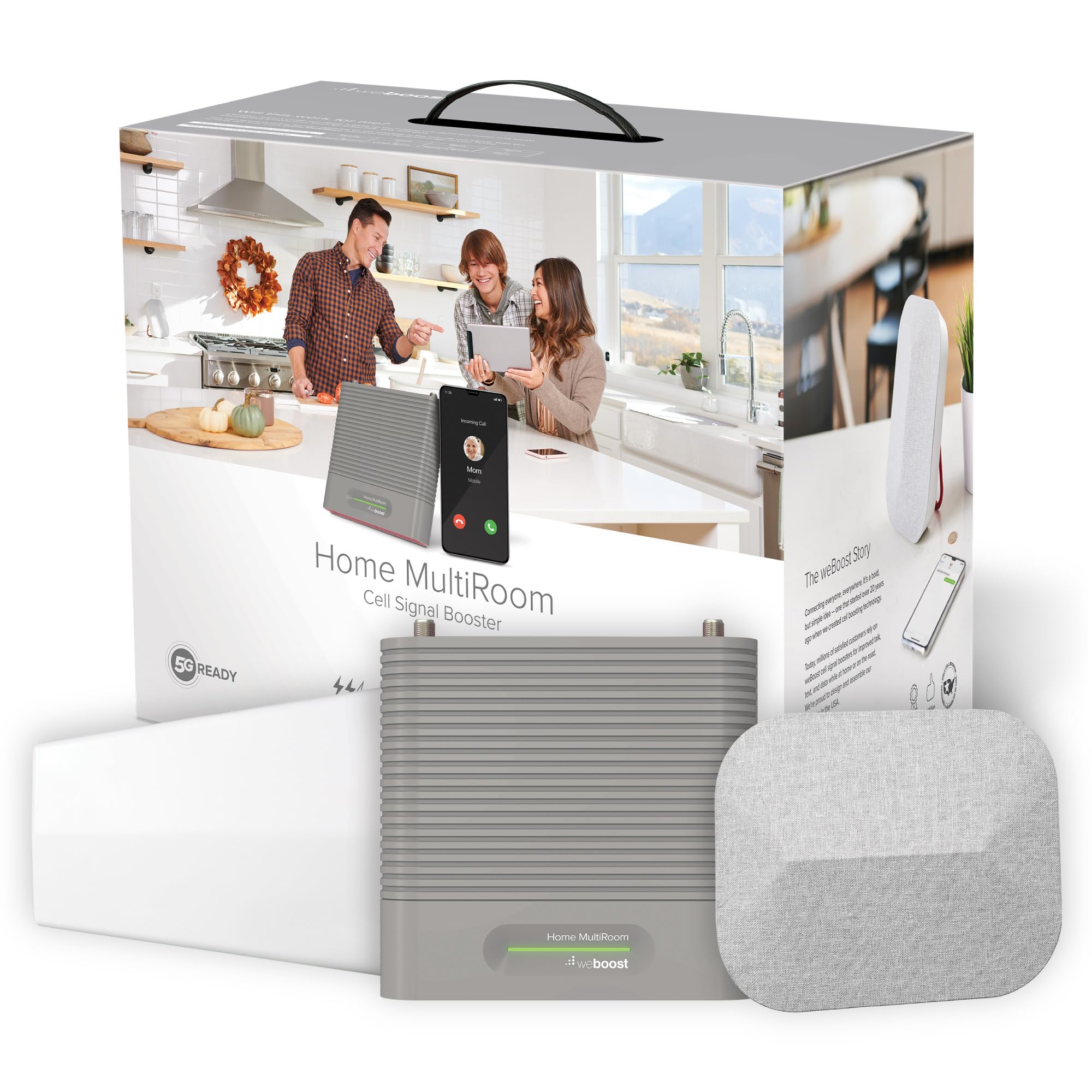
The weBoost Home MultiRoom covers up to 5,000 square feet and comes from one of the most recognized brands in signal boosting. It offers broader coverage than the top pick, but real-world performance is less consistent – some installations see a solid 2–3 bar gain while others see little change. Its directional Yagi outdoor antenna and fabric panel indoor antenna are typical for this class, and installation is straightforward with provided mounting hardware.

This booster works best in homes with at least two bars of outdoor signal, where a moderate dead zone needs filling. It is not a solution for complete dead zones (0–1 bar) – in those cases, performance may disappoint. For buyers who prioritize brand recognition and broad coverage over guaranteed results, this remains a popular choice.

Tip: Place the amplifier in a well-ventilated area and avoid covering it – surface temperature can become quite high during extended operation.

Bottom line: Best for those who want a recognized brand with wide coverage and have at least two bars of outdoor signal – not a reliable solution for weak signal areas or when consistent results are critical.

4

CEL-FI GO G41

CEL-FI GO G41

Very large spaces

Our Score 9.0/10
Check Price

Worth Noting

  • The premium price is hard to justify unless you need extreme coverage or are in a dead zone.
  • In a typical home, the setup may require drilling and cable routing that some prefer to leave to a professional.
Gain (dB)
100
Bands Supported
700MHz, 1700/2100MHz
Indoor Antennas
1 dome + 1 panel
Coverage (sq ft)
15000

With 100dB of gain and a rated coverage of 15,000 sq ft, the CEL-FI GO G41 turns a faint whisper of an outdoor signal into strong, usable bars indoors. It goes where other boosters struggle — pulling in a signal from miles away when there’s virtually nothing to work with.

This booster is built for commercial buildings, warehouses, and homes over 10,000 sq ft, especially in remote rural areas where the outdoor signal is barely detectable. The tradeoff is a steep upfront cost and an installation process that may require drilling and careful cable routing — some buyers opt for professional help to get full performance. For a typical two-story house with a moderate outdoor signal, a mid-range booster like the HiBoost Hero delivers similar results at a fraction of the price.

Tip: Consider hiring a professional installer for antenna placement and cable routing to get the full benefit.

Bottom line: If you need to cover a very large space or are in an extremely remote area with barely any outdoor signal, the CEL-FI GO G41 is the only booster that will actually deliver. For everyone else, the cost and effort are hard to justify.

5

HiBoost 4K Mate

HiBoost 4K Mate

No-drill install

Our Score 8.8/10
Check Price

Worth Noting

Gain (dB)
Bands Supported
Multiple bands (700-2600)
Indoor Antennas
Built-in
Coverage (sq ft)
4500

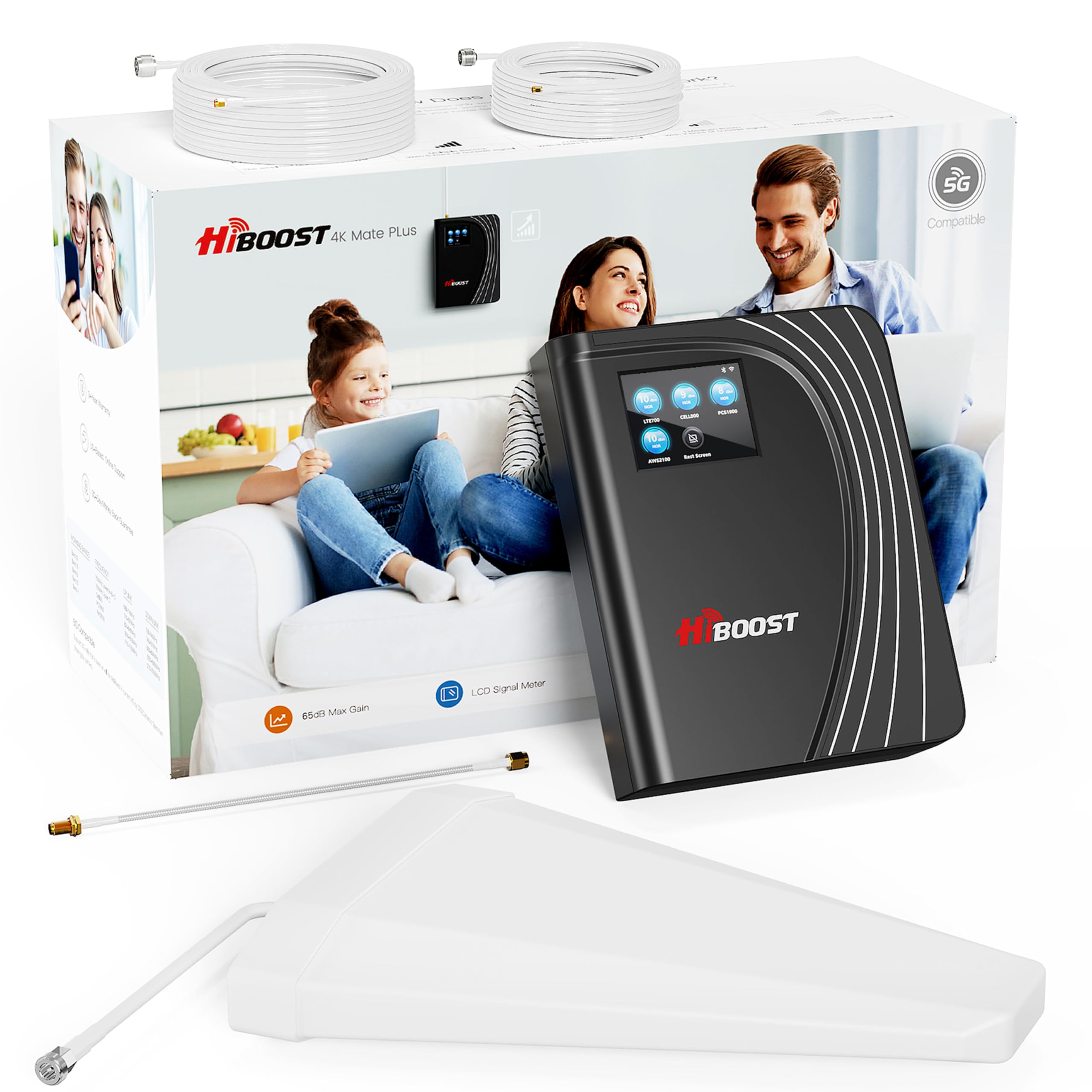
The HiBoost 4K Mate removes the biggest barrier to using a cell signal booster: installation. Its built-in indoor antenna and included window pass-through cable let you route the outdoor directional antenna to a window without drilling holes or running cables through walls. Setup takes under 30 minutes and requires no tools beyond what's in the box.

This booster suits homeowners and renters with 3000 to 4500 square feet of space who want a clean, low-profile installation. Users report reliable gains of 3 to 5 bars in most rooms, provided outdoor signal is moderate to strong. The LCD touch screen provides real-time signal strength feedback, which simplifies aiming the outdoor antenna for best results.

Bottom line: A practical choice for anyone who needs a booster but can't drill — the 4K Mate delivers on clean installation and consistent coverage in medium-large homes.

6

weBoost Home Studio

weBoost Home Studio

Single room

Our Score 8.2/10
Check Price

Worth Noting

  • Unit temperature rises noticeably during continuous use
  • Indoor antenna range is only a few feet, restricting placement options
Gain (dB)
60
Bands Supported
12/17,13,5,4,25/2
Indoor Antennas
Whip
Coverage (sq ft)
One room

The weBoost Home Studio delivers consistent signal improvement in a single room at a lower price point than most new boosters. Its refurbished status includes a one-year warranty, making it a cost-effective option for a home office, studio, or bedroom where one bar of usable reception makes the difference.

This booster suits anyone who only needs coverage in one specific area and is comfortable buying refurbished electronics. The indoor whip antenna covers only a few feet, so placement within the room is critical – the booster must sit close to your phone or hotspot. The unit also runs warm during extended use, which is manageable in ventilated spaces but worth noting if the room is small or enclosed.

The directional outdoor antenna requires a clear line of sight to the nearest cell tower to capture a usable signal. In areas with very weak outdoor signal, the limited indoor range may still leave desk spaces near the unit uncovered, reinforcing that this is strictly a close-range solution.

Tip: Place the booster in an open, ventilated spot to manage heat buildup during long calls or streaming sessions.

Bottom line: If your need is strictly one room and you’re open to refurbished gear, this is a sensible way to improve cellular reception without spending for whole-home coverage.

7

HiBoost Sidekick

HiBoost Sidekick

Small homes

Our Score 8.8/10
Check Price

Worth Noting

  • Bluetooth pairing with the SignalAdvisor app can be unreliable for live monitoring.
  • Requires at least one bar of outdoor signal; ineffective in complete dead zones.
Gain (dB)
Bands Supported
12/17,13,5,25/2,4
Indoor Antennas
Whip
Coverage (sq ft)
2000

The Sidekick delivers noticeable improvement in call clarity and data speeds for spaces up to 2,000 sq ft, provided there is at least one bar of outdoor signal. Installation is guided by a companion app and an LCD display, removing guesswork. For its price, it offers solid build quality and consistent performance. However, coverage is limited compared to the Hero, which adds 1,000 sq ft for about $110 more, making this a better fit for smaller budgets and spaces. Areas with no outdoor signal will see no benefit.

Bottom line: Best suited for apartments or home offices with at least one bar of outdoor signal, where the extra coverage of the Hero isn't needed to justify the price difference.

8

HXSDplus 5G Booster

HXSDplus 5G Booster

Budget large

Our Score 9.6/10
Check Price

Worth Noting

  • Supported frequency bands are not specified, so carrier-specific compatibility is unclear.
Gain (dB)
70
Bands Supported
All US
Indoor Antennas
2 panel
Coverage (sq ft)
7000

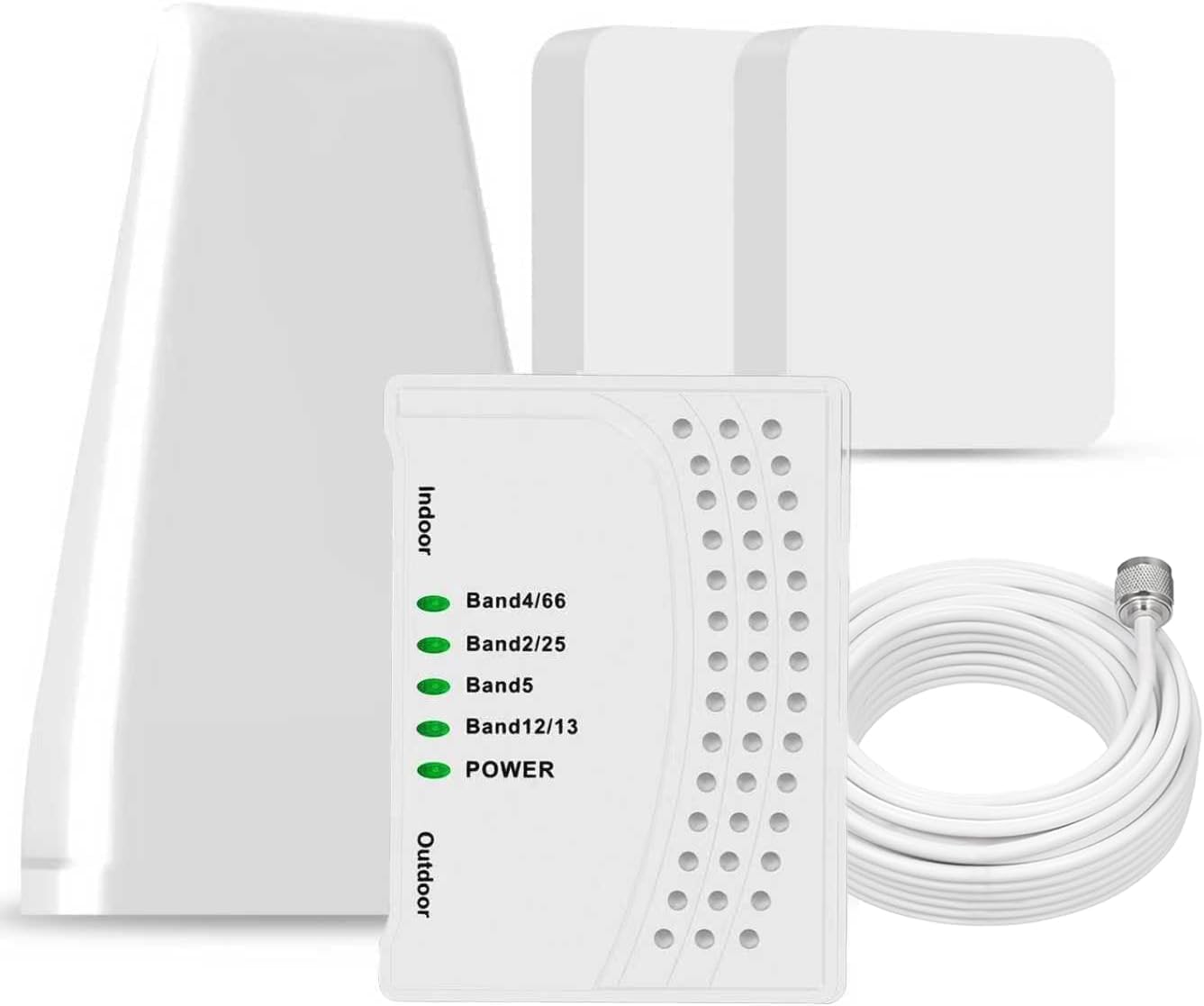
The HXSDplus 5G Booster is attractively priced for a device that claims 7000 sq ft of coverage and supports all major US carriers. Installation is simple, with two indoor panel antennas and a log-periodic outdoor antenna included. However, this model is relatively new, so long-term durability and consistent performance across different signal environments have not been broadly verified. That makes it a risk compared to boosters with a longer track record of user experience.

Bottom line: A low-cost option for buyers who prioritize price over proven long-term reliability and are willing to accept unverified performance for large-area coverage.

9

weBoost Home Complete

weBoost Home Complete

Large homes

Our Score 8.0/10
Check Price

Worth Noting

  • In homes with weak outdoor signal, the booster may show no improvement
  • Premium price does not consistently translate to signal improvement, making the value questionable for some
Gain (dB)
Bands Supported
Major bands
Indoor Antennas
Panel
Coverage (sq ft)
7500

The weBoost Home Complete offers whole-home coverage up to 7500 sq ft with support for all major US carriers and 5G/4G LTE. A directional outdoor antenna and panel indoor antenna are included. Installation is manageable with manufacturer video guides. The catch: its premium price does not guarantee signal improvement – some setups see no gain, making the value highly dependent on outdoor signal strength. For consistent performance, the CEL-FI or HiBoost 8000 are stronger investments.

Bottom line: Fits buyers with moderate outdoor signal in large homes who prioritize brand recognition, but only if they accept the risk of inconsistent results.

10

HiBoost 8000

HiBoost 8000

Very large homes

Our Score 9.0/10
Check Price

Worth Noting

  • Indoor antenna coverage may not fill the full 8000 sq ft if outdoor signal is weak.
  • Connection cable may require a separate adapter for existing mounts.
Gain (dB)
70
Bands Supported
2/4/5/12/13/17/25
Indoor Antennas
2 panel
Coverage (sq ft)
8000

The HiBoost 8000 brings 70dB of gain across two panel antennas to handle large homes and metal buildings. Real-world coverage depends on outdoor signal strength — in weak-signal areas, the full 8000 sq ft claim may not be reached. While capable, this model competes with the weBoost MultiRoom, which has a larger base of user feedback and is often the preferred choice for proven large-space performance. The HiBoost 8000 is a solid option if outdoor signal is decent and you want dual-antenna distribution, but it carries more uncertainty than the more reviewed alternative.

Bottom line: For large homes with moderate outdoor signal, this booster provides strong dual-antenna coverage, but the more established weBoost MultiRoom is a safer bet for buyers who prioritize a larger review base.

How to Choose

Coverage Area (sq ft)

The coverage rating tells you the maximum indoor square footage the booster can fill with signal under ideal conditions. But real-world range depends on outdoor signal strength and building materials — a 5,000 sq ft rating may only deliver 2,500 sq ft in a house with thick walls or a metal roof.

Measure your home's actual floor plan and consider where you need signal most. If your outdoor signal is weak (below -100 dBm), expect the booster to cover less than its rated area. Choose a model rated for 50-100% more space than your home for a safety margin.

Gain (dB)

Gain measures how much the booster amplifies the incoming signal. A higher dB number can pull in weaker signals from farther away, but it also increases the risk of oscillation — feedback that shuts the unit down when the indoor and outdoor antennas are too close.

For most homes with moderate outdoor signal, 60-70 dB is sufficient. If you live miles from the nearest tower with only one bar, look for 70-100 dB. But note that extreme gain requires careful antenna separation (often 20+ feet vertical or horizontal) to avoid oscillation.

Indoor Antennas

The type and number of indoor antennas determine how the boosted signal spreads through your home. Panel antennas broadcast directionally and cover a wide area (ideal for open floor plans), while whip antennas radiate in all directions but over a shorter range.

Systems with two indoor antennas can cover separate zones or floors more evenly. A single antenna may leave dead spots in far corners. If your home has multiple rooms or a split-level layout, a dual-antenna kit is worth the extra cost.

Bands Supported

Carriers use different frequency bands for 4G LTE and 5G. A booster must support the specific bands your carrier relies on in your area — commonly 12, 13, 5, 4, 2, and 25 for US networks. If a booster misses a key band, you may get voice but no data, or vice versa.

Most products advertise 'all carriers' but verify they cover Band 12/17 (T-Mobile and AT&T's long-range) and Band 13 (Verizon's primary). Also note that true 5G mmWave (high-band) is not boostable on consumer units — what they call '5G compatible' typically refers to mid-band (sub-6 GHz) which already uses existing 4G bands.

Ease of Installation

Installation is the most overlooked pain point. A booster requires mounting an outdoor antenna (typically on a roof or wall), routing a cable through a window or wall, and placing the indoor antenna at least 20-50 feet away from the outdoor one to prevent oscillation.

Models with app-guided setup, LCD displays, or window pass-through cables simplify the process. If you rent or can't drill holes, look for a kit with a thin window cable (like the HiBoost 4K Mate) instead of a permanent mount. Budget for 1-2 hours of setup time and possibly a window seal kit.

Frequently Asked Questions