Audio & Headphones

13 Best Bookshelf Speakers of 2026: Match Your Setup and Budget

Find the best bookshelf speakers for desktop, home theater, or near-field listening — whether you need powered convenience or passive performance.

Bookshelf speakers promise big sound from a small footprint, but the first fork in the road is powered versus passive. Powered speakers bundle an amplifier for plug-and-play simplicity, while passive speakers let you choose your own amp and upgrade components later. Many buyers discover the trade-off only after they've already set up a system that can't grow with their needs.

This guide focuses on the use case that matters most: where you'll place them, what you'll connect, and whether you plan to add a subwoofer or upgrade later. The right choice depends less on specs and more on whether you want a complete solution in one box or a flexible foundation for future upgrades.

Considering that most bookshelf speakers struggle to deliver deep bass without a subwoofer, the real question is not which speaker is 'best' in isolation, but which one fits your room size, amplifier situation, and long-term plans.

1

Edifier R1280T

Top Pick
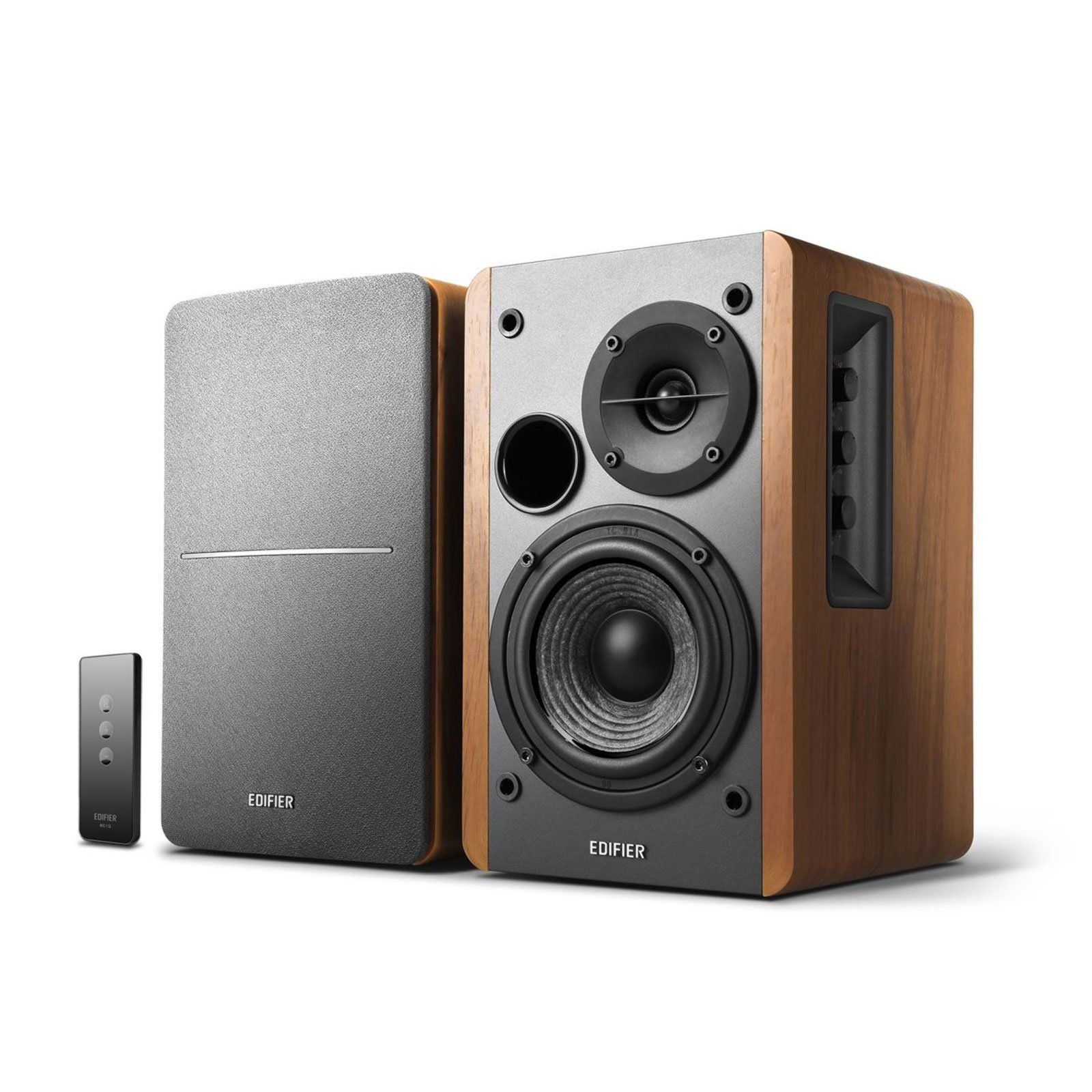
Edifier R1280T

Desktop computer audio

Our Score 9.2/10
Check Price

Worth Noting

  • Remote control loses reliability beyond a few feet and requires clear line-of-sight
  • Maximum volume is sufficient for near-field use but may not fill large rooms or high listening levels
  • Bass extension is modest
Connectivity
RCA, 3.5mm
Amplification
Powered
Power & Sensitivity
42W RMS
Driver Configuration
4″ woofer + 13mm silk dome tweeter

Edifier’s R1280T delivers a level of clarity and balance that typically belongs to speakers costing twice as much. The 4-inch woofers and silk dome tweeters produce clean highs and a surprisingly full midrange, while the built-in 42W amplifier drives them loud enough for near-field listening without distortion. Bass and treble controls on the front panel let you tweak the signature to match your room or taste, which is a rare convenience at this price.

The wood-look vinyl finish is convincingly attractive and blends into most living spaces without sticking out. Dual AUX inputs (RCA and 3.5mm) mean you can plug in a computer, TV, or turntable simultaneously without a switcher. Setup is literally plug-and-play: connect the included RCA cable, flip the power switch, and adjust volume on the speaker or remote. That simplicity is a genuine convenience for anyone who just wants music without fuss.

This speaker is best for a desktop workstation, a small bedroom, or a compact living room where you sit within 6–8 feet. The maximum volume is adequate for these spaces but will run out of headroom in a large open-plan area or for hosting parties. The bass is present and punchy for the size but won’t reach sub-bass territory — if you want chest-thumping low end, plan on adding a separate subwoofer. The remote control works well at close range but becomes unreliable beyond a few feet, so keep it on your desk or use the front-panel volume knob.

Build quality is solid for the money — the cabinet is MDF with a textured vinyl wrap, and the grilles are removable. Power and connectivity are straightforward with no Bluetooth or digital inputs, so this is strictly a wired analog solution. That focus keeps the price low and the reliability high, but buyers expecting wireless or optical inputs should look at the R1280DB or R1280DBs instead.

Tip: Keep the remote within 3 feet and pointed at the speaker; for longer distances, use the front-panel volume knob.

Bottom line: If your listening space is a desk, dorm, or small room and you want a wired analog speaker that sounds far better than its price suggests, the R1280T is the one to get — just accept its volume and bass boundaries.

2

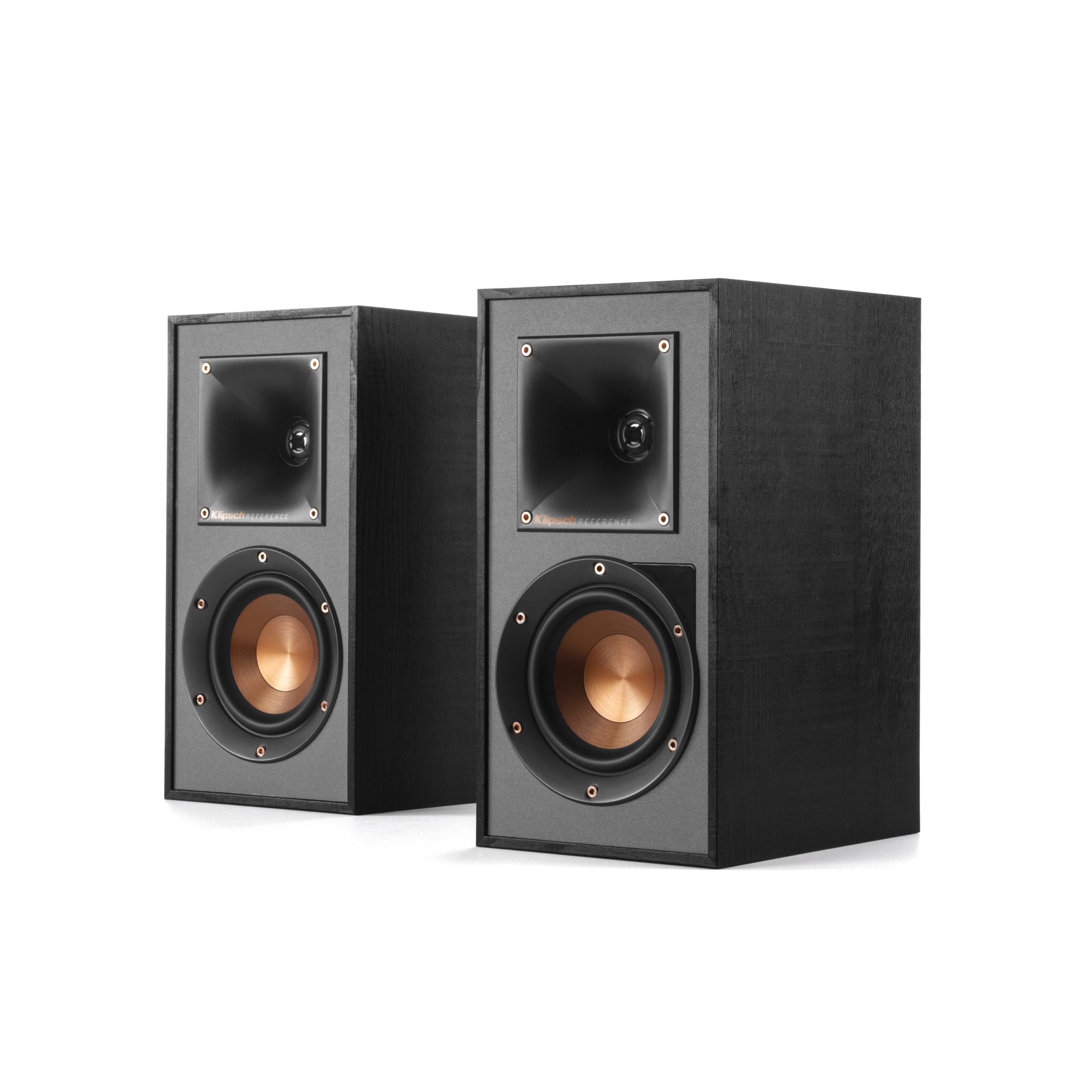
Klipsch R-51M

Klipsch R-51M

Home theater

Our Score 9.6/10
Check Price

Worth Noting

  • Horn tweeter can sound bright or harsh in untreated rooms with hard surfaces
  • Requires a separate amplifier and a subwoofer for full-range bass response
Connectivity
Amplification
Passive
Power & Sensitivity
340W peak / 90dB
Driver Configuration
1″ tweeter + 5.25″ woofer

The R-51M’s 90 dB sensitivity means a modest 20-watt amp can drive them to satisfying levels, while the aluminum tweeter and copper woofer produce crisp, detailed sound that cuts through a mix without strain.

These passive speakers require a separate amplifier and benefit from a subwoofer for bass below 62 Hz. The horn tweeter can sound bright in rooms with hard surfaces, making room treatment or careful placement worthwhile.

Unlike the top pick’s all-in-one simplicity, the R-51M offers upgrade flexibility — swap amps, expand to 5.1 later. Best suited for home theater builders or stereo enthusiasts who have an amplifier and plan to add a subwoofer.

Tip: If the treble sounds bright, toe the speakers away from your listening position or add soft furnishings to the room.

Bottom line: For home theater builders and stereo enthusiasts who have an amplifier and plan to add a subwoofer, the R-51M delivers reference-level clarity at a mid-range price.

3

Polk Audio T15

Polk Audio T15

Budget home theater

Our Score 9.4/10
Check Price

Worth Noting

  • Static or distortion can occur in a small number of units, making arrival inspection advisable.
  • Bass response drops off below 60Hz, requiring a subwoofer for full-range sound.
Connectivity
Amplification
Passive
Power & Sensitivity
100W peak
Driver Configuration
0.75″ tweeter + 5.25″ woofer

Clear, balanced sound and a wide soundstage make the Polk Audio T15 a strong foundation for a budget home theater or stereo system. As a passive design, it requires a separate amplifier or receiver, which gives buyers flexibility to upgrade components over time rather than being locked into an all-in-one powered unit.

This speaker suits newcomers to passive setups who want a low-cost way to build a surround sound system. Its limited bass extension – the official spec drops off around 60Hz – means a subwoofer is nearly essential for movie effects and full-range music. For front-channel use, plan on adding a subwoofer early in the build.

A small number of units have exhibited static or distortion right out of the box, so inspecting the pair upon arrival is worth the time. For rear or surround channels, the bass limitation is less noticeable, and the T15’s clear midrange and treble make it a capable performer in those roles.

Tip: Pair with a subwoofer to fill the low end – the T15 handles mids and highs well, making it a capable surround speaker even without deep bass.

Bottom line: An affordable starting point for a budget home theater system when paired with a subwoofer and a basic amp – it gets the fundamentals right without unnecessary extras.

4

Klipsch RP-600M

Klipsch RP-600M

Serious music

Our Score 9.6/10
Check Price

Worth Noting

  • Horn tweeter's bright character may be fatiguing in highly reflective rooms or with bright electronics.
  • Bass extension down to 45 Hz still leaves deep low-end absent without a subwoofer for some listeners.
Connectivity
Amplification
Passive
Power & Sensitivity
400W peak
Driver Configuration
1″ tweeter + 6.5″ woofer

The Klipsch RP-600M uses a 6.5-inch cerametallic woofer and Tractrix horn tweeter to produce dynamics and soundstage that compete with speakers costing significantly more. Its high 91 dB sensitivity makes it easy to drive with modest amplifiers, and the clarity across the frequency range suits critical listening in medium to large rooms. This model sits below the RP-600M II in the lineup but shares the same core driver technology at a lower price point.

This speaker is best for listeners who value detail, impact, and efficiency over a warm, forgiving tone. The horn tweeter presents subtle details clearly but can sound bright in untreated rooms or with poorly mastered material. It works well in home theater systems where high efficiency and dynamics matter, and with a quality amplifier, stereo imaging is precise. However, its rear port requires space from walls, and the cabinet size may not fit all bookshelf shelves. Pairing with a subwoofer is recommended for those wanting deeper bass extension.

Build quality is a strong point: the MDF cabinets with ebony veneer feel substantial, and magnetic grilles add a clean aesthetic. The speaker is rear-ported, so placement matters - at least a few inches from the wall for balanced bass. While the horn tweeter's narrow directivity creates a well-defined sweet spot, off-axis listening may reduce high-frequency energy more than typical dome tweeters. For the price, the RP-600M offers a level of performance that challenges many models in the higher price bracket.

Tip: Positioning the speakers slightly off-axis can reduce perceived brightness from the horn tweeter while retaining detail.

Bottom line: For the listener who already has a quality amplifier and values dynamic range and detail over laid-back warmth, the RP-600M is a compelling choice that justifies its mid-range price with near-audiophile performance.

5

Edifier R1280DBs

Edifier R1280DBs

Desktop computer audio

Our Score 9.2/10
Check Price

Worth Noting

  • Bluetooth pairing can be finicky and occasional dropouts may occur
  • Remote control has limited range and responsiveness beyond 10 feet
  • Bass sounds muddy and loose when the low-end boost is engaged
Connectivity
BT, Optical, Coax, RCA, Sub
Amplification
Powered
Power & Sensitivity
42W RMS
Driver Configuration
4″ woofer + 13mm silk dome tweeter

A dedicated subwoofer output and optical/coaxial digital inputs set the R1280DBs apart from other budget powered speakers. This allows lossless audio from TVs and game consoles, with the option to add a subwoofer for deeper low end without upgrading the whole system. Most competitors at this price limit connections to analog RCA or Bluetooth, making the Edifier a practical choice for users who want a clean digital signal path and room to grow.

This speaker targets desktop computer users and TV listeners who need digital inputs and a subwoofer upgrade path. The bass can become muddy and loose when boosted, and the remote control works reliably only within about 10 feet with direct line-of-sight. For desktop use where the remote stays close, these tradeoffs are minor — for a TV across a living room, the remote range becomes a noticeable limitation.

The wood-grain finish and compact dimensions make the R1280DBs unobtrusive on a desk or shelf, and the 4-inch woofer paired with a 13mm silk dome tweeter delivers clear mids and highs suited for dialogue and acoustic music. Bluetooth 5.0 provides wireless streaming, though occasional pairing drops can occur when multiple devices are connected. For its price, the sound quality competes well with passive speaker and amplifier combos costing more, provided bass is not the priority.

Tip: Keep the remote within 10 feet and line-of-sight for consistent response; for TV use, the speaker volume knobs are more reliable.

Bottom line: A smart pick for desktop listeners or TV users who want digital inputs and subwoofer expansion without moving to a passive system — just plan to use the remote from close range or rely on the speaker knobs.

6

Edifier MR3

Edifier MR3

Studio near-field

Our Score 9.4/10
Check Price

Worth Noting

  • Volume is limited to near-field use; not intended for room-filling playback
  • Some units may cease to function shortly after purchase, so checking warranty is wise
Connectivity
BT 5.4, TRS, RCA, AUX
Amplification
Powered
Power & Sensitivity
36W RMS
Driver Configuration
3.5″ + 1″

The MR3’s balanced TRS inputs and Hi-Res Audio certification place it in a different league from typical budget powered speakers. The neutral frequency response and clear midrange make it a capable partner for mixing, mastering, or competitive gaming where positional audio matters. Bluetooth 5.4 adds wireless convenience with minimal latency, and the included app EQ allows fine-tuning without external gear.

This is for the desktop creator who needs uncolored audio for music production or critical listening — not for those wanting to fill a living room with sound. The low volume ceiling is intentional, keeping distortion in check at close distances, but it rules out TV or party use. A subwoofer can be added via the optional output if deeper bass is needed for monitoring.

Tip: Position speakers at ear level and within arm’s reach for the clearest stereo image — near-field benefits from proper placement.

Bottom line: For desktop music production and competitive gaming audio, the MR3 delivers accurate sound at an entry-level price — stay at your desk and it performs admirably.

7

Klipsch R-41M

Klipsch R-41M

Surround rear

Our Score 9.4/10
Check Price

Worth Noting

  • Limited bass extension; a subwoofer is needed for full-range playback
  • Treble can sound bright or sharp in rooms with hard surfaces
Connectivity
Amplification
Passive
Power & Sensitivity
200W peak
Driver Configuration
4″ woofer + 1″ tweeter

The Klipsch R-41M delivers the brand's signature bright, detailed treble and a surprisingly coherent midrange for its size. Its 4-inch woofer keeps the cabinet small enough to tuck into bookshelves or behind a couch without dominating the room. For rear surround channels in a home theater, where bass duties are handled by a subwoofer, this clarity and compactness are a natural fit. As a main left/right speaker in a stereo setup, the limited low-frequency extension becomes apparent — a subwoofer is needed to fill out the bottom end. The treble energy, characteristic of Klipsch horns, may feel forward in a small, untreated room; positioning and toe-in adjustments help. Compared to the larger R-51M, the R-41M trades some output and bass for a significantly smaller cabinet, making it the better choice when space is at a premium.

Tip: Pair with a subwoofer for front-channel use; its small size also works well as desktop nearfield speakers with an amplifier.

Bottom line: If rear surround channels in a compact home theater are your goal, the R-41M offers clear, detailed sound that integrates well with a subwoofer — but for main stereo listening, the larger R-51M provides a more balanced foundation.

8

Polk Monitor XT15

Polk Monitor XT15

Home theater

Our Score 9.6/10
Check Price

Worth Noting

  • In untreated rooms, treble can sound bright and may need EQ adjustment.
  • Some units may cease to function, indicating possible quality control variance.
Connectivity
Amplification
Passive
Power & Sensitivity
40W RMS
Driver Configuration
1″ tweeter + 5.25″ woofer

The Polk Monitor XT15 brings clear, detailed sound and good imaging to budget home theater setups. Its 5.25-inch woofer provides slightly better bass extension than the older T15 model, making it a modern alternative for small rooms. The treble can sound bright in untreated spaces, and some units may cease to function, so careful setup or EQ adjustment helps. While the T15 remains a more established option, the XT15 offers comparable performance at a similar price, suited for buyers building a stereo or surround system on a budget.

Bottom line: A strong budget choice for home theater, especially if you want slightly better bass than the T15 and don't mind occasional setup tweaks.

9

Edifier R980T

Edifier R980T

Budget desktop

Our Score 9.2/10
Check Price

Worth Noting

  • Maximum volume is modest; the speaker may not fill larger rooms without audible strain.
  • Bass response rolls off earlier than larger speakers; listeners seeking deep low end will want a subwoofer.
Connectivity
RCA, 3.5mm
Amplification
Powered
Power & Sensitivity
24W RMS
Driver Configuration
4″ full-range

The R980T offers impressive clarity and bass for its entry-level price, fitting naturally on small desks and in dorm rooms. Its compact size and front-facing port allow easy placement near walls. But the limited 24W of power means it won't fill medium to larger spaces without strain, and bass-heavy music may lack punch without a subwoofer. Compared to the R1280T, the R980T omits Bluetooth and optical inputs — features that justify the higher cost for many buyers.

Bottom line: For a tight budget and a small desk or dorm room, the R980T delivers better sound than anything else at its price point.

10

Edifier R1280DB

Edifier R1280DB

Desktop & TV

Our Score 9.2/10
Check Price

Worth Noting

  • Bluetooth pairing can be inconsistent, with occasional dropouts during streaming.
  • Remote control range is short and requires line-of-sight for reliable operation.
Connectivity
BT, Optical, Coax, RCA
Amplification
Powered
Power & Sensitivity
42W RMS
Driver Configuration
4″ woofer + 13mm silk dome tweeter

The R1280DB adds Bluetooth and digital inputs to the well-regarded R1280T formula, delivering balanced sound for desktop and small-room listening. Its optical and coaxial connections make it a solid choice for TV audio. However, the Bluetooth connection can drop out, and the remote control range is short — these are usability tradeoffs that don't affect wired use. It costs more than the R1280T and lacks the subwoofer output found on the R1280DBs, so it sits between two more focused options.

Bottom line: A solid choice for desktop or TV use with wired connections, but those needing flawless Bluetooth or subwoofer output should look at alternatives.

11

MEVOSTO DS19

MEVOSTO DS19

Budget desktop

Our Score 9.2/10
Check Price

Worth Noting

  • Bass can become boomy and uncontrolled in some room placements or at higher volume levels.
  • Speakers may automatically power down during quiet audio passages, causing brief interruptions.
Connectivity
BT 5.4, RCA, AUX, USB
Amplification
Powered
Power & Sensitivity
36W RMS
Driver Configuration
5″ woofer + 1″ silk dome tweeter

The MEVOSTO DS19 delivers a larger 5-inch woofer and adjustable bass/treble controls at a budget price, making it a practical choice for desktop listeners who value driver size and EQ customization. Multiple inputs including Bluetooth 5.4, RCA, AUX, and USB provide flexibility for various sources. However, bass can sound boomy in some setups, and the speakers may enter standby mode during quiet passages — a tradeoff common at this price point. Overall refinement trails established competitors like Edifier, so this is best for casual listeners who prioritize customization over polished neutrality.

Tip: If auto power-down is disruptive, try providing a low-level constant audio signal to prevent standby.

Bottom line: Best for budget desktop users who want larger woofers and EQ control; not recommended for audiophiles or those needing optical/coaxial inputs.

12

Edifier MR5

Edifier MR5

Studio mixing

Our Score 9.2/10
Check Price

Worth Noting

  • Bass response can feel overpowering before the drivers break in, requiring some patience.
  • Tweeter hiss may be audible in quiet listening environments, especially at close range.
Connectivity
BT 6.0, XLR, TRS, RCA, AUX
Amplification
Powered
Power & Sensitivity
110W RMS
Driver Configuration
5″ woofer + 3.75″ mid + 1″ tweeter

The Edifier MR5 is a three-way studio monitor with 110W RMS output, delivering detailed sound and good instrument separation for near-field to medium-room use. Pro-level connectivity (XLR, TRS) and room compensation via the app give creators precise control. However, the tweeter hiss can be audible in quiet environments, and the bass may feel overpowering before the drivers break in. These traits, combined with the higher price, make this a niche choice best suited for users who need the extra output and tuning flexibility over the smaller MR3, rather than a general-purpose recommendation.

Bottom line: For creators who need the extra headroom and room tuning of a three-way monitor and can work around the tweeter hiss in a moderately quiet studio, the MR5 offers capabilities that smaller monitors lack.

13

Klipsch RP-600M II

Klipsch RP-600M II

Audiophile

Our Score 9.6/10
Check Price

Worth Noting

  • Premium price places it out of reach for most home audio budgets.
  • Full-range bass requires adding a subwoofer, adding to system cost and complexity.
Connectivity
Amplification
Passive
Power & Sensitivity
400W peak
Driver Configuration
1″ tweeter + 6.5″ woofer

The RP-600M II builds on the original with an upgraded Tractrix horn and titanium tweeter, delivering superb clarity and dynamic range that satisfy serious listeners. The furniture-grade cabinet and 400W peak handling make it a compelling choice for dedicated systems. However, the premium price places it above most budgets, and the original RP-600M offers similar performance at a lower cost for those not needing the latest revision. Bass extension still benefits from a subwoofer, and the midrange may sound recessed for listeners used to more forward vocals.

Bottom line: Best suited for audiophiles building a high-end system with a separate subwoofer, who prioritize the latest revision over cost savings.

How to Choose

Driver Size and Type

Larger woofer cones (5 inches or more) move more air and produce deeper bass, but they also require more amplifier power and may overwhelm a small desk. Silk dome tweeters deliver smoother highs, while metal or ceramic tweeters (like Klipsch's aluminum) provide more sparkle but can sound bright in reflective rooms.

A 4-inch woofer is adequate for near-field desktop use and lower volumes, but will lack punch in a living room. If you plan to use the speakers as mains in a medium room, a 5.25-inch or 6.5-inch woofer is a safer starting point.

Power Handling and Sensitivity

RMS power tells you how much continuous power a speaker can handle without distortion, while sensitivity (measured in dB) indicates how efficiently it converts power into volume. A speaker with 90 dB sensitivity will play louder with the same amplifier wattage than one with 85 dB sensitivity.

For a passive setup, a low-sensitivity speaker (85 dB) may need 50+ watts per channel to fill a room, whereas a high-sensitivity speaker (90 dB) can achieve similar levels with only 25 watts. This matters most if you pair speakers with a modest budget amplifier.

Connectivity Options

Powered speakers often include Bluetooth, optical, and RCA inputs, making them versatile for connecting a TV, computer, or turntable. Bluetooth versions differ: older Bluetooth 4.2 can have dropouts, while Bluetooth 5.0+ offers better range and stability.

Digital inputs (optical/coaxial) bypass the source's DAC and use the speaker's built-in converter, which may improve sound quality. If you plan to connect a TV, optical input is essential unless you use an external DAC.

Amplification Type

Powered speakers have a built-in amplifier matched to the drivers, saving space and eliminating the need for a separate AV receiver or integrated amp. The trade-off is that you cannot upgrade the amplifier without replacing the entire speaker.

Passive speakers require an external amplifier, which adds cost and complexity but allows you to upgrade the amp, swap speakers, or build a multi-channel system over time. For a dedicated home theater, a passive setup with an AV receiver is the standard route.

Frequency Response Range

Frequency response numbers (e.g., 45 Hz – 25 kHz) indicate the range of sound the speaker can reproduce. The lower the number, the deeper the bass, but real-world bass extension is often 20-30 Hz higher than the spec due to room acoustics and roll-off.

Most bookshelf speakers can't reach the lowest octave (20-40 Hz) without a subwoofer. A 40 Hz low-end is acceptable for music, but home theater effects like explosions benefit from a subwoofer. Don't rely on response specs alone — listen or check reviews for real bass performance.

Frequently Asked Questions