Gaming

10 Best Gaming Keyboard of 2026: Reliable Picks That Don't Fail Early

Which gaming keyboards deliver both satisfying feel and lasting reliability? This guide cuts through the hype to find the ones that won't break in months.

It's become routine: a gaming keyboard sounds incredible and types like a dream for the first month, then a key stops registering. Across every price tier, early failure is the most common complaint – not switch noise or RGB brightness.

This guide treats reliability as the primary spec, not an afterthought. That means accepting a trade-off: you can get thocky mechanical feel for under $70, but the risk of dead keys climbs sharply. The alternative is spending more for a board that sounds nearly as good and is far less likely to break within a year.

Whether you're looking for a disposable budget beater or a long-term investment, the picks here are sorted by how well they balance feel, features, and the simple question of whether they'll still work next season.

1

GravaStar Mercury K1

Top Pick
GravaStar Mercury K1

Sound & feel enthusiasts

Our Score 9.6/10
Check Price

Worth Noting

  • Firmware updates can occasionally cause the keyboard to become unresponsive or lose custom settings.
Form Factor
75% (79 keys)
Switch Type
Linear (Kailh)
Connectivity
Tri-mode
Build & Keycaps
Aluminum alloy

The GravaStar Mercury K1 uses a heavy-duty aluminum alloy exoskeleton and a gasket mount design that gives the chassis a solid, dampened feel. Paired with GravaStar x Kailh linear switches, the typing experience is smooth and the sound profile is creamy – a characteristic often found in higher-priced custom boards. The hot-swap socket supports 3- and 5-pin switches, so you can adjust the feel without soldering.

Tri-mode wireless connectivity (USB-C, Bluetooth 5.0, 2.4GHz) works reliably in gaming and daily typing, with minimal input lag on the 2.4GHz dongle. Per-key RGB lighting is bright and customizable through the GravaStar software, though the software itself is the board's only rough edge. Firmware updates can cause temporary unresponsiveness or reset custom settings, so it's best to update only when necessary and follow the instructions carefully.

Budget 75% options like the EPOMAKER F75 offer a similar creamy sound at a lower price, but their hardware longevity is less predictable. The Mercury K1 provides a more consistent experience over months of use, with fewer reports of hardware issues that plague many lower-cost boards.

This keyboard is best for enthusiasts who value build quality, typing feel, and unique design in a compact 75% layout. It suits gamers and typists who want wireless flexibility without sacrificing mechanical keyboard sound. However, if you need a full-size layout or a numpad, look elsewhere. Also, buyers who prefer a completely hassle-free out-of-box experience without any software tinkering should note that the occasional firmware quirk is part of the package.

Tip: Update firmware with the keyboard connected via USB and avoid interrupting the process to prevent temporary unresponsiveness.

Bottom line: The Mercury K1 is a keyboard that delivers on its core promises day after day – premium typing feel, robust build, and wireless convenience – with the only notable tradeoff being software quirks that don't affect everyday use.

2

SteelSeries Apex 3

SteelSeries Apex 3

Quiet, budget

Our Score 9.2/10
Check Price

Worth Noting

  • Backlighting may appear dim in bright rooms, making key legends less visible.
  • Some units can develop unresponsive keys after several months of use.
Form Factor
Full-size (104 keys)
Switch Type
Membrane (Whisper Quiet)
Connectivity
Wired
Build & Keycaps
Plastic, ABS

The SteelSeries Apex 3 delivers an unusually quiet typing experience for a membrane keyboard, a trait that sets it apart from clicky mechanical options. The included magnetic wrist rest is comfortable and stays in place, while the IP32 water resistance provides a welcome safety net against spills. At this budget-friendly price, the board feels solid and substantial, though the 10-zone RGB backlighting is modest compared to per-key lighting setups.

This keyboard suits gamers who need near-silent operation in shared or late-night environments, or anyone wanting a spill-resistant board without paying a premium. However, keep in mind that some units have shown key failures after several months of use, and the backlighting can be hard to read in bright rooms. Treat this as a replaceable option rather than a long-term investment — if quiet typing and a comfortable wrist rest matter more than longevity, the Apex 3 delivers.

Tip: Consider an extended warranty or plan to replace the board after a year or two if you notice key responsiveness issues.

Bottom line: Ideal for budget-minded gamers who prioritize silence and comfort and are willing to treat their keyboard as a consumable item rather than a permanent fixture.

3

EPOMAKER F75

EPOMAKER F75

Budget thock seekers

Our Score 9.2/10
Check Price

Worth Noting

  • Wireless connectivity can become unstable when the battery drops below 50%
  • A notable portion of units may develop unresponsive keys within weeks or months, particularly the spacebar
Form Factor
75% (80 keys)
Switch Type
Linear (LEOBOG Reaper)
Connectivity
Tri-mode
Build & Keycaps
Plastic, ABS

Immediately out of the box, the F75 delivers a deep, creamy sound that rivals keyboards costing twice as much. The LEOBOG Reaper linear switches feel smooth and well-lubricated, and the factory stabilizers are quiet and consistent — no rattling or scratchiness. The five-layer gasket construction absorbs resonance, giving each keystroke a satisfying, cushioned bottom-out.

What sets this board apart from more expensive mechanical keyboards is that exceptional typing experience at a budget price point — but the trade-off lies in the hardware's long-term stability. Some units develop issues with the spacebar or other keys becoming unresponsive after weeks or months of use. Additionally, the 2.4GHz wireless connection may become less stable when the 4000mAh battery drops below 50%, though wired USB-C mode bypasses this entirely.

This keyboard is best suited for enthusiasts who prioritize sound and feel over absolute dependability — gamers who want that creamy thocky character without spending over $100, and who are comfortable with the possibility that the board may need replacing within a year. For anyone seeking a daily driver they can rely on for years without worry, the top pick in this set offers a more consistent track record.

Tip: Stick to wired USB-C mode during gaming sessions to avoid any wireless hiccups; the 4000mAh battery still charges while connected.

Bottom line: If the typing experience matters more than long-term peace of mind, the F75 delivers an incredible out-of-box feel for the money — just know you are rolling the dice on durability.

4

ASUS ROG Strix Scope II 96

ASUS ROG Strix Scope II 96

Compact full-size wireless

Our Score 9.2/10
Check Price

Worth Noting

  • Wireless connection may occasionally drop or stutter in busy environments
  • Some units have keys that are unresponsive out of the box
Form Factor
96% (104 keys)
Switch Type
Linear (ROG NX Snow)
Connectivity
Tri-mode
Build & Keycaps
Plastic, PBT

The ASUS ROG Strix Scope II 96 squeezes a full numpad into a space-saving 96% layout, pairing it with tri-mode connectivity and battery life that stretches to 1500 hours on 2.4GHz. Pre-lubed ROG NX Snow linear switches deliver a smooth, quiet typing experience right out of the box, and hot-swappable sockets let you change switches without soldering.

This board suits gamers who want dedicated number keys on a compact desk and prefer wireless freedom, especially those already inside the ASUS ecosystem. However, the Armoury Crate software has known bugs that can interfere with key mapping, lighting, and even keyboard recognition — a frustration for anyone expecting a plug-and-play setup.

The steel-reinforced frame gives it a premium feel that matches its mid-range price, and the included PBT keycaps resist shine over time. For those who don't mind occasional software interaction, the layout and battery performance offer a balance that few other compact wireless boards with a numpad can match.

Bottom line: If you need a wireless keyboard with a numpad in a compact footprint and can work around the software, this is a capable choice. For those prioritizing out-of-box reliability, the top pick offers a smoother experience.

5

SteelSeries Apex Pro TKL Gen 3

SteelSeries Apex Pro TKL Gen 3

Competitive FPS

Our Score 9.2/10
Check Price

Worth Noting

  • Some units may have function key glitches that require firmware updates
  • Premium price in a TKL layout may feel steep for those not maximizing adjustable actuation
Form Factor
TKL (84 keys)
Switch Type
Hall Effect (OmniPoint 3.0)
Connectivity
Wired
Build & Keycaps
Plastic, PBT

The SteelSeries Apex Pro TKL Gen 3 delivers the most nuanced actuation control on the market, with OmniPoint 3.0 Hall Effect switches that let you dial in the exact travel distance for each key. This precision pairs with Rapid Trigger and Rapid Tap for near-instantaneous response in fast-paced games, making it a clear choice for esports-focused setups where every millisecond counts.

For competitive FPS players who enjoy tweaking actuation points and use rapid trigger settings, this board offers an edge that cheaper hall-effect options cannot match. However, early units have shown occasional function key glitches, so checking for firmware updates out of the box is wise. The premium-priced TKL form factor means less desk space but also fewer keys for macros — a tradeoff that suits gamers who prioritize speed over extra inputs.

Build quality is solid with a weighty feel, and the PBT double-shot keycaps add durability. The typing sound is quieter than previous generations, though not silent — suitable for shared spaces if you keep the actuation point deeper. The OLED display and RGB lighting are functional extras, but the real value lies in the switch adjustability, not the flashy presentation.

Tip: Update the firmware immediately after unboxing to reduce the chance of function key glitches.

Bottom line: The most advanced hall-effect TKL for competitive gamers who want granular control, but the price and early reliability quirks mean it’s best suited for those who actively use adjustable actuation and can tolerate some setup fine-tuning.

6

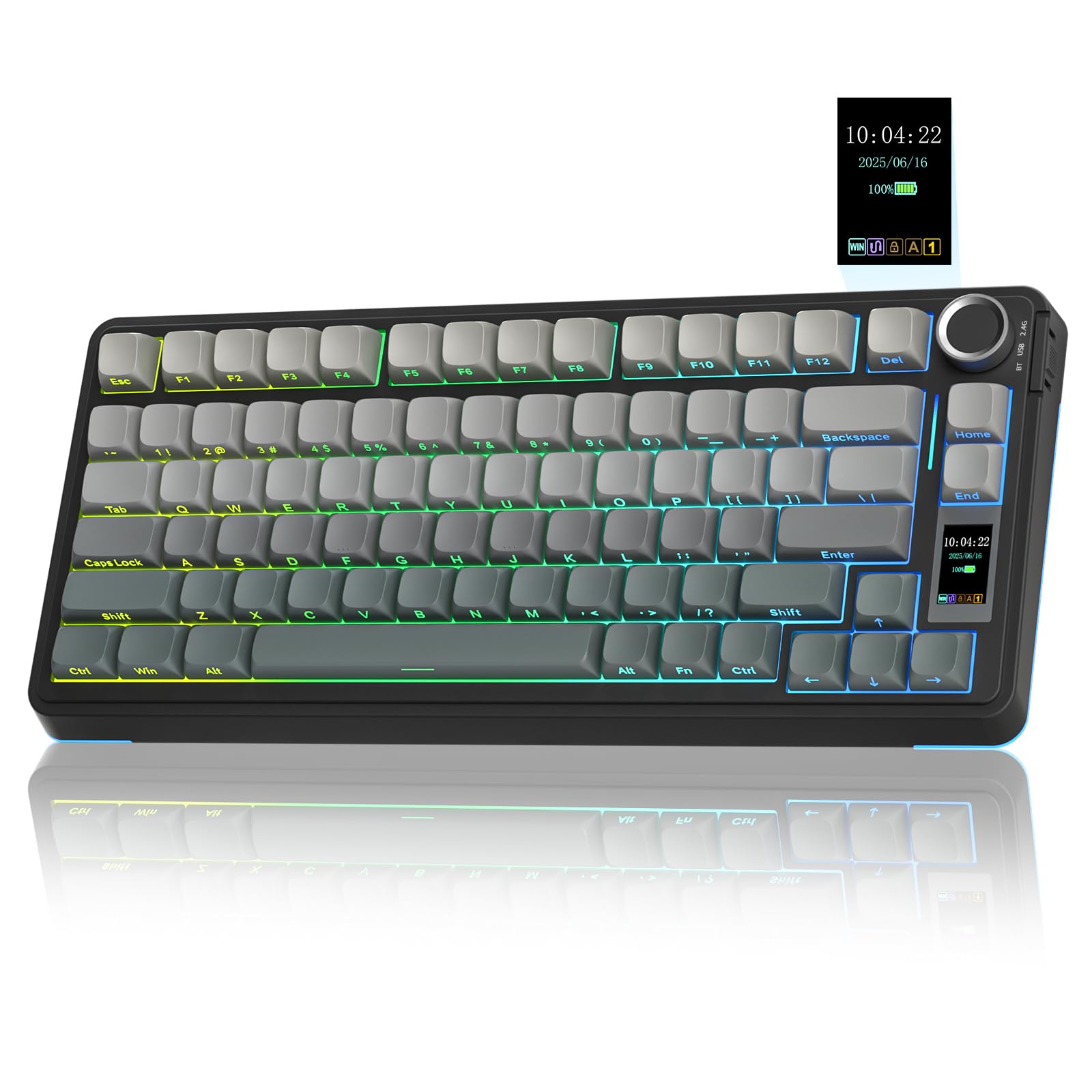
AULA S75 Pro

AULA S75 Pro

Wired mode enthusiasts

Our Score 9.4/10
Check Price

Worth Noting

  • Wireless connectivity (Bluetooth and 2.4GHz) can be unreliable; some units fail to connect
Form Factor
75% (80 keys)
Switch Type
Linear (pre-lubed)
Connectivity
Tri-mode
Build & Keycaps
Plastic, PBT

The AULA S75 Pro delivers a creamy, thocky typing sound and smooth linear switches straight out of the box, plus a lively LCD screen and a convenient knob — all at a budget-friendly price. The side-printed PBT keycaps add a clean aesthetic. However, wireless connectivity (both Bluetooth and 2.4GHz) can be unreliable; some units may not connect at all, making wired use the dependable choice. This keyboard shines for enthusiasts who prioritize sound and feel and don't need the wireless features to work flawlessly. It's best suited for wired desktop use, and those who require a numpad or a full-size layout should look elsewhere.

Tip: Using the USB-C wired mode avoids connectivity issues and ensures stable performance.

Bottom line: This keyboard is a strong choice for wired desktop use where sound quality and extra features matter more than wireless dependability.

7

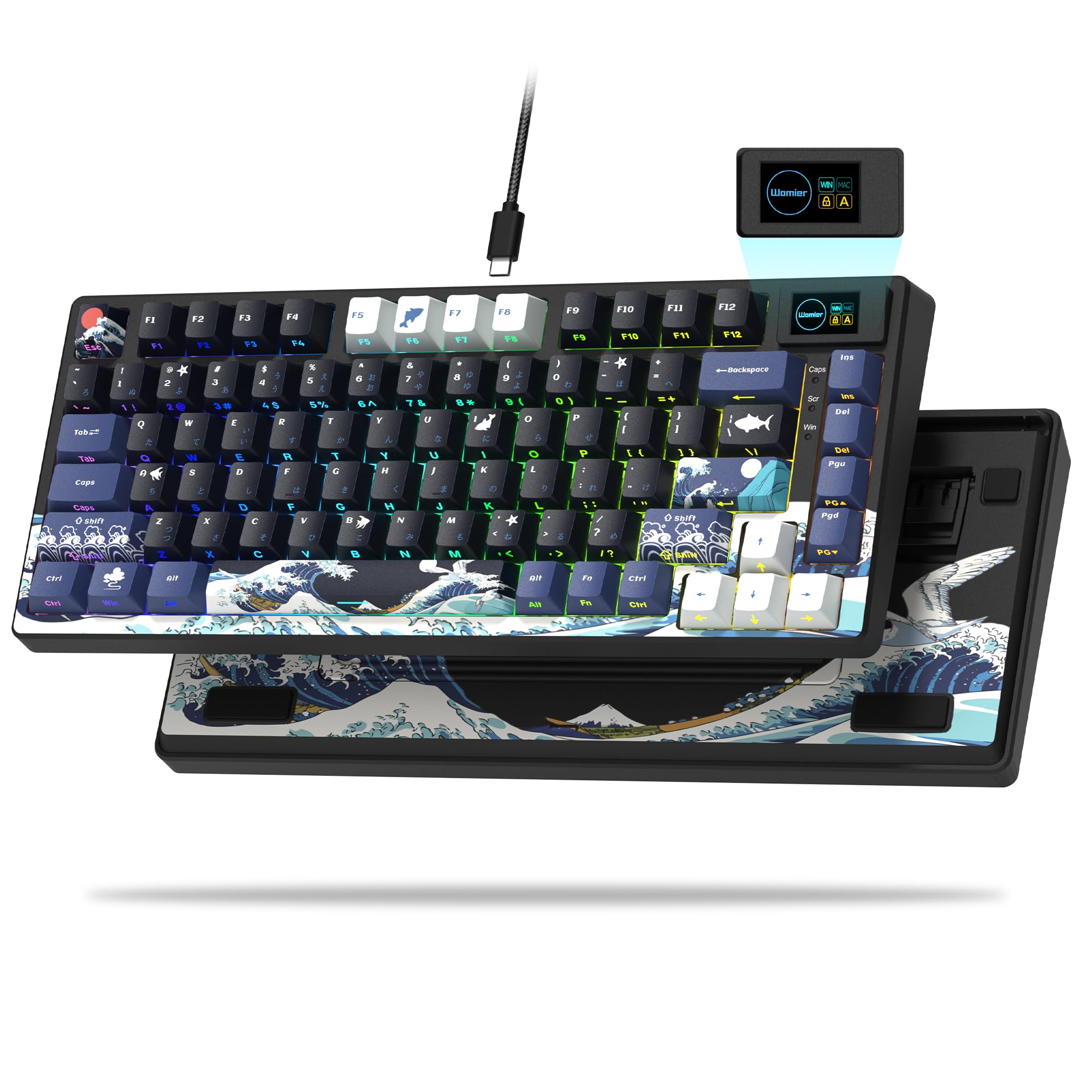
Womier SK80

Womier SK80

Aesthetic budget

Our Score 9.4/10
Check Price

Worth Noting

  • Key responsiveness may degrade in some units after months of use
  • Occasional boot recognition problems may occur
Form Factor
75% (82 keys)
Switch Type
Linear (pre-lubed)
Connectivity
Wired
Build & Keycaps
Plastic, ABS

The Womier SK80 stands out in the budget segment with its color multimedia display and pre-lubed linear switches that produce a creamy sound. The 75% layout with hot-swap capability adds flexibility for customization. Build quality feels solid for the price point. However, keyboard longevity is an area where individual units may differ — some have reported key responsiveness issues after extended use, and occasional boot recognition problems can occur. This makes the SK80 better suited for occasional gaming or aesthetic enjoyment rather than as a primary daily driver.

Bottom line: For a secondary gaming setup or as a decorative keyboard where consistent daily use is not required, the SK80 delivers distinctive visuals and satisfying sound at a low price.

8

AULA WIN68 HE

AULA WIN68 HE

Competitive budget

Our Score 9.2/10
Check Price

Worth Noting

  • Software installation can be difficult and the driver may be flagged by security software.
  • Key unresponsiveness can develop early in some units, making warranty claims a real possibility.
Form Factor
60% (68 keys)
Switch Type
Hall Effect (magnetic)
Connectivity
Wired
Build & Keycaps
Plastic

The AULA WIN68 HE brings hall-effect magnetic switches, adjustable actuation from 0.02 to 3.44mm, and an 8000Hz polling rate — features typically reserved for keyboards costing three times as much. The typing feel is smooth and the sound profile satisfies both gaming and casual typing. However, the software required for customization can trigger antivirus alerts and may be difficult to install. Additionally, key responsiveness can degrade early in some units, making this a keyboard best suited for buyers comfortable with potential troubleshooting and warranty returns.

Bottom line: This keyboard is worth considering only if you are an FPS player on a strict budget who is prepared to deal with potential software quirks and unit variance — and who has the patience to exchange if needed.

9

Razer Ornata V3

Razer Ornata V3

Clicky low-profile

Our Score 9.2/10
Check Price

Worth Noting

  • Keycap clips may detach, causing keys to fall off
  • Some keys may become unresponsive after extended use
Form Factor
Full-size (104 keys)
Switch Type
Mecha-Membrane (hybrid clicky)
Connectivity
Wired
Build & Keycaps
Plastic, ABS

The Ornata V3 delivers a genuinely satisfying clicky sound with a low-profile travel that appeals to gamers who like tactile feedback without a high actuation distance. Snap Tap support is a plus for competitive FPS. However, the keycaps are more delicate than average – clips can detach, causing keys to fall off – and some units may develop unresponsive keys over time. This makes it a better fit for occasional gaming sessions rather than heavy daily use or aggressive typing.

Bottom line: Best suited for competitive FPS gamers who prioritize Snap Tap and clicky low-profile feel over long-term durability.

10

Alienware AW510K

Alienware AW510K

Alienware ecosystem

Our Score 9.2/10
Check Price

Worth Noting

  • Wired-only design limits placement flexibility in cable-free setups
  • Lighting or responsiveness inconsistencies can occur in some units
Form Factor
Full-size (104 keys)
Switch Type
Cherry MX Low Profile Red
Connectivity
Wired
Build & Keycaps
Plastic, ABS

The Alienware AW510K pairs Cherry MX Low Profile Red switches with per-key AlienFX lighting, delivering a quiet, responsive typing feel in a full-size layout with USB pass-through and media controls. However, some units have shown lighting or responsiveness irregularities, meaning unit variance is a consideration. This wired-only board best suits Alienware system owners who prioritize ecosystem integration over wireless freedom or value alternatives.

Bottom line: Best suited for Alienware enthusiasts who want matching RGB and a full-size low-profile mechanical keyboard, provided they are comfortable with a wired connection and accept potential unit-to-unit variation.

How to Choose

Switch Type

Membrane switches are quiet and cheap but wear out faster – the rubber dome loses elasticity, causing inconsistent key presses within a year. Mechanical switches last longer but vary in noise and actuation force; clicky switches are loud, linear are smooth, and tactile offer a bump.

Hall-effect and optical switches use magnets or light to detect actuation, so they have no physical contact to wear out. That means near-infinite lifespan and adjustable actuation, but the keyboard's controller still can fail, and these boards cost more.

Form Factor

Full-size boards include a numpad and navigation cluster, taking up more desk space but essential for data entry or productivity. Tenkeyless (TKL) removes the numpad to save space while keeping arrow keys, a balance for gamers who do not need a numpad.

75% and 60% layouts omit the function row and navigation keys, making them ultra-portable but requiring more key combinations for everyday tasks. The trade-off: smaller boards mean less hand movement during gaming but more memorization for non-gaming use.

Connectivity

Wired keyboards have zero latency and no battery worries, but the cable can be a tangle. Wireless (Bluetooth or 2.4GHz) offers cleaner desks and mobility, but 2.4GHz is more stable than Bluetooth in crowded environments.

The hidden cost of wireless is battery life – some boards drain fast with RGB on, and when the battery drops, connectivity can become spotty. Many budget wireless keyboards work best as wired keyboards in practice.

Build Quality & Keycaps

Keycaps are the interface you touch every day; ABS keycaps develop a shiny, greasy feel within months, while PBT keycaps resist wear and retain texture far longer. The keyboard frame material matters too – plastic boards flex less under heavy typing than metal ones.

Hot-swap sockets let you replace switches without soldering, but not all hot-swap boards accept the same pin types (3-pin vs 5-pin). The PCB and controller are still sealed; if those fail, the whole board is dead regardless of switch replacement.

Frequently Asked Questions